
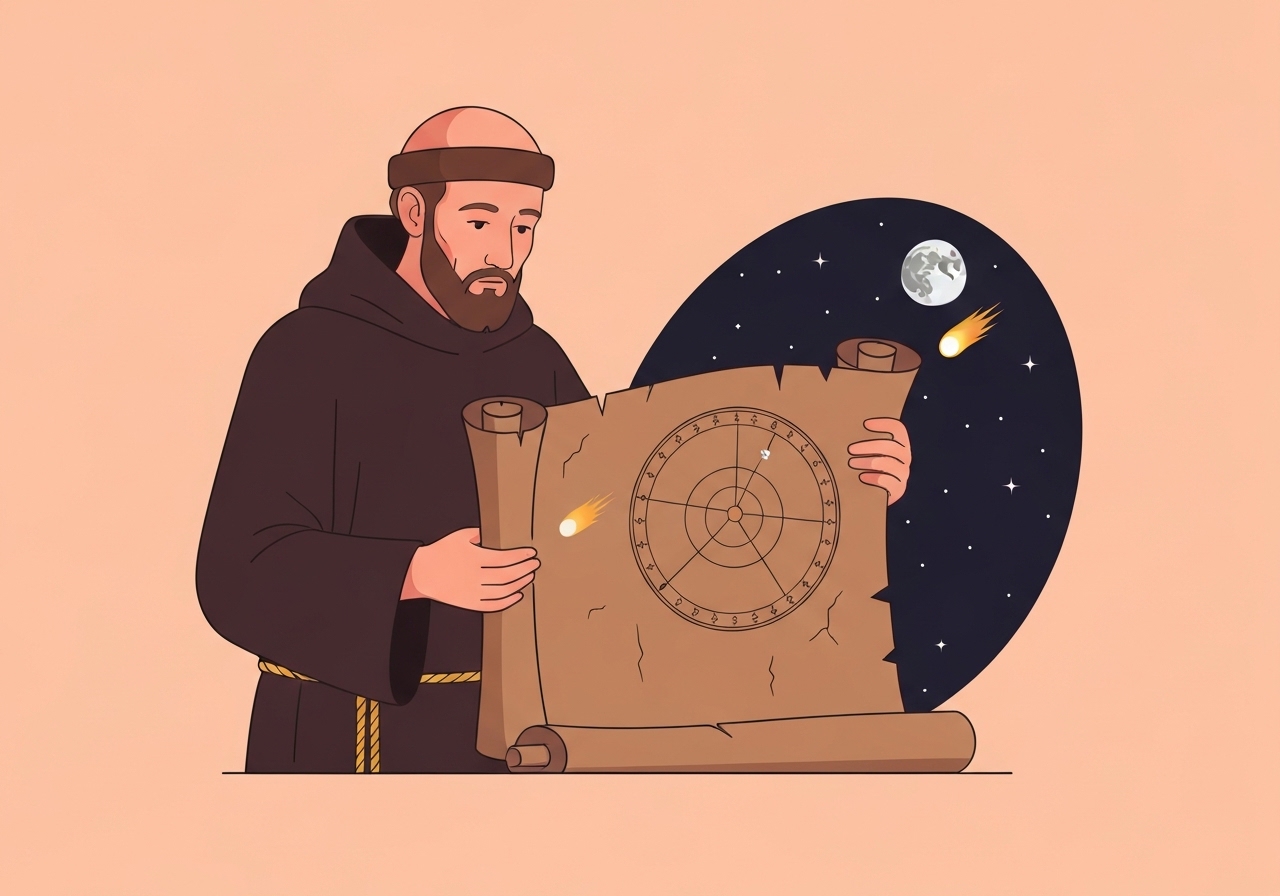
Lead: New research argues that an English monk, Eilmer of Malmesbury, may have connected two comet sightings in 989 and 1066 and recognized their recurrence long before Edmond Halley formalized the comet’s periodic orbit in 1705. The claim rests on William of Malmesbury’s 12th-century chronicle and a fresh reading by astronomer Simon Portegies Zwart and collaborator Michael Lewis. If sustained, the finding would reframe the timeline of early observational astronomy while leaving Halley’s mathematical synthesis intact. The comet in question follows a highly elliptical 72–80 year orbit and will next return in July 2061.
Key Takeaways
- Researchers propose Eilmer of Malmesbury observed the same comet in 989 and again in 1066, a span of about 77 years, matching Halley-type periodicity.
- Edmond Halley identified the comet’s periodic appearances in 1705 from records of 1531, 1607 and 1682 and predicted its return in 1758; he died in 1742 and was vindicated posthumously.
- Halley’s Comet has recorded appearances dating back to 239 B.C. in Chinese records and has been noted repeatedly in global annals and artifacts, including the Bayeux Tapestry for 1066.
- The new argument is presented as a chapter in the book “Dorestad and Everything After” (Sidestone Press, 2025) by Portegies Zwart and Michael Lewis.
- Orbital behavior: the comet’s highly elliptical path brings it near Earth roughly every 72–80 years and leaves a characteristic dust trail visible from Earth.
- Primary sources are medieval chronicles (William of Malmesbury) and material culture (Bayeux Tapestry); interpretation depends on reading those records as linked observations rather than separate omens.
Background
Eilmer (also recorded as Aethelmaer) of Malmesbury was an 11th-century monk known in later tradition for an early attempted gliding flight and for an interest in the heavens. William of Malmesbury, writing in the 12th century, recorded that Eilmer saw a bright comet as a child in 989 and again in 1066. Medieval chroniclers often mixed astronomical reporting with moral or political commentary, so chronicled sightings commonly carried interpretive overlays.
Halley’s role is well documented: in 1705 Edmond Halley compared multiple historical sightings and—using Newtonian mechanics—argued the appearances of a single comet in 1531, 1607 and 1682 were the same body. He predicted a return around 1758; the comet’s reappearance confirmed his orbital hypothesis and secured his eponymous association.
Main Event
Simon Portegies Zwart, an astronomer at Leiden University, and Michael Lewis of the British Museum present a chapter that revisits William of Malmesbury’s passages and proposes Eilmer recognized the comet’s recurrence. William recorded an exchange attributed to Eilmer upon seeing the 1066 comet; Portegies Zwart reads that account as evidence Eilmer recalled an earlier sighting from 989 and considered the two linked.
The Bayeux Tapestry, an embroidered narrative of the 1066 Norman invasion, includes a depiction widely interpreted as the comet seen that spring over Brittany and the British Isles. Contemporary observers commonly read cometary apparitions as omens; William’s wording frames the sighting within England’s succession crisis after Edward the Confessor died without a clear heir.
Portegies Zwart and Lewis argue the 989 and 1066 dates align with a ~77-year interval consistent with Halley-type returns; they present this alignment as evidence that an intellectual recognition of recurrence predated Halley’s formal orbital calculation by some six centuries. The claim appears in the 2025 volume “Dorestad and Everything After: Ports, Townscapes and Travelers in Europe, 800–1100” (Sidestone Press).
Analysis & Implications
At minimum, the new reading highlights continuity in astronomical observation across the medieval period and shows that careful attention to chronicles can yield insights about how people tracked recurring sky events. If Eilmer did connect the two sightings, it suggests an observational memory and reasoning about recurrence among at least some medieval scholars, even if they lacked the mathematical apparatus to compute an orbit.
That said, recognizing recurrence and deriving an orbital solution are different intellectual acts. Halley combined multiple dated observations with Newtonian dynamics to compute orbital elements and predict a future return; the proposed Eilmer observation would amount to an empirical connection rather than a formal calculation.
Revising the historical credit for an insight does not diminish Halley’s scientific achievement, but it expands the narrative about who noticed patterns in celestial appearances. Historians of science will weigh the philological strength of William’s account, the plausibility of accurate memory over decades, and how medieval observational practices supported such conclusions.
Practically, the claim will prompt targeted archival work: closer textual criticism of William’s passages, reassessment of other medieval chronicles for similar pattern-recognition, and interdisciplinary dialogue between medievalists and astronomers to evaluate the likelihood of identification without telescopic precision.
Comparison & Data
| Year | Record / Source | Interval (yrs) |
|---|---|---|
| 239 B.C. | Chinese chronicle (probable earliest record) | — |
| A.D. 66 | Flavius Josephus (historian) | — |
| 989 | William of Malmesbury records Eilmer’s childhood sighting | — |
| 1066 | William of Malmesbury; Bayeux Tapestry depiction | ~77 |
| 1531, 1607, 1682 | European and global observations used by Halley | 76, 75 |
| 1758 | Halley’s predicted return (observed posthumously) | ~76 |
| 2061 | Next expected return (visible late July 2061) | — |
The table shows that the 989→1066 gap (~77 years) fits within the comet’s known 72–80 year recurrence window and matches the 75–76-year intervals Halley used to argue periodicity. Matching intervals alone do not prove identification, but they strengthen the case when combined with descriptive chronicle details.
Reactions & Quotes
“Eilmer appears to have linked two comet sightings separated by roughly 77 years,”
Simon Portegies Zwart, Leiden University (astronomer)
“William of Malmesbury’s chronicle places the 1066 comet in a highly charged political moment, framing it as portentous rather than purely astronomical,”
William of Malmesbury (12th-century chronicler, as cited in medieval sources)
“If sustained, this reading gives Eilmer a clearer place in the practice of medieval observation, though it does not replicate Halley’s mathematical synthesis,”
Michael Lewis, British Museum (historian/curator)
Unconfirmed
- Whether William of Malmesbury’s account preserves Eilmer’s precise words or a later interpretive gloss remains debated among medievalists.
- It is not confirmed that Eilmer intended to assert periodicity in a modern sense rather than recalling two striking but separate events.
- Attribution of the Bayeux Tapestry depiction specifically to the same comet seen by Eilmer is inferential, not independently proven.
Bottom Line
The new reading that credits Eilmer of Malmesbury with recognizing a recurring cometal appearance reframes part of the premodern observational record but does not replace Halley’s methodological breakthrough in computing orbital elements. The claim illuminates how medieval observers recorded and sometimes compared celestial events across decades, suggesting pockets of sophisticated empirical attention long before classical orbital mechanics.
Confirming the interpretation will require careful philology, cross-referencing other medieval chronicles, and interdisciplinary review. Regardless of authorship of the insight, the comet itself remains a reliable celestial clock: mark your calendars for its expected return in late July 2061.
Sources
- LiveScience (journalism) — original report summarizing the new claim and book chapter.
- Leiden University (academic) — staff profile for Simon Portegies Zwart.
- Sidestone Press (publisher) — book: “Dorestad and Everything After: Ports, Townscapes and Travelers in Europe, 800–1100” (2025).
- NASA Solar System (government/science) — overview and orbital data for Halley’s Comet.
- Encyclopaedia Britannica (reference) — background on William of Malmesbury and his chronicles.