
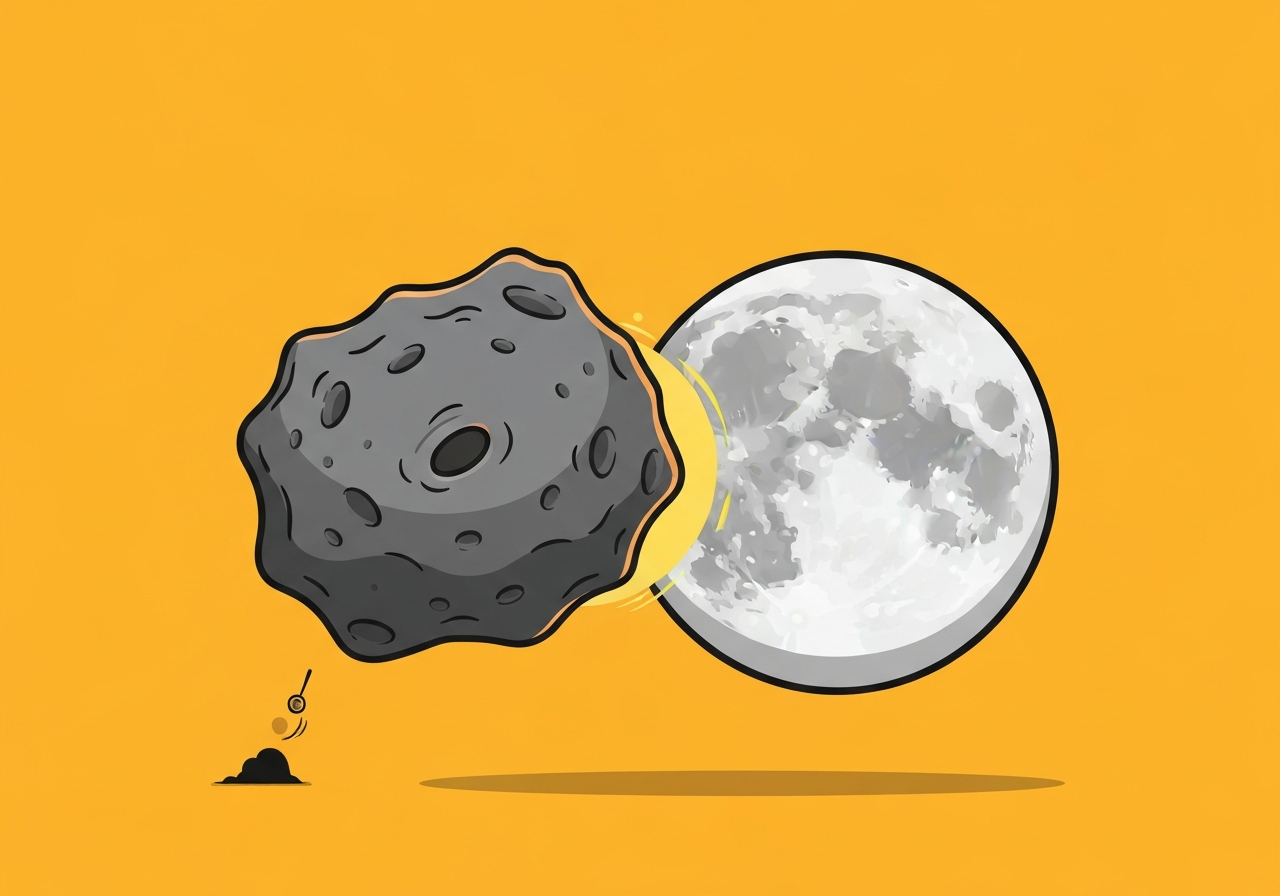
New infrared observations from the James Webb Space Telescope in February 2026 confirm that near-Earth asteroid 2024 YR4 will fly past the Moon in 2032 at an estimated distance of about 13,000 miles, eliminating a previously nonzero chance of a lunar impact. The rock, discovered by the ATLAS survey in late 2024, measures roughly 174 to 220 feet (53 to 67 metres) across — large enough to cause catastrophic regional damage if it struck Earth. Early orbit estimates briefly produced unusually high impact odds: an Earth collision probability that peaked at 3.1% and an initial 4.3% chance of hitting the Moon. Webb’s sensitive NIRCam imaging collected on Feb. 18 and Feb. 26 refined the trajectory and reduced the lunar impact probability to zero while also removing the remaining Earth risk.
Key takeaways
- Asteroid designation: 2024 YR4, discovered late 2024 by the Asteroid Terrestrial-impact Last Alert System (ATLAS).
- Size estimate: 174–220 ft (53–67 m) in diameter, comparable in scale to tall urban landmarks.
- Closest lunar approach: projected for 2032 at about 13,000 miles (≈21,000 km) from the Moon’s surface.
- Impact probabilities: earlier Earth collision odds peaked at 3.1% (highest ever for a near-term object) and lunar odds were 4.3%; JWST observations reduced both Earth and lunar impact chances to zero.
- Observational campaign: JWST NIRCam images taken on Feb. 18 and Feb. 26, 2026, supplied the decisive astrometry used to update trajectories.
- Follow-up plans: NASA intends to observe 2024 YR4 again during its 2028 approach to further test orbital models and planetary defense tools.
Background
ATLAS, a ground-based survey designed to discover hazardous near-Earth objects (NEOs), found 2024 YR4 in late 2024. Objects in the 50–70-metre size class are too small to cause global catastrophe but large enough to obliterate a city or produce severe regional destruction on impact; previous studies have compared the energy release from such an impact to hundreds of nuclear detonations. Because orbital solutions depend heavily on the amount and quality of tracking data, newly discovered asteroids often carry substantial initial uncertainty that can produce non-negligible impact probabilities until more observations narrow the range.
Before the Webb measurements, a series of ground- and space-based telescopes supplied early astrometry that temporarily produced unusually high impact odds for 2024 YR4 — including a peak 3.1% chance the object could strike Earth and a 4.3% chance for a lunar collision. Those numbers prompted an intensified tracking campaign across international observatories and highlighted how a short arc of data can inflate perceived near-term hazards for relatively close-approach objects.
Main event
Webb targeted 2024 YR4 with its Near-Infrared Camera (NIRCam) on Feb. 18 and Feb. 26, 2026, capturing extremely faint infrared detections that extended the asteroid’s observation arc. Those two epochs provided high-precision positions against background stars, enabling orbit modelers to markedly reduce uncertainties in semimajor axis, eccentricity and inclination. With the refined orbit, trajectory projections showed the asteroid missing both the Earth and the Moon, with the closest predicted lunar passage in 2032 at roughly 13,000 miles.
The revised solution dropped the previously quoted 4.3% lunar impact probability to zero and likewise removed any remaining Earth impact probability. Modelers note that reducing an impact probability to zero requires a statistically significant exclusion of all plausible impact solutions; Webb’s astrometry accomplished that exclusion for the critical 2032 window. The 13,000-mile miss distance remains a close approach in celestial terms — within the realm of targeted follow-up observations and modeling tests — but well outside any collision envelope.
Because 2024 YR4’s size places it in the “city-killer” category for potential Earth strikes, mission teams and planetary defense groups regard the object as an important test case. Agencies have scheduled additional observations during the asteroid’s next encounter with the inner solar system in 2028, which will provide another chance to validate trajectory predictions and to trial response tools and telescopic coordination for future hazardous objects.
Analysis & implications
Operationally, Webb’s contribution underscores how a space-based infrared observatory with high sensitivity can rapidly tighten orbital solutions for faint, newly discovered NEOs. Infrared detection helps because it tracks thermal emission and can sometimes detect objects that are too faint in visible light; combined with ground-based optical astrometry, the dataset yields a more constrained orbital fit. For planetary defense, that means shorter alert timelines and more confident assessments of impact risk for objects discovered on short notice.
Scientifically, the case of 2024 YR4 highlights the limits of early impact probabilities derived from short observation arcs. A small number of early detections can produce a wide range of possible orbits, including low-probability but high-consequence impact trajectories. The quick reduction of risk following Webb data illustrates that initial alarm should be balanced with an understanding of statistical uncertainty and the expectation of rapid refinement as more data arrive.
Practically, agencies can use 2024 YR4 as a rehearsal: observing strategies, data-sharing protocols, and trajectory propagation codes will all be tested during future approaches. International coordination among ATLAS, NASA/JPL, ESA and other survey teams proved effective in this case; institutional lessons learned will inform official planetary defense playbooks that aim to reduce public confusion while enabling timely scientific follow-up.
Comparison & data
| Parameter | Earlier estimate | Revised value (post-JWST) |
|---|---|---|
| Diameter | 174–220 ft (53–67 m) | 174–220 ft (53–67 m) — size unchanged |
| Earth impact probability (peak) | 3.1% | 0% |
| Lunar impact probability (initial) | 4.3% | 0% |
| Closest lunar approach | — (uncertain) | ≈13,000 miles (≈21,000 km) in 2032 |
| Key observations | Ground telescopes (various) | JWST NIRCam on Feb. 18 & Feb. 26, 2026 |
The table shows that Webb data did not change the physical size estimate — which derives mainly from brightness and albedo assumptions — but significantly revised the impact probabilities and the predicted flyby distance. That pattern is common: size estimates tend to be stable after a few photometric measurements, whereas orbital uncertainties can shrink rapidly once precise astrometry is added.
Reactions & quotes
Officials and scientists have framed the result as both reassuring for public safety and instructive for planetary defense practice. Agencies emphasize the value of coordinated, rapid-response observations to resolve early uncertainty.
“Webb’s infrared astrometry removed the plausible impact solutions for 2032, making a lunar collision effectively impossible,”
NASA/JPL Center for Near-Earth Object Studies (paraphrase)
This paraphrased statement summarizes the modeling outcome as presented by orbit analysts who used the new astrometry to collapse the range of allowable trajectories. Webb’s images provided the decisive positional constraints that eliminated previously probable impact corridors.
“2024 YR4 will serve as a useful test case for refining tracking and response procedures ahead of future close approaches,”
European Space Agency (paraphrase)
ESA and other international partners highlighted the operational value of watching 2024 YR4 during subsequent returns. The 2028 campaign is flagged as an opportunity to validate models and joint observation protocols across agencies.
Unconfirmed
- Whether an impact on the Moon in 2032 would have been visible to the unaided eye from Earth; earlier claims varied depending on assumed impact energy and ejecta brightness.
- Whether lunar ejecta from a hypothetical impact would have produced a measurable new meteor shower at Earth; models produced divergent outcomes and this remains speculative.
- Detailed physical properties such as precise density, porosity and rotation state for 2024 YR4 remain incomplete and subject to refinement with future observations.
Bottom line
High-sensitivity infrared astrometry from JWST in February 2026 has removed the lingering impact risk posed by asteroid 2024 YR4 for both the Earth and the Moon in the 2032 encounter window, while confirming a very close but safe lunar flyby at roughly 13,000 miles. The object’s size — about 53–67 metres across — still places it in a class that would cause severe regional damage if it ever struck Earth, which is why continued monitoring and model validation remain priorities.
Beyond immediate reassurance, the episode demonstrates the current planetary defense system’s capacity to converge rapidly on accurate risk assessments through international cooperation and space-based assets. Agencies plan further observations in 2028 to validate models and practice coordinated responses; those activities will help ensure faster, more certain public guidance for any truly hazardous future discoveries.
Sources
- Live Science — media report summarizing observations and agency updates
- NASA/JPL Center for Near-Earth Object Studies (CNEOS) — official orbital analyses and risk evaluations
- ESA NEO Coordination Centre (NEOCC) — official European tracking and coordination
- James Webb Space Telescope (JWST) mission pages — instrument and observation details