
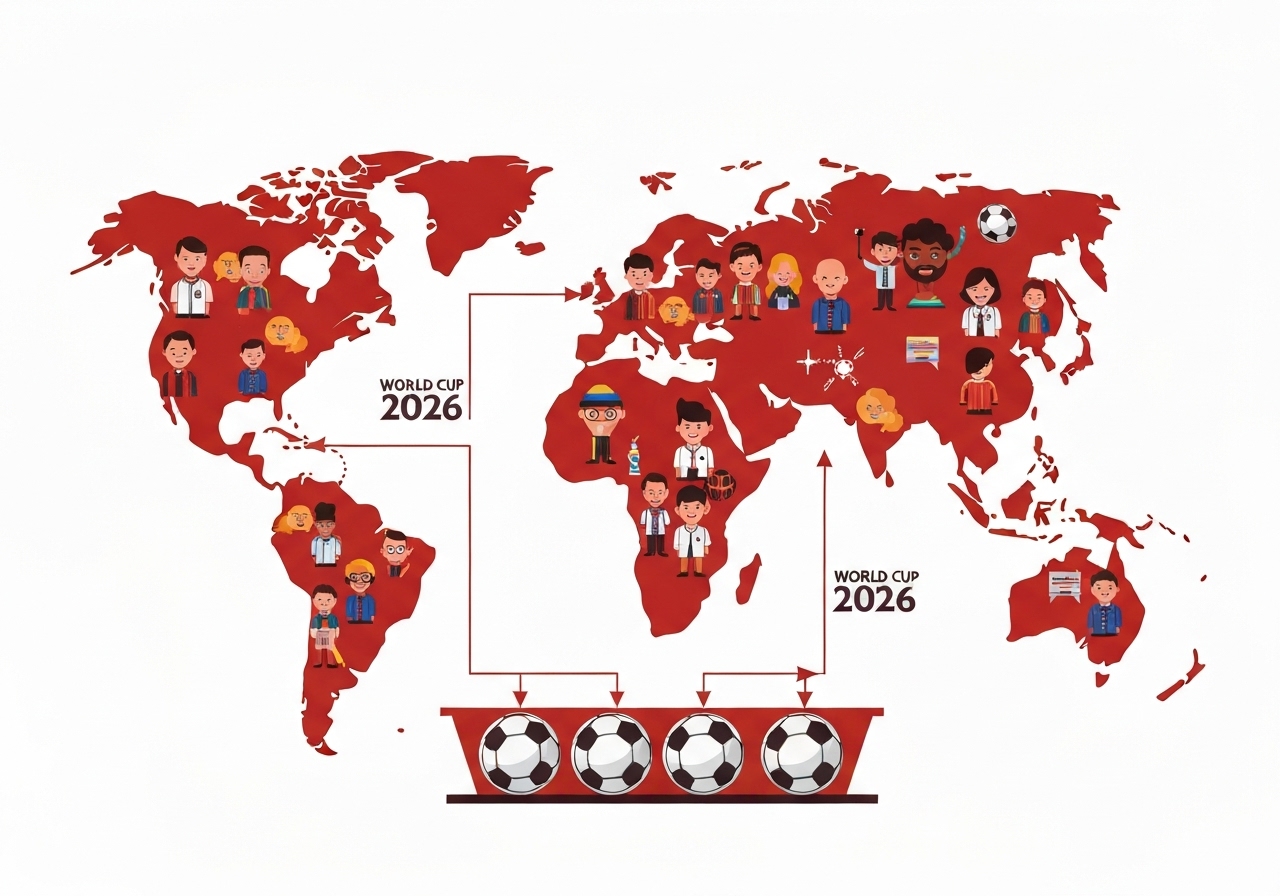
On 5 December at 17:00 GMT in Washington DC, FIFA will stage the draw that places 48 teams into 12 groups for the 2026 World Cup. The ceremony mixes live entertainment and speeches with a technically complex allocation process: teams are assigned to four pots, confederation rules are enforced and a computer system prevents impossible combinations. Hosts Mexico, Canada and the United States have automatic seeded positions, and the six inter-confederation and four UEFA play-off routes introduce late uncertainty. Fans will learn match dates and opponents on Friday, then venues and kick-off times when FIFA publishes the match schedule 24 hours later.
Key takeaways
- Draw date and time: 5 December, 17:00 GMT (12:00 local); ceremony runs roughly 90 minutes including performances.
- Format: 48 teams in four pots of 12; one team from each pot fills each of the 12 groups.
- Hosts: Mexico, Canada and USA are pre-assigned to A1, B1 and D1 respectively and will play all group games at home.
- Special seeding: top four FIFA-ranked teams (Spain, Argentina, France, England) will be placed in separate quadrants, provided they win their groups.
- Play-off paths: six inter-confederation/UEFA routes feed pot four and contain specific candidates (listed below), complicating placement.
- Confederation rule: no group may contain more than one team from the same confederation, except UEFA where up to two Europeans can appear in four groups.
- Deadlock prevention: a draw computer enforces restrictions and may skip groups to avoid situations where the draw cannot be completed.
- Schedule reveal: fixtures’ dates and match order confirmed on 6 December, 17:00 GMT; hosts’ venues are already set for groups A, B and D.
Background
The 2026 tournament expands the World Cup to 48 teams and a new knockout bracket, creating logistical and sporting challenges for the draw. FIFA adapted seeding and placement rules to protect tournament balance and to maximise high-profile match-ups in later rounds; that includes the first-time use of quadrant placement for the top four ranked teams. Confederation balance — especially with 16 UEFA qualifiers competing across only 12 groups — produces exceptions to the usual one-per-group rule that in turn force algorithmic solutions.
Play-off pathways add late-stage uncertainty because several teams will only be known after continental playoffs conclude. Those possible entrants (from UEFA, CONCACAF, CAF, AFC, CONMEBOL and OFC) sit in pot four and carry constraints tied to their confederations. FIFA’s draw software must therefore anticipate many contingency combinations and avoid “deadlocking,” a situation where remaining teams cannot be placed without breaching rules. The system and ceremony combine spectacle with a technical process: music, hosts and speeches are part of the broadcast while an algorithm runs the placement logic behind the scenes.
Main event: how the draw proceeds
FIFA will begin by drawing the 12 teams in pot one, respecting the automatic positions for the three hosts — Mexico (A1), Canada (B1) and the United States (D1) — which ensures their group-stage matches are staged in-country. The remaining pot-one nations are assigned to groups in order, then pots two, three and four are drawn sequentially. Each drawn team is placed in the first available group slot that does not violate confederation or quadrant restrictions.
A major innovation this year is quadrant seeding for the top four FIFA-ranked teams (Spain, Argentina, France, England). If those teams win their groups, FIFA will position them in four different quadrants of the knockout bracket so they cannot meet before the semi-finals or final according to ranking pairings (1 vs 2 in opposite halves; 3 and 4 separated similarly). That protection applies only if they finish top of their groups; a seeded side finishing second loses the bracket privilege.
When pots three and four are drawn, the computer can skip certain groups to maintain confederation balance. For example, because both inter-confederation play-off pathways contain a CONCACAF nation, those potential qualifiers cannot be placed in groups already containing the United States, Mexico, Canada or Panama. To avoid deadlocks the draw software reserves groups that can host a two-European or a Europe-plus-Africa combination as required by the remaining teams.
Fixture positions are also pre-determined by pot: seeded teams take position 1 in their groups and a preset grid assigns positions for pots two, three and four. That means the draw decides opponents and group order, while the match order and host venues (for non-host groups) are supplied in the schedule release the following day. Matchday pairings for all groups follow this order: MD1: 1 v 2 and 3 v 4; MD2: 1 v 3 and 4 v 2; MD3: 4 v 1 and 2 v 3.
Play-off paths (pot four composition)
Several play-off routes are predefined and their candidate teams are known even if final qualification is not. FIFA has assigned these potential entrants into specific play-off paths that will feed pot four:
- UEFA Play-off A: Italy, Wales, Bosnia-Herzegovina, Northern Ireland
- UEFA Play-off B: Ukraine, Poland, Albania, Sweden
- UEFA Play-off C: Turkey, Slovakia, Kosovo, Romania
- UEFA Play-off D: Denmark, Czech Republic, Republic of Ireland, North Macedonia
- FIFA Play-off 1: DR Congo, Jamaica, New Caledonia
- FIFA Play-off 2: Iraq, Bolivia, Suriname
Analysis & implications
Quadrant seeding for the top four is designed to maximise the chance of high-profile knockout matches late in the tournament, which has commercial and sporting benefits. By placing Spain, Argentina, France and England in distinct quadrants (if they top their groups) FIFA increases the likelihood of marquee semi-finals and a final. That advantage, however, depends entirely on group-stage performance; finishing second erases the protected status and can create immediate heavyweight knockouts in the Round of 16.
Confederation constraints and the UEFA overrepresentation add complexity that can produce unevenly strong groups. With 16 Europeans and only 12 groups, four groups must contain two UEFA teams, which increases the probability of a ‘group of death’ where two high-quality European sides compete in the same section. Additionally, pot-four uncertainty — especially from FIFA Play-off 2 which mixes CONMEBOL, CONCACAF and AFC candidates — forces the computer to reserve specific group slots and sometimes mandate two-European or European-plus-African combinations.
Operationally, FIFA’s reliance on software to steer the draw highlights the importance of robust testing and transparency. The 2021 example where UEFA’s technology failed is a reminder that live draws combine production and algorithmic complexity. Fans and federations will be watching not just the match-ups but also whether the draw system handles edge cases cleanly; any perceived mistake would quickly fuel controversy given the tournament’s commercial stakes.
Comparison & data
| Feature | 2022 World Cup | 2026 World Cup |
|---|---|---|
| Teams | 32 | 48 |
| Groups | 8 groups of 4 | 12 groups of 4 |
| Top-four quadrant seeding | Not used | Used if top four win groups |
| UEFA slots | 13 | 16 |
The expansion from 32 to 48 teams increases the number of group fixtures and creates new bracket logic; a larger field drives both sporting opportunity and scheduling complexity. The table highlights the structural differences that make the 2026 draw procedurally more demanding than recent tournaments.
Reactions & quotes
Organisers and stakeholders offered brief statements ahead of the draw that underline FIFA’s emphasis on rules and spectacle.
The draw “will be conducted under FIFA regulations with the computer enforcing confederation and seeding constraints.”
FIFA (official procedure summary)
“The quadrant system aims to protect late-stage drama by separating the highest-ranked teams at the point they top their groups.”
Competition analyst (media briefing)
Fans and federations should expect complex group allocations driven by confederation limits and play-off uncertainties.
Broadcast commentary (draw preview)
Unconfirmed
- Attendance: reports that the US President will speak are listed in event previews but his appearance has not been formally confirmed by an official presidential schedule.
- Performers: the lineup (Andrea Bocelli, Robbie Williams, Nicole Scherzinger, Village People) has been announced in promotional material but last-minute changes are possible.
- Exact pot placement for final play-off winners remains conditional on match outcomes and could alter which groups are viable for those teams.
Bottom line
The 2026 World Cup draw balances television spectacle with a technically detailed placement process that must respect seeding, confederation limits and play-off uncertainty. The quadrant protection for the top four ranked teams is the tournament’s main procedural novelty, but its benefit depends strictly on group-stage results — finishing second removes the protection.
Fans should expect an orderly but non-intuitive allocation where teams occasionally “skip” apparent slots because the draw computer enforces constraints to prevent deadlocks. Final match dates and venues (except groups with host nations) will be released on 6 December at 17:00 GMT, completing the picture of who plays whom, where and when.