
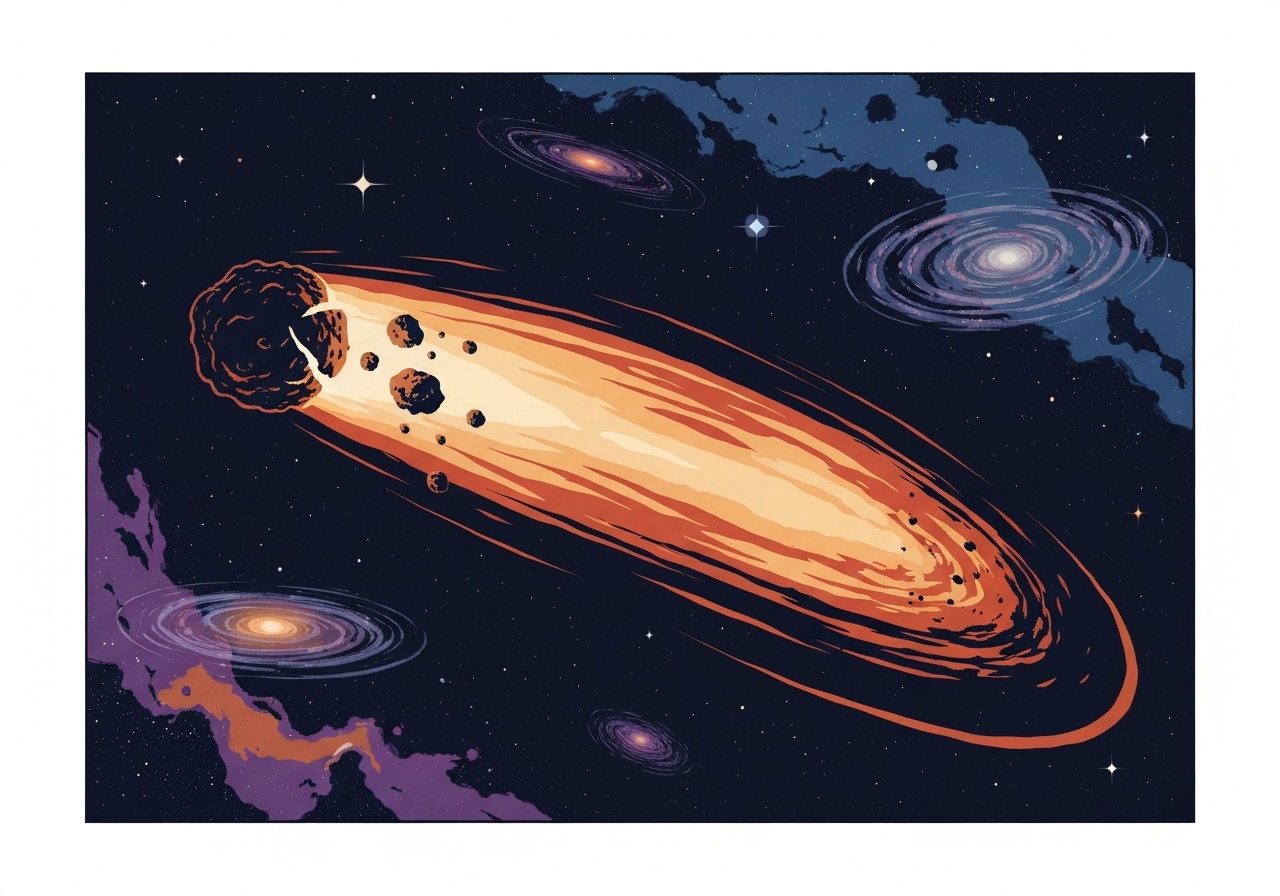
Lead: On Friday, Dec. 19, interstellar comet 3I/ATLAS made its closest pass to Earth, approaching within 168 million miles (270 million kilometers) at about 1 a.m. EST (0600 GMT). Discovered by NASA’s ATLAS survey on July 1, 2025, the object has provided a rare chance to study material formed beyond the solar system. After its brief visit—including a perihelion passage on Oct. 29 that produced an unexpected brightening—3I/ATLAS is now moving back toward the outer solar system and will ultimately depart the Sun’s neighborhood. Data gathered by space- and ground-based observatories will inform studies of interstellar small bodies for years to come.
Key Takeaways
- Closest approach: 168 million miles (270 million km) from Earth on Dec. 19 at 1 a.m. EST (0600 GMT).
- Discovery: First detected by NASA’s Asteroid Terrestrial-impact Last Alert System (ATLAS) on July 1, 2025.
- Origin: Trajectory and kinematics indicate an interstellar origin, likely from the Milky Way’s older thick stellar disk; age estimates place it as old as ~7 billion years.
- Perihelion: Passed nearest the Sun on Oct. 29 and brightened significantly more than typical Oort-cloud comets at comparable distances.
- Observations: Brightening and structure were tracked by STEREO-A/B, SOHO, GOES-19, Hubble (STScI), and numerous ground facilities.
- Research: Preliminary analysis by Qicheng Zhang (Lowell Observatory) and Karl Battams (Naval Research Laboratory) highlights an anomalous brightening rate discussed in a research preprint.
- Trajectory forward path: The comet will travel back into the outer solar system before leaving the Sun’s gravitational influence to continue through the galaxy.
Background
Interstellar visitors are rare but scientifically valuable. The solar system has seen only a handful of confirmed interstellar objects in modern times—most notably 1I/’Oumuamua in 2017 and 2I/Borisov in 2019—and each provided distinct insights into planetesimal diversity beyond our system. Observers anticipated new detections as survey capabilities improved; ATLAS is one of several wide-field systems designed to spot transient objects and hazardous asteroids, and it flagged 3I/ATLAS on July 1, 2025.
Astrophysicists examine an interstellar object’s incoming velocity and orbit to reconstruct its galactic origin. For 3I/ATLAS, orbital analysis points to the Milky Way’s thick disk rather than the thin disk that contains the Sun. The thick disk formed earlier in galactic history, which is why researchers estimate that material from that population can be significantly older—hence the suggestion that 3I/ATLAS may be up to about 7 billion years old. That age implication, if sustained by compositional evidence, would make it among the oldest cometary material observed directly.
Main Event
After discovery, telescopes across the electromagnetic spectrum tracked 3I/ATLAS as it moved through the inner solar system. The comet’s perihelion on Oct. 29 coincided with a rapid and notable brightening that exceeded standard models for comets at the same solar distance. Instruments that monitored the Sun and near-Sun environments—NASA’s twin STEREO probes, the Solar and Heliospheric Observatory (SOHO), and the meteorological satellite GOES-19—recorded that increase in brightness and the evolution of the coma and tail.
Hubble Space Telescope imaging and other high-resolution observations captured structural details of the coma and enabled measurements of dust and gas production rates. Researchers used these datasets to compare 3I/ATLAS’s activity with typical Oort-cloud comets and with past interstellar visitor 2I/Borisov. Preliminary spectroscopic and photometric analyses indicate significant water content, reinforcing descriptions of the object as water-rich compared with some expectations for interstellar debris.
Teams led by Lowell Observatory and the Naval Research Laboratory released an early analysis on the observation repository arXiv noting that the comet’s brightening rate remains unexplained. While most observational campaigns are complete for the inner-solar-system phase, archival and follow-up studies will continue to mine brightness, composition and dynamical data as the object recedes. Public-facing tools such as NASA’s Eyes on the Solar System allow users to visualize the comet’s path and projected escape trajectory from the Sun.
Analysis & Implications
If 3I/ATLAS did indeed form in the thick disk, its inferred age and composition offer a direct sample of planetesimal formation in an older galactic environment. Thick-disk stars generally formed earlier and with different chemical enrichment histories than thin-disk stars like the Sun. That difference can influence the inventory of volatiles and refractory materials available when small bodies accreted—data that inform models of planet formation across the galaxy.
The anomalous brightening near perihelion is particularly significant because brightness evolution encodes physical processes: sublimation of ices, dust release, fragmentation events, or exposure of fresh volatile-rich material. A rate of brightening that exceeds typical Oort-cloud comets at comparable solar distances suggests either an unusually volatile-rich nucleus, structural weakness leading to rapid dust shedding, or some combination. Distinguishing among those mechanisms requires cross-calibrated photometry, spectroscopy, and modeling of dust grain properties.
Beyond composition, 3I/ATLAS sharpens forecasts for future interstellar detections. Survey projects now routinely cover large swaths of sky with rapid cadence, improving the detection probability for fast-moving interstellar objects. Each new visitor refines population statistics—size distributions, volatility, and dynamical origin frequencies—that in turn guide telescope designs and observing strategies for the coming decades. The collected data from 3I/ATLAS will therefore feed both immediate analysis and long-term statistical studies of interstellar small bodies.
Comparison & Data
| Parameter | 3I/ATLAS | Typical Oort-cloud comet |
|---|---|---|
| Closest approach to Earth | 168 million mi (270 million km) | Varies widely (tens to hundreds of millions of miles) |
| Perihelion date | Oct. 29, 2025 | N/A |
| Estimated age | Up to ~7 billion years | ~4.5 billion years |
| Brightening behavior | Markedly faster than typical at similar r | Standard brightening rates tied to sublimation |
The table contextualizes 3I/ATLAS relative to typical solar-system comets: its estimated age and perihelion-driven activity stand out. While many comets show increased activity near the Sun, the photometric slope observed for 3I/ATLAS is steeper than expected for most Oort-cloud objects at comparable heliocentric distances. Quantitative modeling of dust-to-gas ratios and grain-size distributions will be required to convert these observational contrasts into physical interpretations.
Reactions & Quotes
The astronomical community has emphasized both excitement about the dataset and caution about interpretation. Observers stress the value of coordinated multi-instrument campaigns while noting remaining puzzles about activity drivers.
“All non-interstellar comets, such as Halley’s comet, formed at the same time as our solar system, so they are up to 4.5 billion years old. But interstellar visitors have the potential to be far older.”
Matthew Hopkins, University of Oxford (statement, July 2025)
Researchers directly involved in the photometric study have pointed to unresolved causes behind the rapid brightening.
“The reason for 3I’s rapid brightening, which far exceeds the brightening rate of most Oort cloud comets at similar r, remains unclear.”
Qicheng Zhang (Lowell Obs.) & Karl Battams (NRL), research note
Public and professional astronomers alike have described the object’s visit as a rare opportunity to sample interstellar material in situ with modern instruments. Community discussion has already begun about follow-up archival studies and whether future targeted missions could benefit from the lessons learned.
Unconfirmed
- The precise physical mechanism that caused 3I/ATLAS’s unusually rapid brightening remains unconfirmed; competing explanations include volatile exposure, fragmentation, or atypical dust properties.
- The exact birth location within the thick disk and a definitive age (e.g., a strict 7-billion-year value) are tentative pending further compositional and dynamical analysis.
- Predictions about future fragmentation or long-term disintegration of 3I/ATLAS are provisional and require continued monitoring of its outbound behavior.
Bottom Line
3I/ATLAS’s December 19 closest approach capped an intensive observational campaign that began with its discovery on July 1, 2025. The object’s likely origin in the Milky Way’s thick disk and its possible multi-billion-year age make it a uniquely valuable specimen for comparative planetology beyond our solar neighborhood. The perihelion brightening that exceeded expectations is a central puzzle: resolving it will refine models of cometary activity and may reveal new aspects of small-body physics for interstellar material.
Although 3I/ATLAS is now receding and will eventually leave the solar system, the datasets—photometry, spectroscopy, imaging and trajectory solutions—will be reanalyzed and reinterpreted for years. Those analyses will strengthen statistical knowledge about interstellar visitors and help design future observational and, potentially, mission strategies to sample such objects more directly.
Sources
- Space.com (science journalism / media)
- ATLAS project (survey project / official)
- NASA Eyes on the Solar System (interactive tool / NASA official)
- Lowell Observatory (research institution)
- Naval Research Laboratory (NRL) (research institution)
- arXiv (research preprint repository)
- Space Telescope Science Institute (STScI) (Hubble image archive / official)