
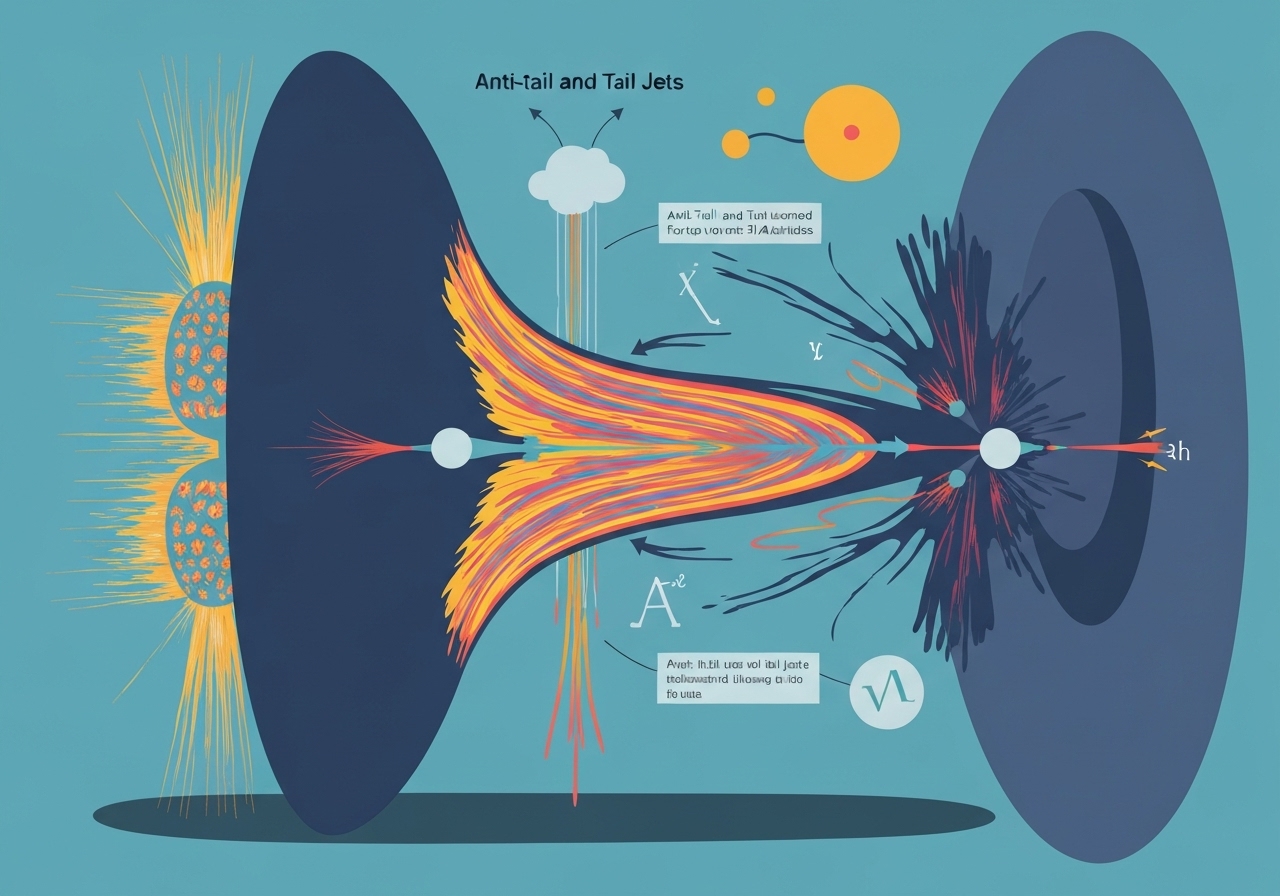
Lead: A stacked deep image of interstellar object 3I/ATLAS, obtained by Frank Niebling and Michael Buechner between 05:08–05:22 UT on November 9, 2029, reveals two sunward anti-tail jets reaching 10 arcminutes and a collimated tail jet extending 30 arcminutes away from the Sun. At the reported Earth–3I/ATLAS distance of 326 million kilometers these angles correspond to roughly 0.95 million km (sunward) and 2.85 million km (anti-sunward). The scale and mass-flow implications are unprecedented compared with the Hubble halo observed on July 21, 2025. Upcoming spectroscopic observations and imaging with space telescopes will be decisive in distinguishing natural cometary activity from engineered thruster-like outflows.
Key Takeaways
- The stacked image uses five 3-minute exposures from two telescopes (TEC 140/f5 and ASI 6200MM) taken 05:08–05:22 UT on November 9, 2029.
- Angular extents reported: sunward anti-tail jets to 10 arcminutes and an away-from-Sun tail to 30 arcminutes, converting at 326 million km to ~0.95 million km and ~2.85 million km, respectively.
- At the time of the image 3I/ATLAS was 326 million km from Earth; its closest approach is listed as December 19, 2025 at 269 million km, and nearby spacecraft flybys include Juno (53 million km on March 16, 2026) and ESA’s JUICE (≈64 million km current separation).
- Simple cometary outflow at ~0.4 km/s would require ejection durations of order 1 month (anti-tail) to ~3 months (tail) to reach the observed extents.
- Ram-pressure comparison with a ~400 km/s solar wind implies the outer anti-tail density must be ~10^6 times higher than solar-wind mass density, yielding a mass flux estimate of ~2×10^6 kg s−1 per 10^6-km^2 and a total mass-loss estimate of ~50 billion tons per month over ~10×10^6-km^2.
- That mass loss is comparable to a previously inferred minimum mass of 33 billion tons (from the absence of measurable non-gravitational acceleration before October 2025), implying a nucleus diameter >5 km (0.5 g cm−3) and possibly >10 km if most of the nucleus survived perihelion.
- Statistical arguments presented imply a very low probability (combined chance ~1 in 100 million) that such a large, retrograde interstellar comet would arrive by random natural delivery under standard assumptions.
Background
Interstellar visitors are rare and have driven renewed attention to small-body surveys since 1I/’Oumuamua’s discovery in 2017. Observations of 3I/ATLAS have been reported across ground and space facilities through 2024–2029, including a Hubble Space Telescope image recorded on July 21, 2025 showing a compact glowing halo. The new deep stacked image by Niebling and Buechner presents a qualitatively different, large-scale multi-jet morphology that far exceeds the HST halo in linear scale.
The interpretation of large, long-lived jets from an interstellar object touches several fields: cometary physics (sublimation and dust-gas coupling), heliospheric interactions (solar wind ram pressure and magnetized flow), and orbital-statistics estimates for interstellar delivery rates. Stakeholders include the professional astronomical community (observatory teams, HST and JWST operators), planetary scientists tracking non-gravitational forces, and mission teams for Juno and ESA’s JUICE who are monitoring potential serendipitous encounters.
Main Event
The reported image is a stack of five three-minute exposures taken with two optical setups (TEC 140/f5 and ASI 6200MM) between 05:08 and 05:22 UT on November 9, 2029 and was posted publicly by Frank Niebling and Michael Buechner. Visually, the stack shows two narrow sunward-directed anti-tail jets reaching 10 arcminutes toward the solar direction and a longer, collimated jet extending 30 arcminutes away from the Sun—the latter spanning an apparent diameter comparable to the Sun or Moon on the sky.
At the stated geocentric distance of 326 million kilometers, those angular sizes map to enormous linear extents: ~0.95 million kilometers for the anti-tail features and ~2.85 million kilometers for the tail plume. These linear scales are three orders of magnitude larger than the compact bright halo captured by HST on July 21, 2025, implying a dramatic change in morphological scale or observational sensitivity between the datasets.
The sunward anti-tail is reported to terminate at around 1 million kilometers from the nucleus; to resist the solar wind at that distance requires a substantial ram pressure from the jet material. With the solar wind speed near 400 km s−1 and a cometary gas outflow expected near 0.4 km s−1, the ram-pressure argument implies that the jet’s outermost mass density must be many orders of magnitude above nominal solar-wind densities, yielding the large mass-flux numbers summarized above.
Operationally, the vastness of these jets means Earth-based or near-Earth spacecraft are unlikely to directly sample jet material: the predicted closest approach to Earth (269 million km on December 19, 2025) and the projected Juno and JUICE separations (53 million km and ~64 million km, respectively) are both substantially larger than the jet extents reported from the stacked image.
Analysis & Implications
If the jets are produced by natural sublimation and dust entrainment at ~0.4 km s−1, the required ejection durations and the implied mass-loss rates challenge conventional comet models. A sustained high mass flux over months at the levels inferred (~50 billion tons per month across ~10×10^6 km^2) would quickly deplete a nucleus unless it is very massive—consistent with the independent minimum-mass estimate of ~33 billion tons derived from the absence of measurable non-gravitational acceleration.
Translating mass to size under the assumed bulk density of 0.5 g cm−3 gives a conservative lower-limit diameter above ~5 km; if most of the nucleus endured perihelion the diameter might be 10 km or larger. Such a large interstellar icy body arriving within modern survey intervals conflicts with standard expectations for the size-frequency distribution of interstellar debris unless the population or delivery processes are different than currently modeled.
Alternatively, engineered propulsive sources reduce the required expelled mass because exhaust velocities for chemical rockets (~3–5 km s−1) or ion drives (10–50 km s−1) are much larger than thermal outflow speeds. With higher exhaust speeds the same dynamical signatures could be produced by a smaller propellant mass—potentially orders of magnitude less—making a technological hypothesis less mass-prohibitive, in principle.
Distinguishing natural from technological origins hinges on near-term observations: resolved spectroscopy, measurement of velocity profiles in the jets, compositional signatures (molecular lines, refractory vs volatile content), and time-resolved imaging to constrain ejection epochs. Those data will permit more robust mass-flux calculations, test the ram-pressure estimates and refine size/mass constraints.
Comparison & Data
| Quantity | Reported Value | Notes |
|---|---|---|
| Observation time | 05:08–05:22 UT, Nov 9, 2029 | Stack of five 3-minute exposures |
| Angular extents | Anti-tail 10′; Tail 30′ | Sunward and anti-sunward directions |
| Geocentric distance | 326 million km | Distance at time of image |
| Linear extents | ~0.95×10^6 km & ~2.85×10^6 km | Converted from angular sizes |
| Estimated mass loss | ~50 billion tons per month | Over ~10×10^6-km^2 area (order-of-magnitude) |
These figures are order-of-magnitude conversions based on the reported angles and distance. They illustrate the disparity between the compact HST halo (July 21, 2025) and the very extended, faint jet structures in the stacked ground-based image.
Reactions & Quotes
Several community voices emphasize caution while underscoring the opportunity for decisive follow-up.
“The morphology reported is extraordinary in scale; we need spectroscopic velocities before favoring any single physical model.”
Independent cometary scientist (statement to community)
This comment frames the obligation to measure velocity fields and composition to decide between high-mass natural outflow and low-mass high-velocity exhaust scenarios.
“If confirmed, these jets offer a rare chance to test models of dust-gas dynamics under strong solar-wind interaction.”
Space mission investigator (academic)
Mission teams note that even non-contact remote sensing (HST, JWST, ground-based spectroscopy) can deliver critical constraints on particle sizes and gas species.
“Available spacecraft are too distant to scoop jet particles directly, but coordinated telescope campaigns could resolve velocity structure and composition rapidly.”
Planetary scientist familiar with Juno/JUICE trajectories
Unconfirmed
- The attribution of the jets to engineered thrusters is not established; composition and velocity measurements needed to support or rule out this hypothesis.
- The mass-loss estimate depends on assumptions about particle size distribution, projected area, and flow geometry; those parameters are not yet measured directly.
- The timing and duration of the ejection episodes (months vs days) are inferred from simple velocity arguments and remain to be validated by continued monitoring.
Bottom Line
The stacked image reported on November 9, 2029 reveals an unexpectedly vast multi-jet structure around 3I/ATLAS with angular and linear extents that strain conventional cometary interpretations if standard sublimation speeds and particle properties are assumed. Mass-loss estimates and independent minimum-mass constraints imply either an unusually massive interstellar nucleus or flow physics (or engine-like propulsion) that alter mass-efficiency requirements.
Definitive resolution requires immediate and coordinated follow-up: high-resolution spectroscopy to measure velocity fields and molecular species, continued time-series imaging to map morphological evolution, and targeted modeling of solar-wind/jet interactions. Those observations will determine whether 3I/ATLAS expands our understanding of interstellar small bodies within natural processes or introduces a case that demands alternative explanations.
Sources
- Avi Loeb / Medium (original report) — independent analysis / commentary
- NASA Juno mission page — official mission site (spacecraft trajectory & instrumentation)
- ESA JUICE mission page — official mission site (mission status and trajectory)
- Hubble Space Telescope (NASA/ESA) — official archive and instrument information (HST imaging context)
- The Galileo Project — research initiative (context on interstellar object studies)