
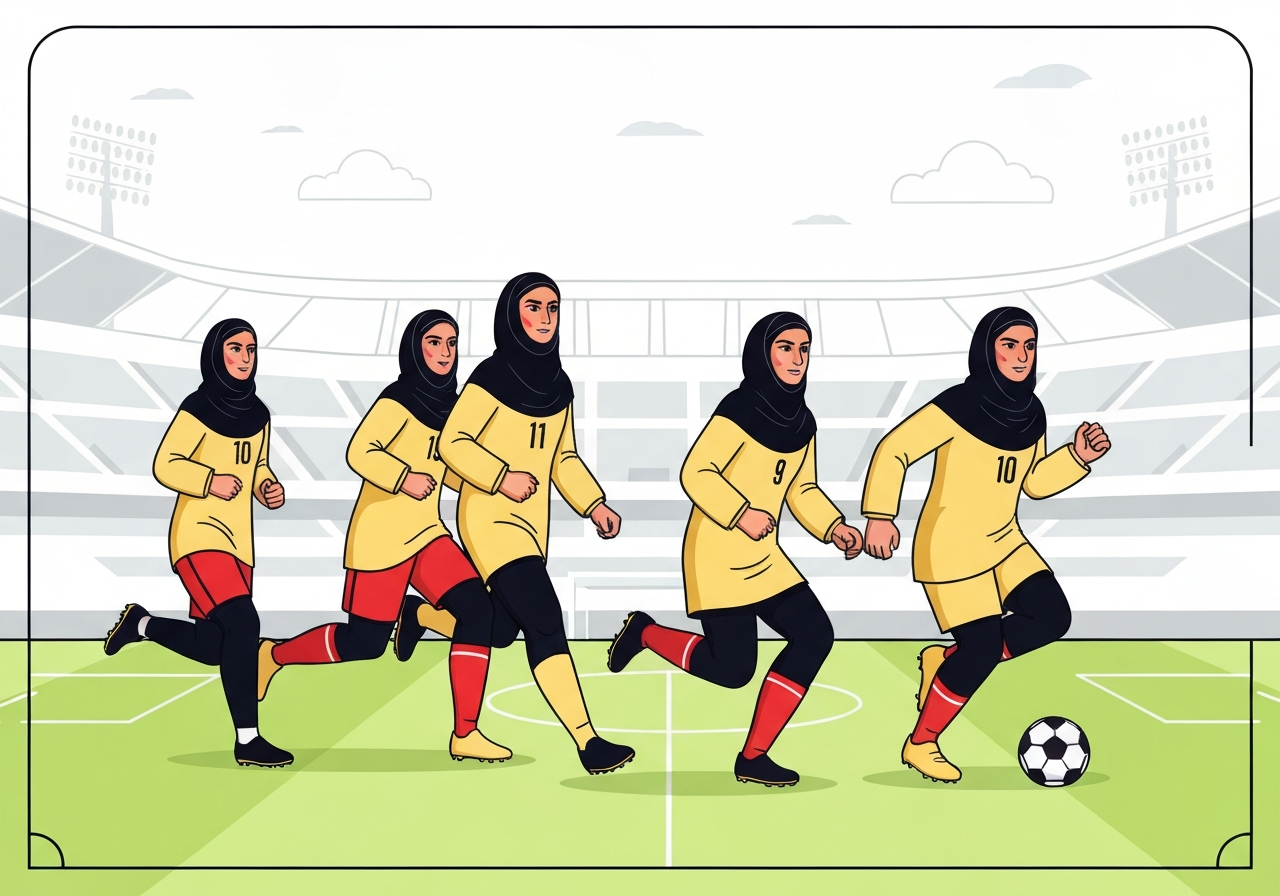
Lead: Five members of Iran’s women’s national soccer delegation who earlier sought asylum in Australia have returned to their teammates in Kuala Lumpur after the squad flew from Sydney on March 10. Officials say four players plus a support staffer have rejoined the team; two players remain in Australia and are receiving assistance. The Asian Football Confederation is hosting the group in Malaysia while their travel plans home remain unresolved. Government and diaspora sources say pressure and complicated logistics are factors in the rapidly changing situation.
Key Takeaways
- On March 10 the Iran squad flew from Sydney to Kuala Lumpur after elimination from the Women’s Asian Cup in Australia.
- Six players and one support staffer initially sought protection visas in Australia; four players and the staffer have since returned to Kuala Lumpur.
- Two players remain in Australia in an undisclosed safe location and are receiving government and community support.
- The Asian Football Confederation (AFC) is providing logistical support while the team awaits onward travel to Iran.
- Iranian state media framed the returns as a political victory; Australian officials describe the cases as complex and personal decisions.
- Australian Prime Minister Anthony Albanese severed diplomatic ties with Iran in August 2024 after intelligence linked the Revolutionary Guard to attacks in Sydney and Melbourne.
- Observers and diaspora groups say Tehran pressure may be a factor; direct evidence of coercion has not been independently verified.
Background
The Iran women’s national team traveled to Australia to compete in the Women’s Asian Cup. The tournament coincided with a fresh outbreak of violence in the Middle East beginning Feb. 28, which complicated travel and heightened public attention around the delegation. After Iran’s elimination, a subset of the delegation sought protection visas in Australia; reports cited six players and one support staff member among those who did not immediately rejoin the team.
International sports delegations from Iran and other countries have previously been the focus of asylum claims, political messaging and diplomatic dispute. Iran’s government regularly monitors high-profile defections and has in past cases used public statements to frame returns as repatriations rather than forced movements. Diaspora groups and host-country officials often play dual roles providing support while also raising protection concerns.
Main Event
The squad departed Sydney on March 10 and landed in Kuala Lumpur, where AFC staff say they are assisting with travel arrangements. AFC general secretary Windsor Paul John told reporters the team was in Malaysia waiting for onward connections and that the confederation had not received complaints from players about returning home. He added that the players appeared “in high spirits” and had told officials they felt safe.
Australian Assistant Immigration Minister Matt Thistlethwaite described the situation as “very complex,” stressing that decisions to seek or withdraw asylum are deeply personal. Australian authorities say the two players remaining in Australia are in a secure, undisclosed location and are receiving assistance from both government services and the Iranian diaspora community.
Iranian state outlets framed the returns as a rebuke of Western policies, describing the players’ decisions as a homecoming. Diaspora activists in Australia voiced concern that pressure from Tehran or targeted messaging could have influenced some returnees; at least one diaspora group alleged a staff member who traveled back may have communicated with players in Australia.
Analysis & Implications
The movement of these players sits at the intersection of sport, diplomacy and human rights. For Iran, public accounts of the returns help the government present a narrative of unity and resistance to foreign interference. For Australia, the episode raises questions about consular protection, asylum screening and the management of high-profile cases that attract political attention.
Regionally, the case could deepen mistrust between Canberra and Tehran. Australia cut diplomatic relations with Iran in August 2024 after intelligence attributed arson attacks in Sydney and Melbourne to the Islamic Revolutionary Guard Corps; that rupture narrows conventional diplomatic channels for resolving welfare or consular issues when Iranian nationals abroad face pressure.
For the athletes themselves, the choices carry potential legal, social and personal consequences. Returning players may face social scrutiny or state attention in Iran; those who remain will confront lengthy asylum processes and integration challenges. Human-rights advocates warn that publicity can both protect and endanger individuals, depending on circumstances and the responses of home-state actors.
Comparison & Data
| Item | Count / Date |
|---|---|
| Players/staff who initially sought asylum | 6 players + 1 staffer |
| Returned to Kuala Lumpur | 4 players + 1 staffer |
| Remain in Australia | 2 players |
| Squad departure from Sydney | March 10, 2025 |
These figures show the movement from Australia to Malaysia and the remaining caseload still under Australian protection. The modest numbers belie the wider political impact: a small group can generate broad diplomatic fallout when media coverage and government statements amplify the case.
Reactions & Quotes
Officials and analysts offered contrasting frames. AFC general secretary Windsor Paul John stressed logistical uncertainty while downplaying immediate safety complaints.
“It could be today, tomorrow or next week. We are just waiting for them to tell us their plans.”
Windsor Paul John, AFC general secretary (sports confederation)
Australia’s Assistant Immigration Minister described the matter as sensitive and stressed government support for those remaining.
“These are deeply personal decisions, and the government respects the decisions of those that have chosen to return. And we continue to offer support to the two that are remaining.”
Matt Thistlethwaite, Assistant Immigration Minister (Australian government)
Academics and former detainees warned that high-profile publicity can change how home governments react.
“The high stakes made the Iranian regime sit up and pay attention and try to force their hand in response, in my view.”
Kylie Moore-Gilbert, political scientist, Macquarie University (academic)
Unconfirmed
- Whether Tehran directly coerced any players to return has not been independently verified by authorities or reporters.
- Allegations that a returning staff member persuaded players in Australia via messages remain unproven and lack corroborating evidence.
- The precise timeline and method by which the two remaining players in Australia will be processed or offered residency are not yet public.
Bottom Line
What began as a small group of asylum claims quickly became a diplomatic flashpoint that mixes sport, national politics and individual protection needs. The return of several delegation members to Kuala Lumpur reduces the immediate number of asylum seekers in Australia but does not resolve broader questions about safety, state pressure and consular access.
Close observers should watch the status of the two players remaining in Australia, official travel arrangements for those in Malaysia and any statements from Iranian authorities about their treatment on return. The case will test how governments, sports bodies and diaspora communities coordinate care and information in politically charged protection cases.
Sources
- AP News (news report)