
Lead
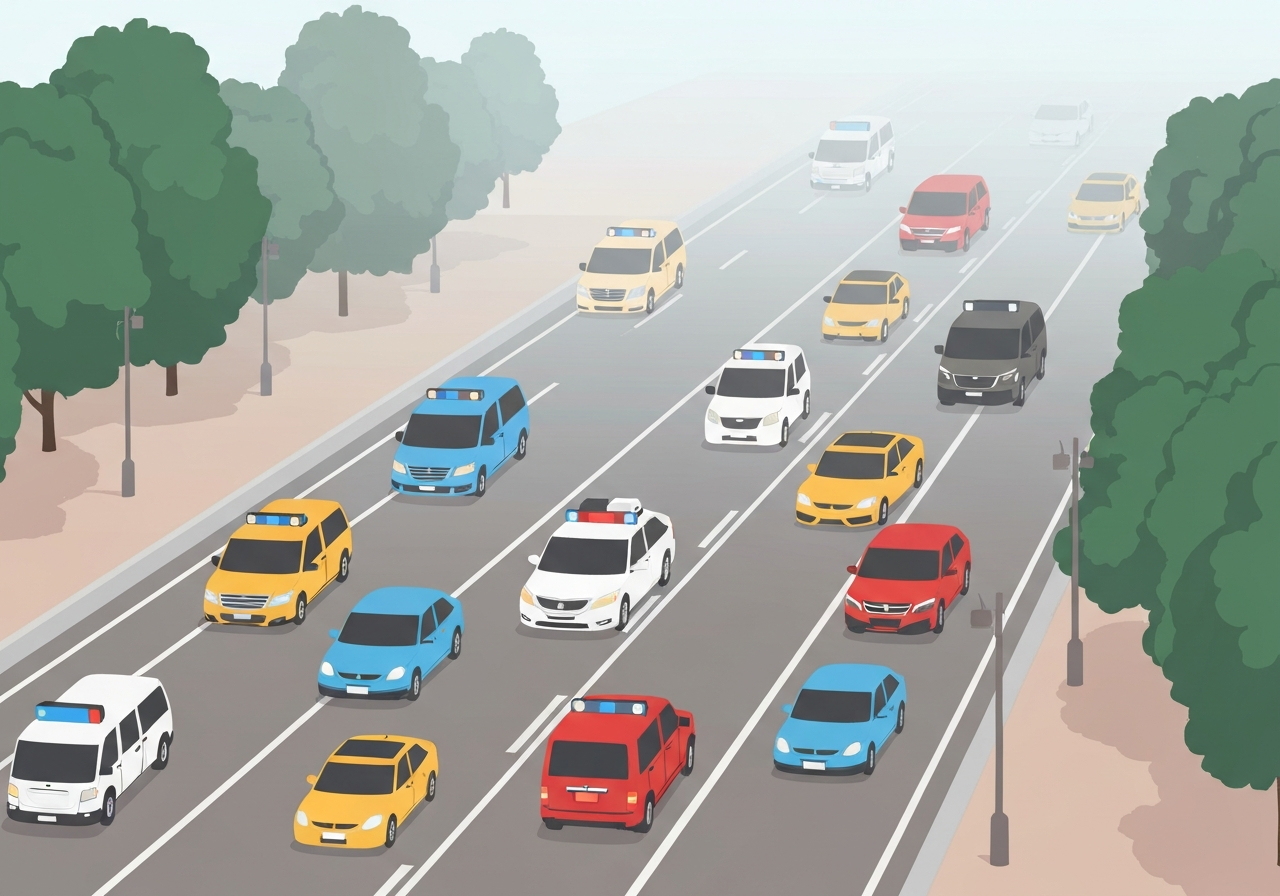
On the morning of Jan. 31, 2026, a multivehicle collision on Highway 99 in an unincorporated area of Tulare County, California, left 10 people injured and shut the road for more than six hours. The California Highway Patrol said roughly 59 vehicles — including big rigs, trucks and cars — were involved in the pileup after dense fog reduced visibility to a reported 100–200 feet. Emergency calls began just after 8:15 a.m. local time; all injured were taken to health care centers, one with a moderate forehead laceration and nine with minor injuries. Authorities continue to investigate the sequence of impacts and the role of weather in the crash.
Key Takeaways
- 59 vehicles were involved in the Jan. 31, 2026 crash on Highway 99 in Tulare County, California, according to the California Highway Patrol (CHP).
- Ten people were injured; one sustained a moderate cut to the forehead and nine had minor injuries; all were transported to area health centers.
- First 911 reports arrived just after 8:15 a.m. local time; responders reported visibility of about 100–200 feet due to thick fog.
- The pileup included a mix of big rigs, trucks and passenger cars; CHP described some vehicles as severely damaged.
- Highway 99 was closed for more than six hours, causing significant regional traffic disruption.
- Thick fog has been implicated in prior multi-vehicle crashes on the same corridor, including a Jan. 11, 2026 collision that killed one person and involved 17 vehicles.
- Historic precedent on Highway 99 includes a 1990 crash in which five people died and roughly 40-plus vehicles were involved.
Background
Highway 99 is a major north–south artery through California’s Central Valley, connecting cities from Bakersfield northward through Fresno and beyond. Certain stretches of the route, particularly in Tulare County, have a history of dense tule fog — a radiation fog common in low-lying valley areas during winter — that can collapse visibility in minutes. That meteorological pattern has repeatedly contributed to serial collisions and multi-vehicle pileups on the corridor.
Traffic on Highway 99 includes a heavy mix of commercial freight and local commuter vehicles, increasing the risk that a single incident will cascade into a large-scale crash. Emergency response capacity along the corridor involves CHP, county fire and EMS units; road closures on this route often require detours of many miles and can take hours to clear when commercial vehicles are involved. Past incidents, including a deadly 1990 collision and a January 2026 17-vehicle crash, have prompted periodic safety reviews but the combination of weather, speed and heavy traffic remains difficult to control.
Main Event
Just after 8:15 a.m. on Jan. 31, 2026, CHP began receiving multiple calls about collisions on both sides of Highway 99 in an unincorporated portion of Tulare County, officials said. Responding officers and firefighters encountered dense fog; initial on-scene reports put visibility in the range of 100 to 200 feet. Crews found a long chain of struck vehicles, with some passenger cars and commercial trucks piled into one another and into concrete barriers.
CHP spokesman Officer Adrian Gonzalez reported that nearly 60 vehicles were involved and that several were “mangled up,” requiring coordinated extraction and traffic management. Medical teams transported 10 injured people to local health centers; one person was described as moderately injured with a forehead laceration while nine others sustained minor injuries. No deaths were reported at the scene.
Roadway clearance took more than six hours as tow crews and emergency responders removed wreckage and crews inspected the pavement and barriers for safety. Traffic was diverted around the scene, creating delays for commuters and freight traffic between Fresno and Bakersfield. Investigators documented vehicle positions, interviewed witnesses and gathered evidence to reconstruct the sequence of events.
Analysis & Implications
The incident highlights how quickly limited visibility from tule fog can convert routine driving conditions into a severe safety hazard on high-speed corridors. When visibility falls below a few hundred feet, reaction times and stopping distances for vehicles — especially heavy trucks — diminish dramatically, increasing the likelihood that a lead collision will trigger a chain reaction involving many vehicles.
Freight traffic volume on Highway 99 raises the stakes: large commercial vehicles carry more momentum and can cause disproportionately greater damage in multi-vehicle impacts, prolonging clearance operations and magnifying the potential for injuries. The presence of concrete barriers and narrow medians on some segments also increases the risk of secondary impacts and complicates extraction efforts.
Policy responses used elsewhere include variable-speed advisory systems, fog detection sensors, and portable changeable-message signs to warn motorists when visibility is poor. Implementing or expanding such systems along fog-prone stretches of Highway 99 could reduce crash size, but these measures require sustained funding, maintenance and coordination among state and county agencies.
Looking ahead, investigators will seek to determine whether speed, driver behavior, lighting conditions or mechanical failures contributed alongside weather. Any regulatory or engineering changes are likely to balance the high volume of commercial traffic, regional funding constraints, and local land-use patterns that affect where and how fog forms and persists.
Comparison & Data
| Date | Vehicles Involved | Fatalities | Injuries |
|---|---|---|---|
| Jan. 31, 2026 | 59 | 0 | 10 |
| Jan. 11, 2026 | 17 | 1 | — |
| 1990 | 40+ | 5 | 30 |
The table places the Jan. 31 pileup in the context of recent and historical fog-related crashes on Highway 99. While the January 31 incident involved more vehicles than the Jan. 11 crash, it resulted in fewer serious injuries and no reported fatalities. That variation can reflect many factors including speed at impact, vehicle mix, and the exact moment fog density intensified.
Reactions & Quotes
Officials emphasized the role of poor visibility and the scale of the response required to clear the scene.
“There was only 100 to 200 feet of visibility because of fog,”
Officer Adrian Gonzalez, California Highway Patrol
Officer Gonzalez’s comments were given as CHP coordinated with county fire and EMS units to manage the scene and transport the injured. He also characterized some vehicles as heavily damaged, underscoring the crash’s severity for responders.
“Fog decreased visibility to a dozen feet”
The Fresno Bee (local news report)
Local media and historical reporting note that sudden drops in visibility have led to fatal collisions on the same corridor, reinforcing concerns among residents and transportation planners about recurring fog-related hazards.
Unconfirmed
- The precise sequence of collisions and which vehicle initiated the chain reaction remain under investigation and have not been publicly confirmed by CHP.
- Media accounts gave slightly different vehicle counts (some reports said “nearly 60”); the official tally of 59 vehicles from CHP is the primary figure but could be revised following a full inventory.
- At this stage, investigators have not released definitive findings on the relative contribution of driver behavior, speed or equipment failure versus weather conditions.
Bottom Line
The Jan. 31, 2026 pileup on Highway 99 is a stark reminder that winter fog in California’s Central Valley can rapidly create multi-vehicle emergencies with heavy traffic and commercial trucks present. While the incident did not result in fatalities, it produced significant property damage, substantial traffic disruption and strained emergency resources for hours.
Reducing the risk of future large-scale pileups on this corridor will likely require a mix of short-term operational measures — improved warnings, targeted enforcement, public advisories — and longer-term engineering investments such as sensor networks and road design changes. Pending CHP’s final investigation, policymakers and local agencies will face decisions about where to prioritize those investments to protect drivers in fog-prone stretches of Highway 99.
Sources
- The New York Times — national news report on the Jan. 31, 2026 pileup (news)
- California Highway Patrol — official state law-enforcement agency (official)
- The Fresno Bee — local reporting on Jan. 11 and historical fog incidents on Highway 99 (local news)
- Tulare County — county government and emergency services (official)