
Lead
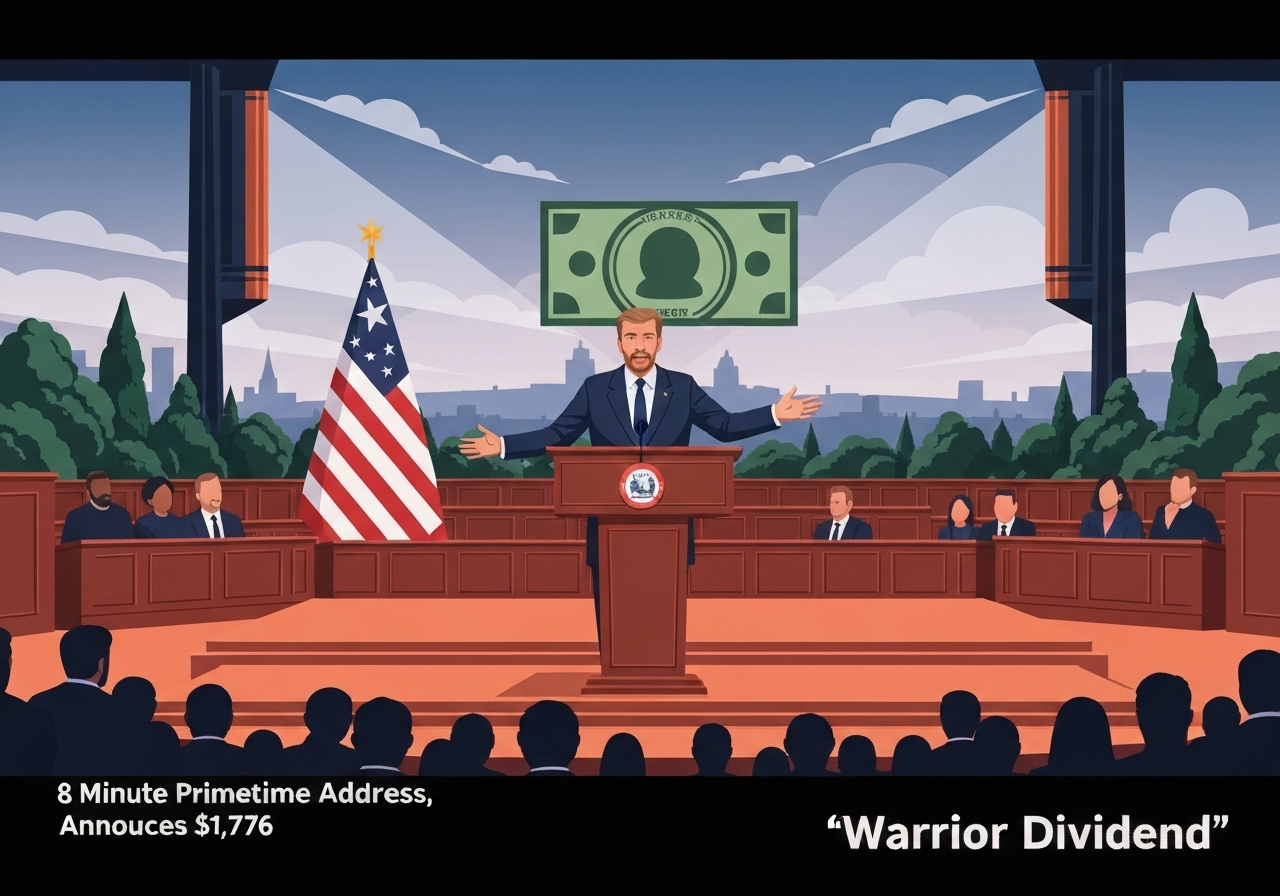
On the evening of Wednesday, December 17, 2025, President Donald J. Trump spoke for 18 minutes from the White House Diplomatic Room, addressing the nation on the economy and national security. He used charts and a string of policy promises — including a $1,776 “Warrior Dividend” for roughly 1.4 million military members — to argue that the economy is improving under his administration. Networks carried the live remarks in prime time as Mr. Trump blamed Democrats and his predecessor while pledging sharp price declines and new housing reforms next year. The address was intended to counter public concerns about affordability, but many of the president’s claims are disputed by public data and independent analysts.
Key Takeaways
- Speech length and setting: The address ran 18 minutes from the White House Diplomatic Room on December 17, 2025, with senior aides present and holiday decorations visible.
- Warrior Dividend announced: Mr. Trump said $1,776 checks would go to about 1.4 million service members, financed by tariff receipts.
- Tariff revenue cited: The administration pointed to more than $200 billion in tariff collections from Jan. 20 to Dec. 15, 2025.
- Economic claims under scrutiny: The president touted falling prices and broad investment pledges (he cited $18 trillion); independent tallies and government data show smaller, more cautious figures.
- Labor and inflation data: November unemployment rose to 4.6 percent; national average gas prices were about $2.90 per gallon in the week ending Dec. 15, 2025, according to government trackers.
- Legal and budget uncertainty: Using tariff receipts for direct payments would require congressional action, and ongoing litigation could force refunds of some collections.
- Political aim: The speech was a targeted rebuttal to Democratic critiques about affordability ahead of next year’s elections.
Background
The address comes amid political pressure on the White House over cost-of-living concerns that voters frequently cite as their top priority. Democrats have made affordability the centerpiece of their messaging, arguing that many Americans are not seeing the improvements the administration claims. Mr. Trump has, in recent months, campaigned on aggressive tariff and trade policies intended to raise revenue and encourage domestic industry, and he has repeatedly contrasted his record with that of President Joseph R. Biden Jr.
Since taking office, the administration has leaned on tariff collections as a funding source for new programs and rebates. The customs agency reported a sharp rise in receipts compared with previous years, a development the White House cites as evidence of policy success. But the executive branch cannot unilaterally reassign collected revenue without Congress, and legal challenges over tariff authority and potential refunds are active, leaving some proposals legally unsettled.
Main Event
Mr. Trump delivered his remarks in a measured, fast-paced style, alternating criticism of Democrats with a series of optimistic economic claims. He repeatedly blamed his predecessors for current problems, framed his own policy moves as corrective, and promised that significant price declines — on energy, housing and other goods — were imminent within the next year. He also previewed planned housing reforms to be announced in the coming months.
A surprise element was the so-called “Warrior Dividend”: a pledge to send $1,776 to about 1.4 million members of the military, financed, Mr. Trump said, from tariff revenues. He asserted the checks were “already on the way,” a claim that has not been independently verified and would require appropriations or administrative mechanisms beyond the president’s unilateral authority.
On trade and industrial policy, the president credited tariffs with attracting investment and reshoring manufacturing. He cited large aggregate investment figures that mix firm commitments, public pledges and previously announced projects. Independent reviewers note that some headline numbers the administration uses double-count or rely heavily on aspirational announcements from foreign entities.
The address touched on foreign policy themes as well — Mr. Trump referenced recent actions in the Middle East and claims of ending “eight wars” since returning to office — while offering limited new detail on operations nearer to the Western Hemisphere, where his administration has authorized strikes at sea and signaled tougher measures on Venezuelan oil shipping.
Analysis & Implications
Politically, the speech was designed to reframe the affordability debate and reassure key constituencies that action is underway. Announcing direct payments to soldiers and promising housing reform are conventional ways to create visible, near-term benefits that can translate into favorable headlines and voter goodwill. But the effectiveness of such moves depends heavily on deliverability: whether promised checks actually reach recipients, whether tariff revenue can legally be allocated as described, and whether the measures materially lower household costs.
Economically, several of Mr. Trump’s claims overstate short-term impact. Government statistics show that while inflation has decelerated from prior peaks, most consumer prices have not fallen in absolute terms; the Federal Reserve’s inflation target remains the benchmark for price stability. Likewise, unemployment rising to 4.6 percent in November indicates a labor market that is cooling, not overheating, complicating a clear-cut political narrative of economic triumph.
On trade policy, tariffs can increase government receipts but also impose costs on businesses and consumers through higher import prices and supply-chain adjustments. Using tariffs as a near-term funding stream is politically attractive but operationally complex: many tariffs are tied to longstanding trade relationships and subject to legal challenge and economic feedback effects that can erode the expected revenue base.
Finally, the speech’s security references signal an administration intent on showing toughness abroad and at home. Statements about naval blockades and military strikes carry diplomatic and operational consequences, and the lack of new factual details in the address leaves analysts to watch for follow-up action and legal oversight from Congress.
Comparison & Data
| Metric | Administration Claim | Independent/Official Data |
|---|---|---|
| Tariff receipts (Jan. 20–Dec. 15, 2025) | More than $200 billion | Customs agency reports a sharp year-to-date increase; specific totals filed by U.S. Customs and Border Protection |
| Unemployment (November 2025) | Administration emphasized jobs growth | 4.6% (Bureau of Labor Statistics) |
| National average gas price (week ending Dec. 15, 2025) | Claimed some areas under $1.99 | ~$2.90 per gallon (Energy Information Administration) |
| Investment pledges cited | $18 trillion (administration figure) | White House tally closer to $9.8 trillion; includes pledges and previously announced projects |
These data show gaps between headline claims and the more cautious totals reported by independent agencies. Tariff revenue is real and elevated, but legal, accounting and economic offsets mean headline figures do not translate automatically into disposable funds for new programs.
Reactions & Quotes
Senate Minority Leader Chuck Schumer offered a pointed rebuttal, framing the speech as out of touch with everyday experience.
“The president’s remarks show he is disconnected from the reality everyday Americans are feeling,”
Senator Chuck Schumer (Democratic Leader)
Political allies stressed the speech’s mobilizing potential. A senior administration official argued the address clarified policy direction and underscored concrete benefits for service members and working families.
“This lays out tangible steps to lower costs and reward those who serve,”
Senior White House official (statement)
Independent economists warned voters to look past rhetoric to verify how proposals would be funded and implemented. One policy analyst noted that large investment tallies frequently combine firm commitments with tentative pledges.
“Aggregate numbers often blend reality and promise; implementation details matter for impact,”
Independent economic analyst
Unconfirmed
- Whether $1,776 checks have actually been distributed: the White House asserted they were “already on the way,” but no independent confirmation of disbursement was available at publication.
- The administration’s $18 trillion investment figure mixes pledges, previously announced projects and firm commitments; the exact realizable portion remains unclear.
- Claims that gas prices reached state averages below $1.99 were not supported by national trackers for the week ending Dec. 15, 2025.
Bottom Line
Mr. Trump’s prime-time address was a concentrated effort to reframe the national conversation on affordability and to present quick, politically salient wins — notably the announced $1,776 “Warrior Dividend” — ahead of the next election cycle. The speech delivered clear political messaging, but many policy claims require legislative action or face legal and empirical scrutiny.
For voters and analysts, the critical questions are procedural and practical: will promised payments be funded lawfully and on schedule, will proposed housing reforms materially reduce costs, and will tariff-based revenue streams hold up under legal and market pressures? Those answers, not the hour of prime-time rhetoric, will determine whether the speech changes economic realities for American households.
Sources
- The New York Times — Live briefing on Trump address (major news organization)
- U.S. Bureau of Labor Statistics (official labor-market data)
- U.S. Energy Information Administration (official energy and gasoline price statistics)
- U.S. Customs and Border Protection (official customs/tariff receipts)