
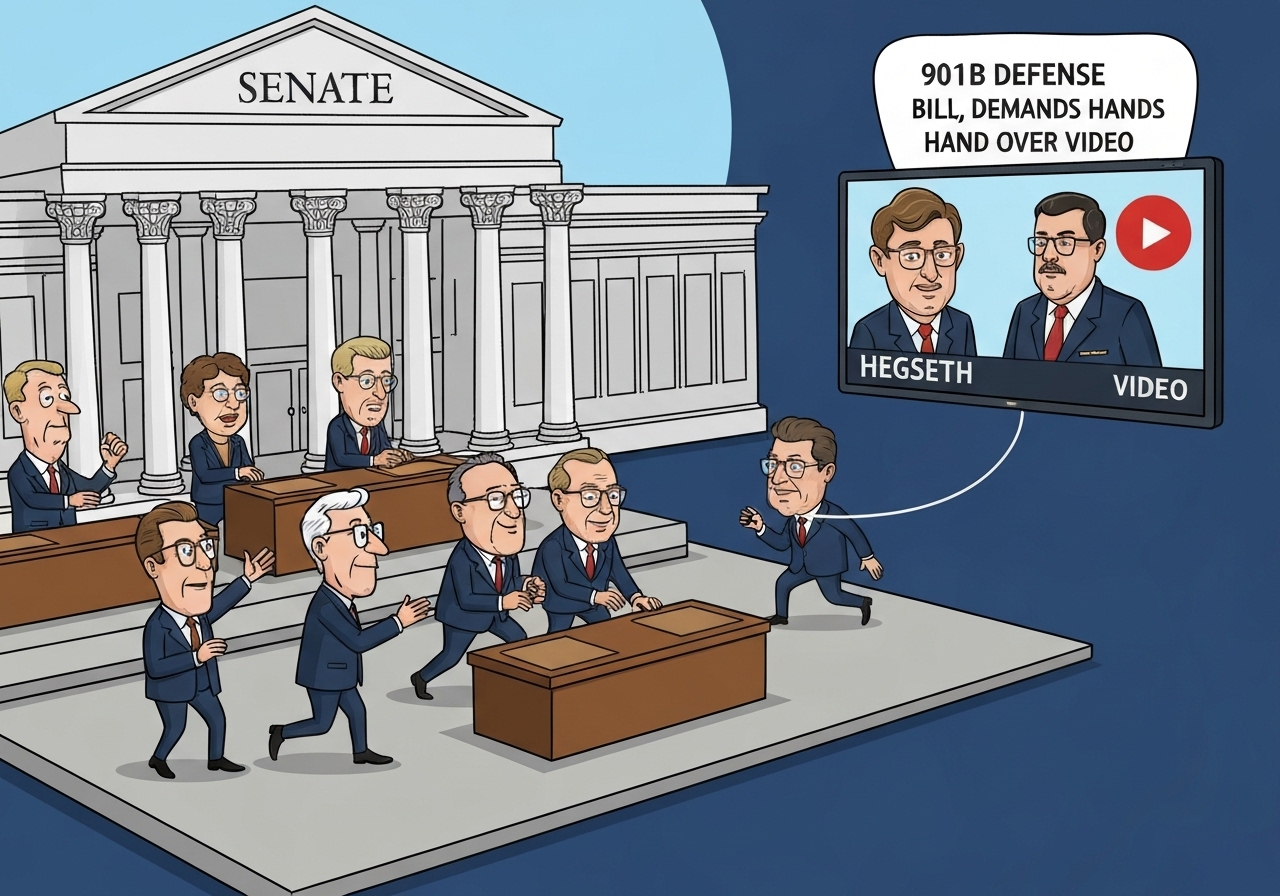
Who: The U.S. Senate. When: final passage ahead of a December 2025 holiday recess. Where: Washington, D.C. What: Lawmakers approved a $901 billion National Defense Authorization Act that raises troop pay and compels Defense Secretary Pete Hegseth to provide unedited video and orders tied to strikes on alleged drug boats near Venezuela. Result: The bill passed 77–20, combining broad GOP and Democratic support while inserting new congressional oversight measures and policy changes across personnel, procurement and operations.
Key Takeaways
- The Senate approved the $901 billion NDAA on a 77–20 vote, with two Republicans (Rand Paul, Mike Lee) and 18 Democrats opposing the measure.
- The lawauthorizes a 3.8% pay raise for troops and requires the Pentagon to maintain at least 76,000 troops and major equipment in Europe unless allies are consulted.
- Congress inserted language threatening to withhold one-quarter of Defense Secretary Pete Hegseth’s travel budget until unedited video and authorizing orders for Caribbean boat strikes are delivered to oversight committees.
- The bill allocates $400 million annually for two years to manufacture weapons intended for Ukraine and repeals the 1991 and 2003 war authorizations.
- It codifies reductions to diversity and inclusion offices (saving about $40 million) and cuts approximately $1.6 billion from Pentagon climate programs.
- Lawmakers advanced a separate measure to require military and civilian aircraft to broadcast precise locations after a January midair collision killed 67 people.
Background
Congress has passed an annual National Defense Authorization Act for decades to set policy and spending priorities for the Department of Defense. This year’s package, totaling $901 billion, surfaced as the Trump administration shifts focus toward challenges in Central and South America and away from some European priorities. That reorientation has produced friction between Pentagon leaders and Congress, producing explicit guardrails in the NDAA to preserve troop posture in allied regions and insist on consultation before major drawdowns.
The bill’s scope runs wide: pay and benefits for service members, procurement reforms aimed at accelerating next-generation capabilities to compete with China, authorization of military aid for Ukraine, and the repeal of long-standing war authorizations from 1991 and 2003. It also advances several administration priorities, including rolling back diversity and equity programs in the armed forces, while increasing congressional oversight over force structure and operational decisions.
Main Event
The Senate moved the measure through in a pre-holiday vote, approving the NDAA 77–20. The final text incorporated compromise provisions to address concerns across the aisle — from retention of troop levels in Europe and South Korea to enhanced transparency over controversial kinetic operations. The bill’s passage followed Capitol Hill briefings about a U.S. maritime campaign in international waters near Venezuela, where a Sept. 2 strike that killed two people is under scrutiny.
Republicans and Democrats agreed on a mechanism that pressures Defense Secretary Pete Hegseth to hand over unedited recordings and authorizing documents related to strikes on alleged drug-smuggling boats in the Caribbean. The language ties release of that material to a significant restriction on Hegseth’s travel funds, directing the House and Senate Armed Services Committees to receive the full footage and related orders.
Committee briefings included a classified session in which Navy Adm. Frank “Mitch” Bradley presented video of a contested strike — described in some briefings as a “double-tap” operation that followed an earlier attack on the same vessel. Lawmakers left the classified session split: several GOP senators publicly supported Hegseth’s handling of operational discretion, while many Democrats pressed for broader congressional and public access to the footage.
Analysis & Implications
The NDAA’s provisions reflect a larger tug-of-war over executive military discretion and congressional oversight. By conditioning budgetary levers on the provision of operational material, Congress signals it will use appropriations authority to demand transparency about kinetic actions taken far from U.S. shores. This could set a precedent for future oversight of short-notice strikes and intelligence-driven operations in international waters.
Mandating minimum troop-presence thresholds — 76,000 troops and major equipment in Europe, and maintaining about 28,500 in South Korea — constrains the Pentagon’s freedom to rapidly reallocate forces without consultation. Given that 80,000–100,000 U.S. troops typically serve in Europe, the requirement seeks to prevent abrupt drawdowns that allied governments and some lawmakers fear would weaken NATO deterrence.
On procurement and industrial policy, the bill aims to overhaul Pentagon acquisition practices to accelerate development of technologies where the U.S. competes with China. Coupled with the $400 million annual commitment for weapons to Ukraine, Congress is signaling continued bipartisan interest in sustaining allies and pacing strategic competitors, while also redirecting some policy priorities to the Western Hemisphere.
Comparison & Data
| Item | Previous/Typical | Now in NDAA |
|---|---|---|
| Total authorization | — | $901 billion |
| Troop pay increase | varied | 3.8% |
| Europe troop floor | 80,000–100,000 typically present | At least 76,000 maintained |
| South Korea force | ~28,500 | Maintained at 28,500 |
| Climate programs cut | current spending | $1.6 billion reduction |
The table highlights where the NDAA sets explicit numeric floors or cuts. Legislated minimums in Europe and Korea limit rapid force posture changes; the pay raise quantifies immediate personnel cost increases; and budget cuts to climate and diversity initiatives quantify policy priorities embedded in the bill.
Reactions & Quotes
Lawmakers and officials offered contrasting public signals after briefings and voting.
“We’re about to pass, and the president will enthusiastically sign, the most sweeping upgrades to DoD’s business practices in 60 years.”
Sen. Roger Wicker, R-MS (Senate Armed Services Committee Chair)
Wicker framed the bill as a major acquisition and management reform package aimed at accelerating Pentagon modernization and procurement reforms.
“The American people absolutely need to see this video. I think they would be shocked.”
Sen. Richard Blumenthal, D-CT
Blumenthal and other Democrats argued that public disclosure of parts of the footage is necessary for accountability and public trust in overseas operations.
“The White House supports the aircraft-location broadcasting bill and is committed to helping get it passed.”
White House Official (anonymous brief to reporters)
The administration signaled support for a companion safety measure requiring military and civilian aircraft to broadcast precise locations after concerns tied to a January midair collision that killed 67 people.
Unconfirmed
- Whether the full unedited boat-strike video will be released publicly remains unresolved; committees have different views on redaction and public disclosure.
- Claims that the Sept. 2 strike constituted unlawful conduct are under investigation and not concluded by the committees or public reporting.
- Any immediate decision by the Pentagon to reallocate troops from Europe in violation of the new floor has not yet been announced; future consultations with NATO allies could alter planned posture changes.
Bottom Line
The Senate’s $901 billion NDAA is both a policy instrument and a message: Congress will preserve certain force structures, press for transparency on contentious operations, and push the Pentagon toward faster acquisition and higher oversight. The conditional restrictions on Defense Secretary Hegseth’s travel funds to secure operational footage signal a willingness to use budgetary levers for oversight.
At the same time, the bill reflects compromise: it authorizes long-standing military priorities such as troop pay increases and weapons support for Ukraine while aligning with several administration directives on internal Pentagon policies. The coming weeks will test how the executive branch implements these mandates and whether the compelled disclosures shape future operational norms and congressional-executive relations.
Sources
- Federal News Network (media report)
- The Associated Press (news agency reporting)