
Lead
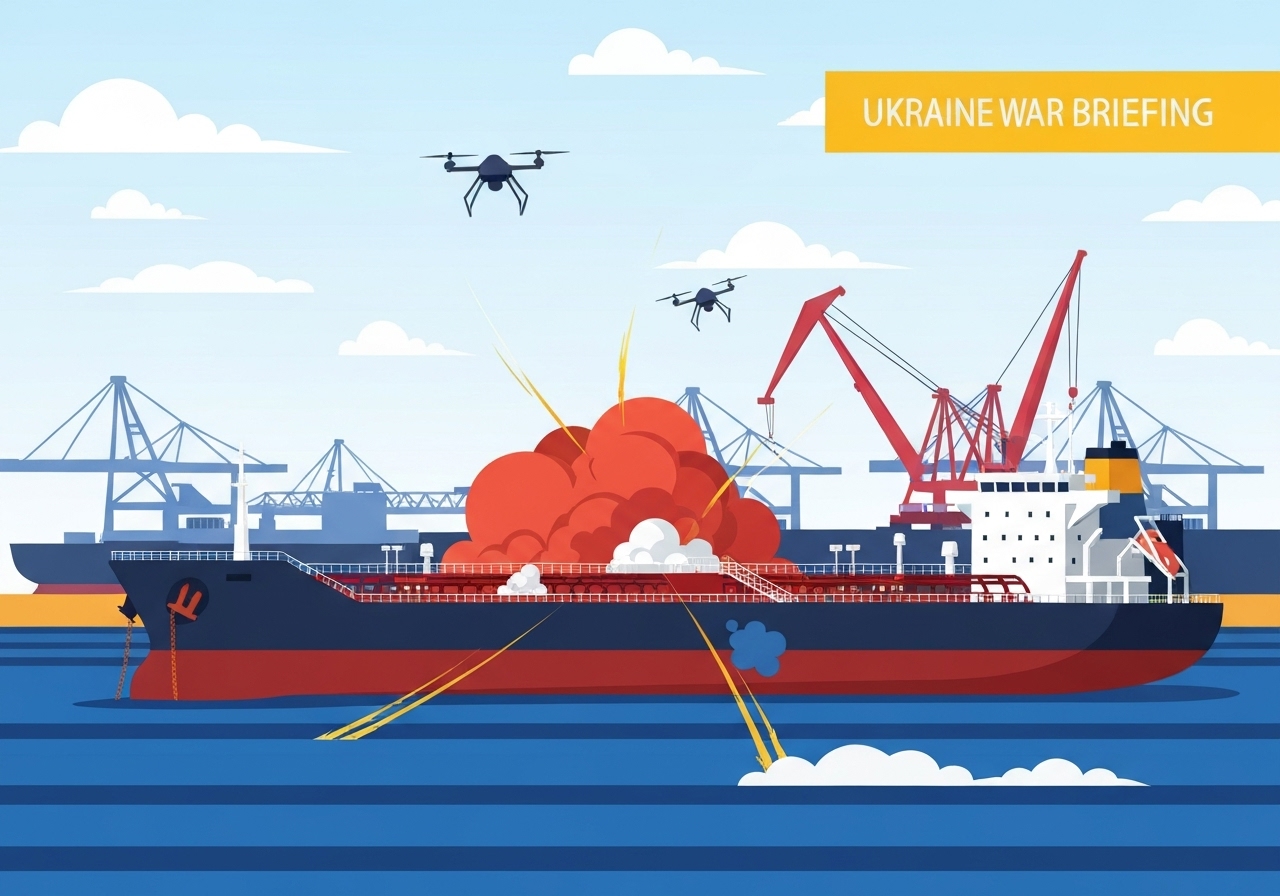
Local Russian officials reported early on Thursday that a drone strike hit a tanker docked in Rostov-on-Don, causing damage and preliminary deaths, while separate Russian strikes on Zaporizhzhia wounded dozens. Regional governor Yuri Slyusar and Rostov mayor Alexander Skriabin described fires and building damage in the city and nearby towns. Ukrainian and Western officials were meeting in Brussels amid fresh diplomacy over using frozen Russian assets to fund Kyiv’s defense. UK authorities concurrently issued a 90-day ultimatum to Roman Abramovich to release sale proceeds for humanitarian use in Ukraine.
Key Takeaways
- A tanker at Rostov-on-Don was struck by drones on Thursday, officials say; local authorities reported fatalities among the crew in preliminary notices.
- Mayor Alexander Skriabin reported the tanker fire was being extinguished and that an oil-products leak had been avoided.
- Russian strikes on and around Zaporizhzhia wounded at least 32 people, including children, according to regional authorities.
- Ukrainian President Volodymyr Zelenskyy visited Brussels to press EU leaders to use frozen Russian assets — a plan centered on a proposed €90bn loan facility.
- European security officials warned of an intimidation campaign targeting Belgian politicians and financial executives, allegedly tied to Russian intelligence, aimed at blocking use of frozen assets.
- Russian President Vladimir Putin said Moscow would “certainly” achieve its goals in Ukraine; Zelenskyy warned Russia may prepare a renewed offensive in 2026.
- The UK ordered Roman Abramovich to release £2.5bn within 90 days from the Chelsea FC sale to fund humanitarian support for Ukraine, or face legal action.
Background
The war in Ukraine has seen frequent cross-border strikes and drone operations in southern Russian regions since 2022, with both military and civilian infrastructure repeatedly affected. Rostov-on-Don, a major port and logistics hub just north of the Russian-Ukrainian border, has been targeted periodically in attacks attributed to Ukrainian forces and their long-range systems by Russian authorities. Zaporizhzhia, in southern Ukraine, remains on the frontline and has experienced sustained aerial and artillery bombardment, often producing civilian casualties and damage to housing and public facilities.
Diplomatically, Western governments have debated how to convert frozen Russian assets into support for Ukraine. The European Commission and member states have proposed mechanisms—ranging from loans secured on frozen central-bank assets to future reparations—to channel funds while awaiting legal and political consensus. Meanwhile, intelligence services in Europe have over recent months reported attempts by pro-Kremlin actors to influence decision-making in key financial centers, raising concerns about coercion and the security of intermediaries such as Euroclear.
Main Event
Early Thursday reports from Rostov oblast officials said a tanker at a Rostov-on-Don berth was struck in a drone attack. Governor Yuri Slyusar posted on Telegram that the vessel was damaged and that, according to preliminary information, crew members had died. Mayor Alexander Skriabin was quoted by Russian state outlets saying emergency teams were working to extinguish the blaze and that an oil-products leak had been prevented.
Authorities also reported collateral damage: parts of a high-rise apartment block under construction in the city were damaged and two private homes burned in a nearby town. Local emergency services were deployed to control fires and assess structural safety, while investigators collected initial evidence at the scene. Russian officials described the incident as a cross-border strike originating from Ukrainian-controlled areas, a claim Kyiv did not immediately confirm publicly.
Separately, authorities in Zaporizhzhia reported a series of Russian air strikes that wounded at least 32 people in the city and surrounding areas. Regional head Ivan Fedorov posted on Telegram that casualties included residents of a block of flats, a private house, and an educational establishment; earlier provisional tolls cited five child victims among roughly 30 reported injured. Rescue teams and firefighters were active at multiple sites as damage assessments continued.
In Kushuhum, south of Zaporizhzhia, officials said two people were wounded after a drone strike hit a civilian car. Local emergency services provided medical evacuation and first response; hospitals in the region reported treating the wounded amid scarce resources. These strikes coincided with a high-profile diplomatic push in Brussels where Ukrainian leaders sought financial commitments from EU partners.
Analysis & Implications
The reported tanker strike in Rostov, if confirmed as conducted by Ukrainian forces, underscores Kyiv’s continuing efforts to target Russian logistics and maritime assets supporting the war effort. Attacks on port infrastructure can disrupt supply lines and create economic and environmental risks, even as they raise the probability of escalation and heightened cross-border retaliation. The presence of civilian casualties and damage to private housing increases pressures on both sides politically and raises humanitarian concerns within Russian regions near the front line.
The wounding of at least 32 people in Zaporizhzhia highlights the persistent danger to civilians in frontline cities. Recurrent strikes on residential and educational sites strain local emergency services and complicate humanitarian operations. These incidents also influence public opinion within Ukraine and among international partners, potentially strengthening calls for accelerated military support while complicating negotiations over ceasefires or localized pauses.
The Brussels discussions over converting frozen Russian assets into a €90bn loan facility represent a major financial and legal test for the EU. If approved, the plan would create a bridge financing mechanism for Kyiv while reserving the right to seek repayment from eventual Russian reparations. However, reports of external pressure and alleged intimidation campaigns against Belgian officials indicate a complex security dimension: financial channels and institutions are becoming secondary theaters in the broader geopolitical contest.
Finally, public statements by Vladimir Putin asserting that Moscow will “certainly” achieve its aims and Zelenskyy’s warning of a potential renewed year of war in 2026 set a tone of prolonged conflict. These competing narratives will inform military planning, alliance cohesion, and domestic politics in both Russia and Ukraine. Western policy choices on funding, sanctions, and force posture will be pivotal in shaping the trajectory of the conflict over the coming year.
Comparison & Data
| Location | Event | Reported Casualties |
|---|---|---|
| Rostov-on-Don | Tanker struck by drones; fires, building damage | Preliminary: crew fatalities reported (number unconfirmed) |
| Zaporizhzhia (city & surroundings) | Russian air strikes on residential/educational sites | At least 32 wounded; provisional reports included ~5 children |
| Kushuhum | Drone strike on civilian car | 2 wounded (local authorities) |
The table summarizes the incident locations, types of attacks and the casualty figures reported by local authorities. Numbers for Rostov remain preliminary and under investigation; Zaporizhzhia’s toll reflects regional administration updates and provisional rescue-service counts.
Reactions & Quotes
“Emergency teams are extinguishing the fire on the tanker that was struck while docked in a drone attack … A leak of oil products was avoided. Unfortunately, there are dead and injured.”
Alexander Skriabin, Mayor of Rostov-on-Don (reported)
Mayor Skriabin’s statement framed immediate damage control efforts while acknowledging casualties and emphasizing that a larger environmental disaster was averted.
“All the wounded came from the city and its surroundings.”
Ivan Fedorov, Head of Zaporizhzhia Regional Military Administration (Telegram)
Fedorov provided a concise casualty update and linked the injuries directly to recent Russian strikes on civilian sites.
“They are preparing to make next year a year of war.”
Volodymyr Zelenskyy, President of Ukraine (evening address)
Zelenskyy used the remark to warn allies about the potential for escalated operations in 2026 and to underline the urgency of accelerated support.
Unconfirmed
- The attribution of the Rostov tanker strike to Ukrainian forces is reported by Russian officials but remains unverified by independent sources.
- The exact number of crew fatalities on the Rostov tanker has not been publicly corroborated; official counts were described as preliminary.
- Reports that Russian intelligence orchestrated a targeted intimidation campaign to block use of €185bn in frozen assets are drawn from European intelligence briefings and have not been fully disclosed for public verification.
- An unnamed Ukrainian official’s claim that Washington is pressuring EU countries against the frozen-assets plan is not independently confirmed in public statements from U.S. officials.
Bottom Line
Thursday’s reported strikes — a drone attack on a Rostov tanker and renewed bombardment around Zaporizhzhia — illustrate the persistence of cross-border and frontline violence as diplomatic efforts continue in Brussels. Casualty reports and property damage increase humanitarian pressures and complicate any near-term moves toward ceasefire or de-escalation. The pace and nature of these incidents are likely to influence decisions in European capitals about financial and military support for Ukraine.
At the same time, debates over converting frozen Russian assets into an emergency loan for Kyiv are entering a decisive phase, with security concerns about coercion and legal challenges shaping the discussion. How EU leaders resolve the balance between speed, legality and the protection of financial intermediaries will matter for Ukraine’s ability to sustain its defense and for the broader geopolitical contest with Russia.
Sources
- The Guardian — News report summarizing regional statements and diplomatic context (media)