
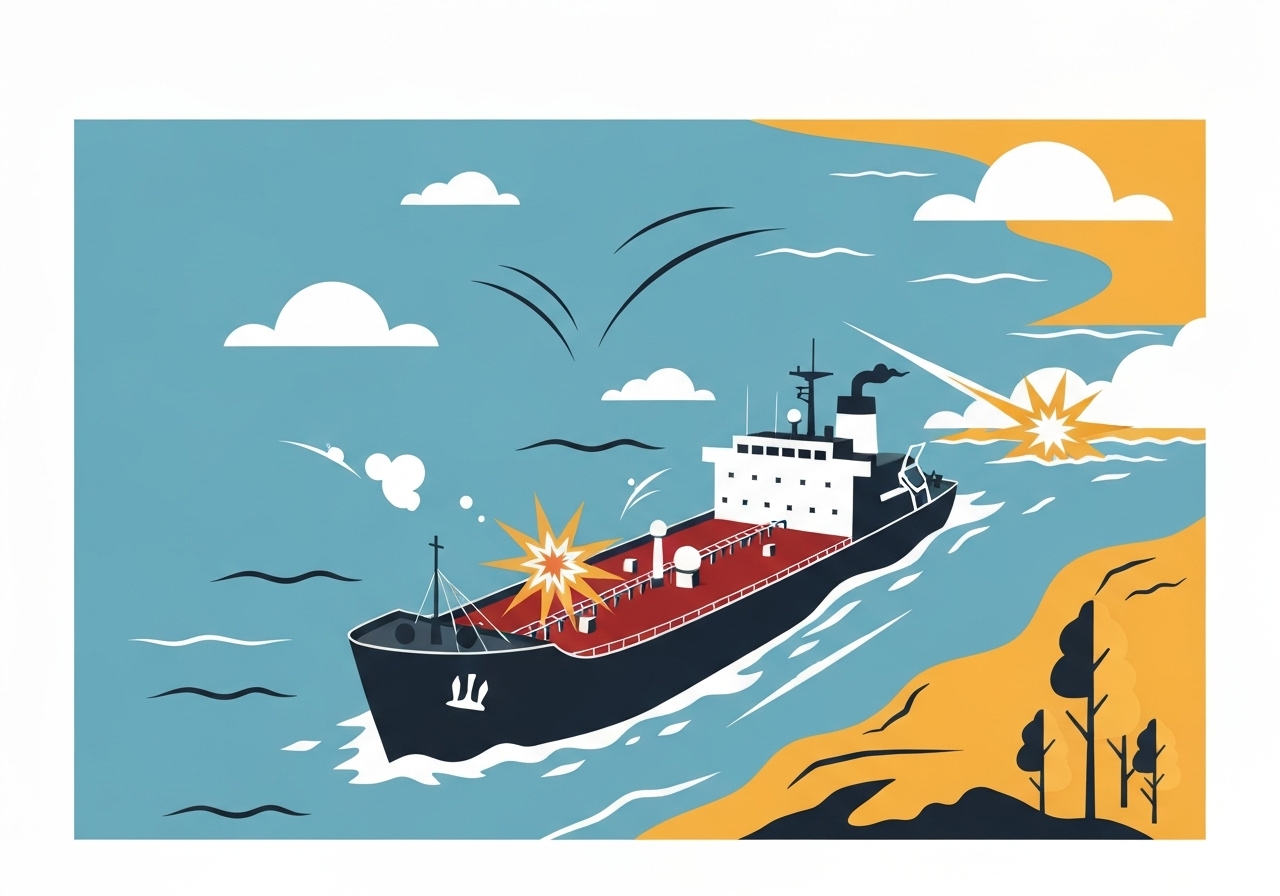
Lead: Ukraine says it used aerial drones to strike a Russian-linked “shadow fleet” tanker roughly 1,250 miles (2,000 km) from its borders, off the coast of Libya, in the first Mediterranean strike of its war. Kyiv and a Security Service of Ukraine (SBU) source said the tanker, identified as the Qendil, suffered critical damage and was empty at the time, with no immediate environmental harm reported. The attack occurred on the day of President Vladimir Putin’s year-end press conference, where he warned Moscow would respond to recent hits on vessels tied to sanctioned exports. Kyiv frames the action as part of a campaign to disrupt oil shipments that finance the Kremlin’s military effort.
Key Takeaways
- Ukraine reported a drone strike on a Russian “shadow fleet” tanker off Libya on 19 December 2025, about 1,250 miles (2,000 km) from Kyiv.
- The tanker was named by Ukrainian sources as the Qendil; Vessel Finder recorded it in Suez on 16 December and off Libya before it altered course.
- SBU described the operation as a “new, unprecedented special operation” and said the ship was empty and that no environmental emergency followed.
- Vanguard, a British maritime risk group, said the strike signals a clear extension of Ukraine’s use of uncrewed aerial systems against sanctioned maritime assets.
- Experts estimate the so-called shadow fleet exceeds 1,000 vessels that frequently change flags and ownership details to evade sanctions.
- President Putin said Russia would “definitely respond” to attacks on its shadow fleet but did not directly address the Mediterranean incident.
- Western states, including recent US actions off Venezuela, have increased enforcement against shadow-fleet operations this month.
Background
The term “shadow fleet” refers to a large and opaque network of tankers and cargo ships that analysts say helps Russia, Iran and Venezuela export hydrocarbons while sidestepping sanctions. Industry and government estimates place the network at more than 1,000 vessels; many routinely switch flags, obscure ownership and disable tracking systems to avoid detection. Western governments and maritime authorities have grown increasingly concerned that these practices not only undermine sanctions but also create risks for regional security and the environment.
Since Russia’s full-scale invasion in 2022, Kyiv has targeted maritime links it says underpin Moscow’s revenue streams, including earlier strikes on tankers in the Black Sea. Those operations aimed to interrupt income used to finance the war effort while signalling Kyiv’s intent to pursue Russian assets beyond strictly local battlefields. In parallel, the US and several European states have stepped up pressure—ranging from boarding operations to legal and financial measures—intended to limit the shadow fleet’s activities.
Main Event
According to Ukrainian sources and maritime tracking records, the strike happened off Libya’s coast and targeted the tanker identified as Qendil. The SBU characterized the operation as multi-stage but provided no operational details about drone launch points, flight corridors or which states’ airspace the drones may have crossed. Ukrainian officials insisted the ship was empty, limiting the environmental footprint of the attack.
Vessel Finder logs show the Qendil was last recorded in Suez, Egypt, on 16 December before being located off Libya where it reportedly turned back after the incident. The SBU said the tanker sustained critical damage and “cannot be used for its intended purpose.” Kyiv framed the strike as lawful under the laws of war because the vessel allegedly functioned to evade sanctions and funnel revenue to Russia’s war effort.
President Vladimir Putin addressed the strikes during his annual televised call-in program, saying Russia would “definitely respond” to attacks on what Moscow calls its shadow fleet and arguing such strikes would not halt supplies but could create additional risks. Putin did not specifically mention operational details of the Mediterranean incident. The timing—coinciding with his signature press event—underlined the Kremlin’s focus on the issue.
Analysis & Implications
The Mediterranean strike marks a tactical expansion of Ukraine’s maritime reach and presents several strategic implications. First, if Kyiv can project unmanned systems this far from its shores, it broadens potential targets in the global supply chain that supports Russia’s energy exports. That raises the operational bar for both sides and could complicate maritime traffic in the region, prompting commercial insurers and flag states to reassess risk exposure.
Second, the legal framing matters. Kyiv argues the tanker was a legitimate military-economic target because it facilitated sanctions evasion; some legal experts say targeting such vessels may be defensible when they materially support an ongoing armed conflict. Opponents will contest strikes beyond territorial waters as escalatory. The disagreement may push third states to clarify rules on interdiction, seizure and use-of-force against shadow-fleet craft.
Third, the incident intensifies diplomatic strain: countries hosting or patrolling adjacent waters may face pressure to respond, and Moscow is likely to press allies and neutral states to take countermeasures. Economically, any sustained campaign against the shadow fleet could hinder one revenue stream for Russia but also disrupt global tanker routes and raise freight and insurance costs.
Comparison & Data
| Incident | Date | Location | Vessel | Reported Damage |
|---|---|---|---|---|
| Mediterranean drone strike | 19 Dec 2025 | Off Libya | Qendil | Reported critical damage (SBU) |
| Previous Black Sea hits | 2023–2025 | Turkish/Black Sea coast | Russia-linked tankers | Explosions/damage (varied reports) |
The table places the Libya strike in a string of maritime incidents since 2023 in which tankers linked to sanctioned networks have been damaged. While details and attribution have varied, the pattern shows Kyiv focusing on maritime economic targets and western states tightening enforcement. Analysts warn that inconsistent tracking and opaque ownership make comprehensive monitoring of the shadow fleet difficult.
Reactions & Quotes
Ukrainian officials and maritime analysts offered swift commentary, each framing the strike within broader strategic goals.
“This tanker was used to circumvent sanctions and earn money that was used for the war against Ukraine,” a Ukrainian official told Ukrainska Pravda, asserting the strike was legally justified.
Ukrainian official (reported by Ukrainska Pravda)
Vanguard highlighted the operational significance and risk expansion.
“This development reflects a stark expansion of Ukraine’s use of uncrewed aerial systems against maritime assets associated with Russia’s sanctioned oil export network,”
Vanguard (maritime risk-management group)
President Putin, speaking during his annual televised event, warned of a response but downplayed claims that such attacks would sever supplies.
“Ultimately, this will not lead to the expected result. It will not disrupt any supplies, but will only create additional threats,”
Vladimir Putin (Kremlin press event)
Unconfirmed
- Exact launch point(s) and flight path(s) of the drones: Ukrainian officials did not disclose where the drones were launched or which airspaces were crossed.
- Precise ownership and registration trail of the Qendil: public records remain incomplete about the vessel’s beneficial owners.
- Full extent of the damage beyond Kyiv’s claim of “critical” impairment: independent verification of long-term operability is pending.
- Concrete plans for Russian retaliation: Putin promised a response but gave no operational timetable or scope.
Bottom Line
The strike off Libya signals an escalation in Kyiv’s campaign to pressure Russia’s sanctioned oil networks and shows a growing willingness to strike assets far beyond the immediate battlefield. If verified, the Qendil incident demonstrates that unmanned systems can reach and affect commercial shipping in the Mediterranean, raising operational and legal questions for multiple states.
Going forward, expect increased diplomatic friction, closer scrutiny of tanker movements, and potentially more interdictions or defensive measures by navies and insurers. The incident also underscores the limits of sanctions enforcement: opaque ownership and evasive practices remain central challenges, and unilateral actions risk widening regional instability unless accompanied by coordinated international policy responses.
Sources
- The Guardian — news reporting and primary account of the incident
- Vanguard — maritime risk-management group comment on drone use (industry statement)
- Vessel Finder — vessel tracking data for Qendil (open-source maritime tracking)
- Ukrainska Pravda — reported Ukrainian official statements (Ukrainian media)
- The Kremlin — transcript/coverage of Vladimir Putin’s annual press event (official)