
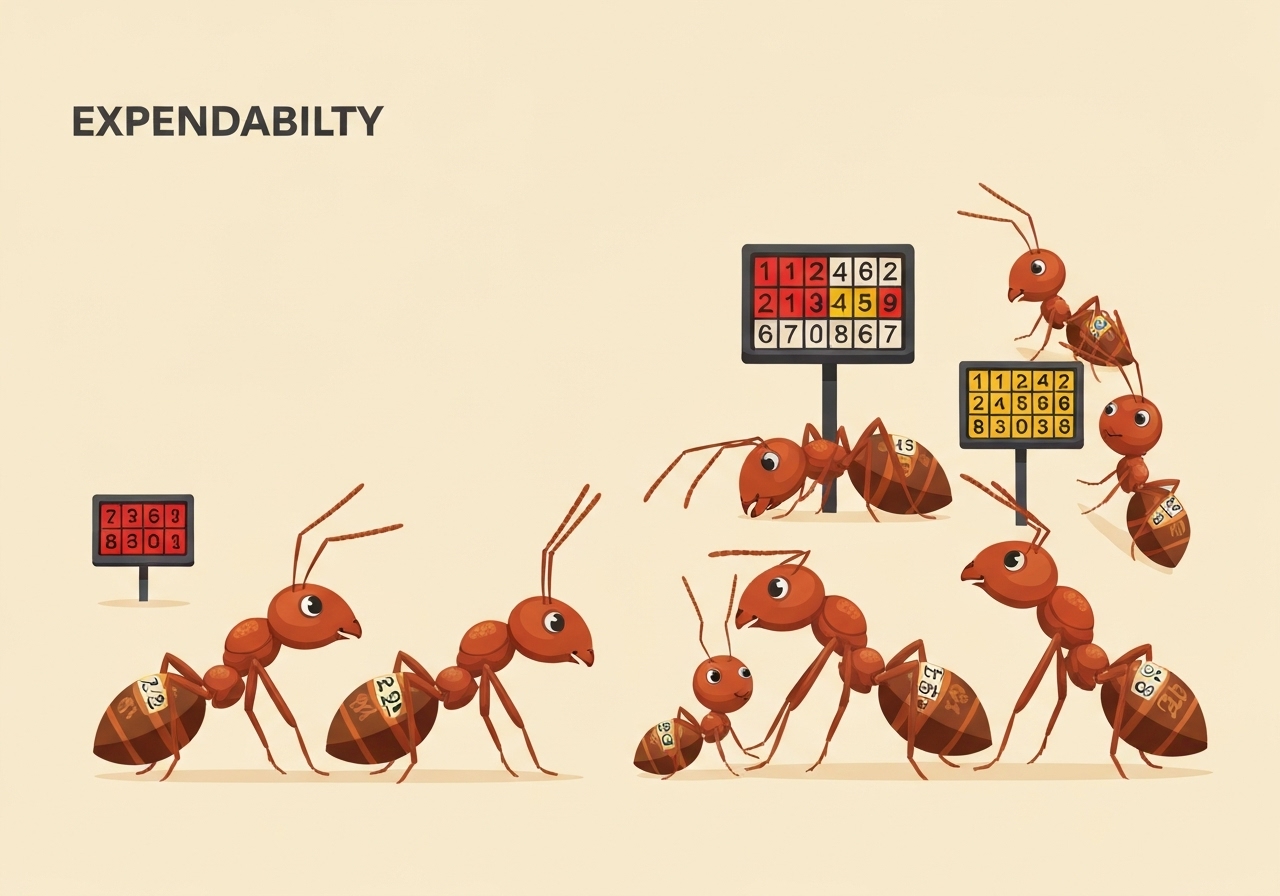
Lead: In a 2025 study published in Science Advances, researchers led by Economo and Matte report that several ant species appear to lower per-worker investment in costly exoskeleton tissue, effectively trading heavily armored individuals for larger numbers of cheaper workers. The work, based on comparative anatomical and ecological analysis, was conducted across multiple ant lineages and argues the shift benefits colony-level performance. The authors frame the change as analogous to transitions toward division of labor seen in multicellular evolution, with consequences for how we understand social complexity.
Key Takeaways
- The peer-reviewed study appears in Science Advances (2025) with DOI 10.1126/sciadv.adx8068 and documents reduced investment in exoskeletal tissue in some ant species.
- Researchers report that per-worker allocation to the exoskeleton, one of the most nutritionally expensive tissues, is lower in species that rely on large, non-reproductive worker castes.
- Ant colonies with many cheaper workers showed ecological advantages in foraging and colony growth compared with species that maintain fewer, better-armored workers.
- The pattern is linked to reproductive division of labor: worker castes that do not reproduce can be rendered effectively expendable by selection acting on the queen-level gene pool.
- The team plans follow-up analyses on nervous tissue, musculature and ant genomes to test whether the cheapening effect extends beyond the exoskeleton and to identify underlying genetic changes.
Background
Evolutionary theory has long noted trade-offs between individual investment and collective performance. Producing a thick, well-sclerotized exoskeleton requires substantial nutrients, so selection may favor alternate strategies when colonies can buffer individual weakness. In eusocial insects such as many ants, workers forgo reproduction and function as extensions of the reproductive queen, creating a distinct selective landscape compared with reproductively autonomous animals.
Biologists have compared this dynamic to the transition from unicellular to multicellular life, where functional specialization and resource sharing allow constituent units to be simpler than solitary cells yet enable far greater collective capabilities. Prior studies have focused on morphological caste differentiation, but the new work quantifies per-tissue investment across species and links it explicitly to colony-level life history and reproductive structure.
Main Event
Using comparative measurements across ant species, the researchers quantified exoskeletal mass relative to worker body mass and dietary input. They found a consistent trend: species with large, sterile worker castes tend to invest less per individual in exoskeleton tissue than closely related species with different social structures. The analysis controlled for body size and phylogeny to isolate social system effects from simple allometry.
Matte and colleagues interpret these results as a shift from self-maintenance to distributed maintenance, where colony function is preserved by numbers rather than by heavily protected individuals. That shift appears feasible precisely because workers are non-reproductive and so their fitness is evaluated through colony-level success rather than individual survival. The authors argue this relaxes selection on costly individual traits and channels resources into producing more workers.
The team also compared ants to other social mammals and humans, noting an absence of the same pattern in those groups. They attribute the difference to persistent individual reproductive interests in mammals and humans, which preserve strong selection for individual-level robustness. The paper therefore links the cheap-worker strategy to the specific reproductive asymmetries of eusocial insects.
Analysis & Implications
The study reframes expendability as an evolved strategy rather than an accidental deficit. By quantifying tissue-level investment, the authors move beyond descriptive caste labels to measurable energetic trade-offs. If worker cheapening is widespread across tissues, colonies may optimize resource allocation by downgrading multiple costly systems in sterile castes while maintaining or enhancing reproductive output at the queen level.
Ecologically, the strategy can be advantageous where rapid colony expansion, foraging coverage and replacement of lost workers outweigh the benefits of highly defended individuals. In disturbed or resource-rich environments, producing many expendable workers may accelerate colony persistence, whereas in environments with high predation on workers, heavier individual investment could be favored.
At the macroevolutionary scale, the authors’ analogy to multicellularity highlights a common principle: cooperative groups can evolve reduced per-unit complexity if shared function compensates. Yet the comparison has limits; multicellularity and eusociality differ in mechanisms of inheritance and conflict mediation, so generalizing the pattern to other taxa requires caution and further data.
Comparison & Data
| Trait | Solitary unit | Multicellular/Colony unit |
|---|---|---|
| Investment per unit | High, jack-of-all-trades | Lower, specialized or expendable |
| Reproductive autonomy | Individual | Often concentrated (e.g., queen) |
The simple table summarizes conceptual contrasts emphasized by the study: solitary units must be versatile, while cooperative systems can distribute tasks and reduce per-unit cost. The authors present quantitative exoskeleton comparisons in the paper, controlling for phylogeny and body size, and report statistically significant reductions in exoskeletal allocation in the species that employ a cheap-worker strategy.
Reactions & Quotes
Ants can reassign energetic costs away from the individual toward colony-scale benefits, according to one co-author.
Matte, study co-author (research team)
The pattern mirrors broad principles in the evolution of cooperative systems but requires specific reproductive structures to evolve, a co-investigator notes.
Economo, principal investigator (research team)
Some evolutionary biologists caution that parallels to multicellularity are illustrative but not exact, stressing differences in inheritance and conflict resolution.
Independent evolutionary biologist, commentary
Unconfirmed
- Whether cheapening extends uniformly to neural tissue and muscle across all species remains untested; follow-up studies are planned but not yet complete.
- Genomic mechanisms proposed as enablers of the strategy are hypothesized but not definitively linked to the observed morphological reductions.
- How frequently ecological context versus phylogenetic history drives the shift in exoskeletal investment is unclear pending broader taxon sampling.
Bottom Line
The 2025 Science Advances paper provides quantitative evidence that some ant lineages reduce per-worker investment in energetically costly exoskeletal tissue as an adaptive colony-level strategy. This trade-off appears tied to reproductive division of labor: sterile workers can be produced cheaply because the queen-centered reproduction redistributes fitness to the colony. The finding strengthens conceptual links between social evolution and the broader principle that cooperative systems can economize on individual complexity.
However, the authors and external commentators stress limits to generalization. The strategy depends on specific reproductive and ecological contexts and so is unlikely to apply to social species with pronounced individual reproductive interests. Ongoing tissue-specific and genomic follow-ups will be decisive in determining how broadly the cheap-worker pattern applies across ants and other eusocial organisms.