
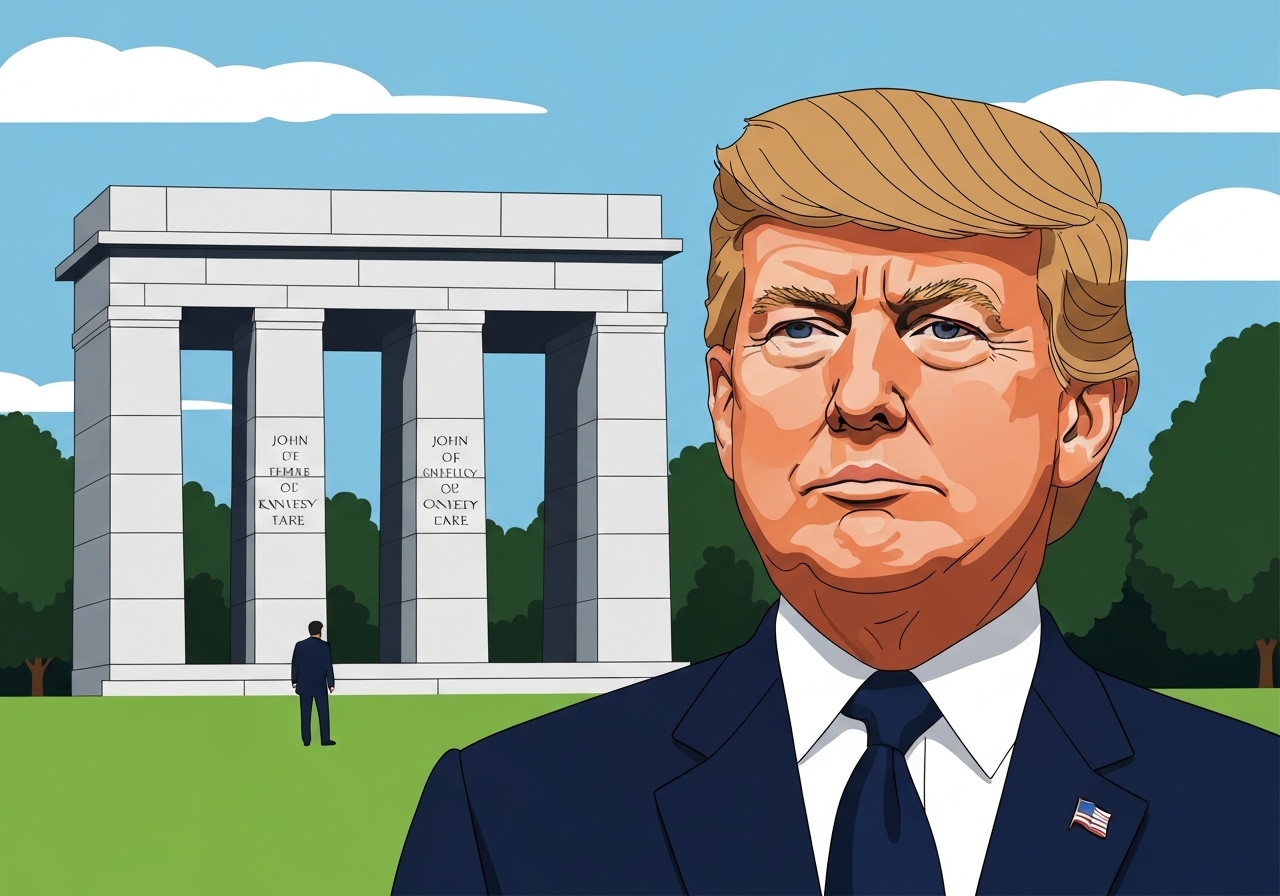
Lead: On Dec. 19, 2025, workers affixed new lettering to the John F. Kennedy Center for the Performing Arts in Washington, D.C., after the center’s board of trustees voted to add President Donald J. Trump’s name to the building. The change followed a unanimous vote by a board whose recent appointees were selected by Trump, who also serves as the board chairman. The facade was obscured with blue tarps while crews installed the new lettering that now reads The Donald J. Trump and The John F. Kennedy Memorial Center for the Performing Arts. Critics contend federal law and some ex-officio congressional trustees say only Congress can alter the name of the federally designated memorial.
Key Takeaways
- Action date: Workers installed Trump’s name on the Kennedy Center facade on Dec. 19, 2025, after a board vote the previous day.
- Board vote: The board of trustees voted unanimously to add Trump’s name; the board was described in reporting as largely handpicked by Trump, who is its chairman.
- Legal constraint: Congress designated the center as a living memorial to John F. Kennedy in 1964 and the statute includes language limiting use of the site as a memorial to others.
- Visible change: Blue tarps and scaffolding were used to obscure crews during the lettering installation captured by news photographers.
- Opposition: Some Kennedy family members and Democratic ex-officio board members have objected, asserting only Congress can change the memorial name.
- Precedent: The Kennedy Center is the most recent high‑profile Washington building to receive Trump’s name after other federal institutions have also been renamed in 2025.
Background
The John F. Kennedy Center for the Performing Arts was established by Congress in 1964 as “a living memorial” to the late president, and federal statute from that period sets out the institution’s status and governance. That law framed the center’s mission around performing arts programming and memorial duties tied to Kennedy’s legacy, and it placed the site under a board of trustees with certain statutory limitations. Over time the center has been governed by a mix of presidential appointees, congressional ex-officio members and private donors; board composition and appointments are a recurrent source of scrutiny in Washington. In recent years, changes to the names or dedications of public institutions have become politically charged, prompting debates over statutory authority, custom and precedent.
Board governance matters because the Kennedy Center operates on a hybrid public-private model: while its operations are funded through a combination of federal appropriations and private support, Congress created and described the center by law. That statutory origin is central to the dispute over whether the board can alter the name the legislature set. Political dynamics in 2025 — including the appointment of trustees by a sitting president who is also the board chairman — intensified attention on how decisions are made and whether they align with the original congressional intent. The broader context includes a pattern of renamings and commemorations in the capital that political actors and interest groups often contest.
Main Event
On Friday, Dec. 19, 2025, crews worked on scaffolding across the Kennedy Center’s facade while blue tarps partially covered the columns and lettering areas. Photographs published by wire services show installers putting up letters that complete the building’s new official name: The Donald J. Trump and The John F. Kennedy Memorial Center for the Performing Arts. The timing followed a board meeting the day before in which trustees voted unanimously to authorize the name addition.
Reporters noted that several Democratic members of Congress who serve as ex-officio trustees opposed the board action, arguing that the board lacks the statutory authority to change the memorial’s name. Ray Smock, a former House historian, told reporters that the center’s name was established by law in 1964 and that a change would require congressional action. The center did not provide an on-the-record statement in response to emailed requests for comment on the day of the installation.
Some members of the Kennedy family have expressed opposition to the renaming, while supporters of the board’s decision framed the change as recognition of Trump’s role in the center’s recent governance. The event intensified partisan commentary on social media and prompted immediate calls from critics for a legal review of the board’s authority versus Congress’s prerogative over memorials established by statute. The public spectacle on the building’s facade quickly became a focal point for both protest and praise in different quarters.
Analysis & Implications
Legally, the central question is whether the 1964 statute that created the Kennedy Center gives Congress sole authority to name and define the memorial, or whether the board’s governance powers include changing exterior signage. If the statute explicitly forbids the board from assigning the site as a memorial to another individual, as reporting indicates, then the board action could be vulnerable to legal challenge and might ultimately require congressional clarification or amendment to stand. Courts typically defer to clear statutory text, so the phrasing of the 1964 law will be pivotal.
Politically, the renaming amplifies debates about the use of public institutions for political branding. Placing a sitting president’s name on a federally designated memorial breaks with many longstanding norms in Washington and may prompt a legislative response, either by members of Congress seeking to preserve the statute’s original intent or by those who would endorse the board’s move. The episode is likely to become a touchstone in congressional hearings, fundraising appeals and gubernatorial or presidential politics ahead.
Practically, the change could affect the Kennedy Center’s relationships with donors, artists and international partners who place value on the institution’s established identity as a memorial to JFK. Some donors and performing artists might reassess affiliations, while others may welcome the new branding; both outcomes could influence programming and fundraising. Internationally, the visible renaming of a bipartisan-era memorial could spark commentary about U.S. institutional norms, though immediate diplomatic consequences are likely to be limited.
Comparison & Data
| Institution | Founding/Original Law | Governance Constraint | 2025 Action |
|---|---|---|---|
| Kennedy Center | Designated by Congress as a living memorial in 1964 | Statute describes memorial status and limits memorial dedications | Board voted; new exterior lettering installed Dec. 19, 2025 |
| U.S. Institute of Peace | Federal institution with board governance | Subject to federal oversight and statutes | Reportedly renamed to include Trump’s name earlier in 2025 |
The table highlights the key legal distinction: the Kennedy Center’s origin in a 1964 law that frames it explicitly as a memorial is a unique constraint not present for all federal facilities. That statutory foundation is central to interpreting whether a board action alone suffices to alter the memorial’s designation. Reporting identifies the Kennedy Center as the most recent of several institutions in 2025 to add Trump’s name, but the legal pathways for each change differ by institution.
Reactions & Quotes
“The Kennedy Center was named by law. To change the name would require a revision of that 1964 law,”
Ray Smock, former House historian (email)
“a living memorial to John F. Kennedy”
Congressional statute establishing the Kennedy Center (1964)
These statements capture the core dispute: one side points to statutory language and historical intent; the other emphasizes institutional autonomy exercised by the board. News coverage has circulated both perspectives while legal experts note the issue may ultimately be resolved by Congress or the courts.
Unconfirmed
- Whether Congress will move to amend the 1964 statute to explicitly permit or prohibit the board action remains unannounced and would require separate legislative action.
- At the time of reporting, no formal court challenge to the board’s name addition had been filed publicly; legal filings or notices could appear after the installation.
- Details about internal board deliberations and legal memos justifying the action have not been released publicly and are not independently verified.
Bottom Line
The installation of Donald Trump’s name on the Kennedy Center’s facade on Dec. 19, 2025, marks a highly visible and contested change to a federally created memorial. The move raises a clear legal question about the interplay between a 1964 congressional statute that established the center and the governance authority asserted by the board of trustees. Expect political fallout: members of Congress, the Kennedy family, civil society groups and possibly the courts will likely press for clarification or remediation in the coming weeks and months.
For readers tracking institutional norms in Washington, the episode is significant because it tests the limits of board autonomy over federally established memorials and could set a precedent for how names and dedications are managed going forward. The most immediate items to watch are any congressional responses, legal filings, and statements from the Kennedy Center and Kennedy family that clarify intent or outline next steps.
Sources
- PBS NewsHour — Photos: Kennedy Center adds Trump’s name to memorial Congress created for JFK (public broadcaster; news report with photos)
- Reuters (newswire/photo service) (newswire reporting and photography credited in coverage)
- The Associated Press (newswire; contributed reporting referenced in coverage)
- Congress.gov (official U.S. legislative database — consult for the 1964 statute establishing the Kennedy Center)