
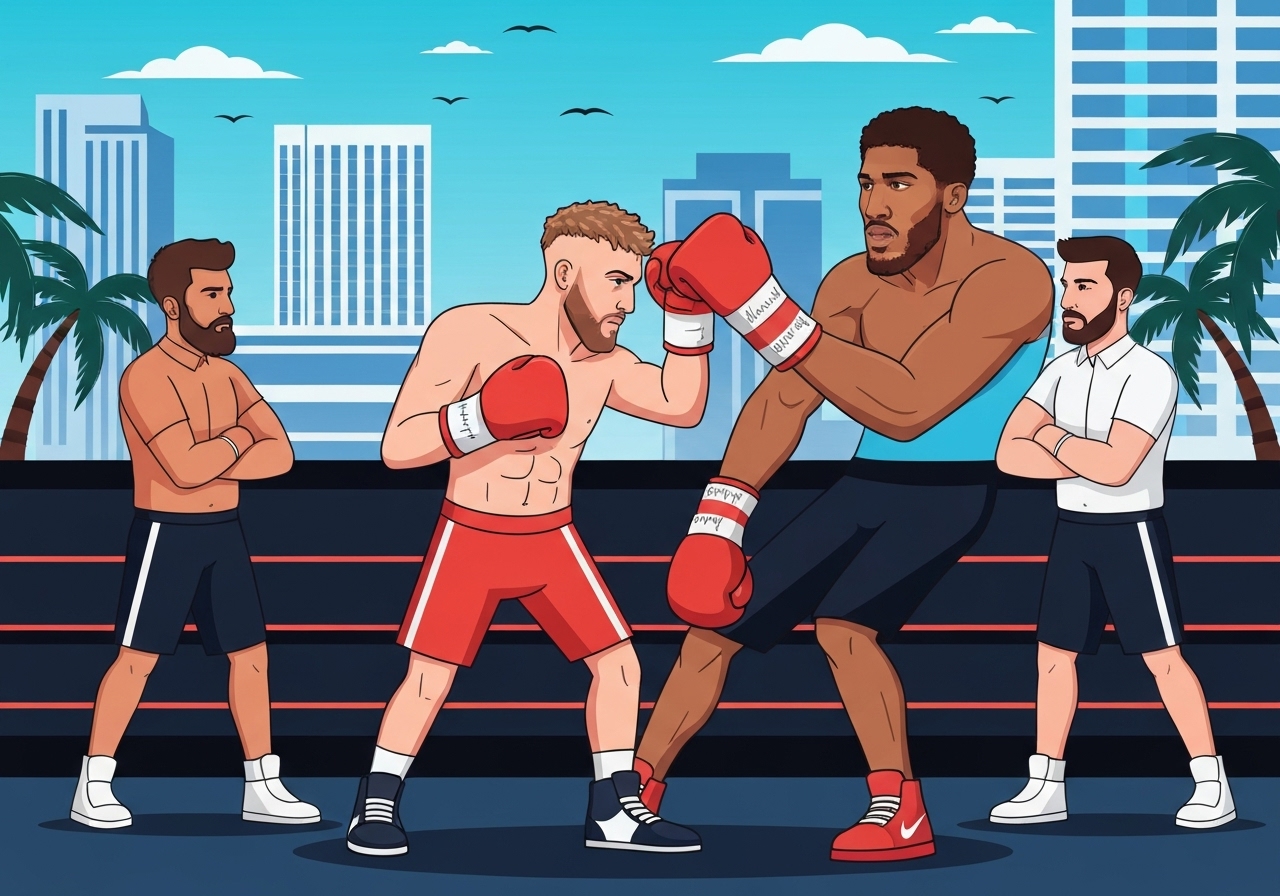
Lead: On 19 December 2025 at the Kaseya Center in Miami, Anthony Joshua defeated Jake Paul by sixth-round knockout in an eight-round, non-title heavyweight contest that capped a star-studded Netflix card. Joshua, 36, entered the ring at 243.4lb and imposed a physical advantage over Paul, 28, who weighed 216.6lb at the official weigh-in. The bout—contested with 10oz gloves and a contractual 245lb cap for Joshua—renewed debate about safety and spectacle in modern boxing while delivering a decisive inside-the-ring outcome.
Key takeaways
- Result: Anthony Joshua won by knockout in round six after Paul was down multiple times in rounds five and six.
- Weights and equipment: Joshua weighed 243.4lb; Paul weighed 216.6lb; the fight used 10oz gloves and included a 245lb contractual limit for Joshua.
- Experience gap: Joshua is a two-time unified heavyweight champion and Olympic gold medallist with a long run at elite level; Paul had 13 professional bouts, many against non-specialist opponents.
- Commercial scale: The card was a major streaming event on Netflix, and industry reports put the combined purse near $184m (£137.4m).
- Betting market: Sportsbooks reported heavy money backing Paul as the speculative choice, with some books showing roughly 80–86% of money wagered on him at long odds before the fight.
- Undercard significance: Four women’s world-title fights featured on the bill, including successful defences by Alycia Baumgardner, Cherneka Johnson and Caroline Dubois.
- Safety concerns: Observers raised issues during fight week about the nearly 30lb disparity and Paul’s limited experience against heavyweight opposition.
Background
The matchup sits at the intersection of two trends in contemporary boxing: the sport’s traditional elite pathway, represented by Joshua’s Olympic pedigree and multiple world-title campaigns, and the commercial, platform-driven variant embodied by Paul’s ascent from social media celebrity to crossover fighter. Joshua has competed in 13 world-title fights and carried heavyweight belts on two occasions; his credentials contrast sharply with Paul’s 13-fight professional résumé, which includes contests against retired MMA stars, former champions past their primes and entertainment-first events.
Promoters packaged the bout as a global streaming spectacle—an eight-round main event engineered for maximum viewership rather than for championship stakes. That commercial framing, backed by a reported nine-figure Netflix investment, revived familiar questions about competitive legitimacy and athlete safety when a seasoned, larger heavyweight faces a much smaller, less experienced opponent. Critics and parts of the boxing community pointed to historical precedents where money and novelty trumped competitive balance.
Main event — how it unfolded
The ringwalks underscored the contrasting identities: Joshua entered to a mixture of cheers and jeers in camo trunks and a purposeful walk, while Paul followed amid theatrics and high-profile entourage members. Early rounds were tactical; Paul used lateral movement and clinches to frustrate the bigger man, and Joshua worked to close distance while probing for power shots. Action volume was low in the opening minutes, and judges’ unofficial tallies from ringside observers had Joshua narrowly ahead after the early rounds.
As the contest progressed, Joshua began to land more telling blows. Rounds three and four saw Joshua find openings to the body and head that visibly affected Paul, who increasingly adopted survival tactics—tying up and seeking respite on the ropes. In round five Paul was dropped twice but beat the count both times; he appeared fatigued and was saved by the bell after Joshua poured on pressure in the closing moments.
Early in round six Paul went down again and rose, but a follow-up sequence left him unable to beat the count on a second knockdown. The referee stopped the contest, awarding Joshua a sixth-round knockout. The stoppage ended a billed spectacle and delivered a clear result that highlighted the physical mismatch many had warned about during fight week.
Analysis & implications
Sporting legitimacy: The outcome reinforced a central sporting conclusion—size, power and elite-level ring experience remain decisive in heavyweight boxing. Joshua’s ability to convert gradual accumulation of damage into a finish is consistent with his history at the division’s top levels and underscores the limits of platform-driven upsets when matched against proven elite opposition.
Safety and governance: The near-30lb weight gap and Paul’s limited heavyweight mileage rekindled debate about sanctioning, matchmaking standards and the ethical duty promoters and regulators owe to fighters. Contractual measures such as Joshua’s 245lb cap and the choice of 10oz gloves did not quiet all concerns, and this fight will likely be cited in future discussions about where lines should be drawn between commercial spectacle and athlete welfare.
Commercial fallout: The bout’s streaming scale—backed by Netflix and a reported combined purse in the region of $184m—illustrates how entertainment platforms can alter incentives in boxing. Big-money events of this kind may continue to bypass traditional competitive hierarchies if they reliably generate subscribers, pay-per-view buys or betting volume, which in turn pressures governing bodies and broadcasters to accommodate them.
Comparison & data
| Item | Jake Paul | Anthony Joshua |
|---|---|---|
| Age | 28 | 36 |
| Weigh-in | 216.6 lb | 243.4 lb |
| Gloves | 10 oz (heavyweight standard for this bout) | |
| Professional context | 13 pro fights; largely non-elite opposition | Multiple world-title campaigns; 13 world title fights |
The table highlights the physical and experiential gap that framed much of the pre-fight commentary. While boxing accepts weight bands and catch-weights in many circumstances, the combination of a substantial mass differential and a sharp experience gap focused attention on whether the pairing was appropriate for an eight-round heavyweight contest.
Reactions & quotes
Official and expert voices ranged from celebratory to critical, reflecting the bout’s dual identity as sport and spectacle.
“I give myself an A-plus,”
Alycia Baumgardner, after retaining her junior lightweight titles on the same card
Baumgardner’s remark—off the main card—captured an athlete’s satisfaction at professional standards on a night otherwise dominated by questions about matchmaking and spectacle.
“This fight sits inside a longer tradition where novelty, money and willing sanctioning bodies have complicated boxing’s integrity,”
Sean Ingle / The Guardian (column)
Ingle’s critique, published alongside live coverage, framed the Joshua–Paul pairing as part of a recurring tension in the sport between commercial opportunity and competitive legitimacy.
Unconfirmed
- Reports that Drake placed a $200,000 bet on Paul are described in contemporary coverage as appearing to be true but remain based on social-media and secondary reporting rather than an official betting-platform release.
- Exact, fully audited purse splits between fighters and distribution of ancillary revenues (streaming/licensing) have been reported around $184m combined but have not been published in a single, verifiable ledger accessible to the public.
- Long-term career consequences for both men—beyond immediate rankings and marketability—are subject to interpretation and will depend on subsequent matchmaking and official sanctioning decisions.
Bottom line
The sixth-round knockout clarified what many observers expected on paper: an experienced, heavy-hitting former world champion can impose outcomes on a less-proven, lighter opponent in a high-profile, short-form bout. The result will be rightfully celebrated by Joshua’s team as a reminder of his power and finishing ability, and it restores a measure of legitimacy to his post-Dubois trajectory.
At the same time, the event will keep alive pressing questions about boxing’s commercial path. When streaming platforms bankroll blockbuster cards that pair proven elite fighters with crossover stars, regulators, promoters and fans must weigh the entertainment value against the sport’s safety norms and competitive integrity. Expect further debate, policy discussion and close scrutiny of matchmaking standards in the months ahead.