
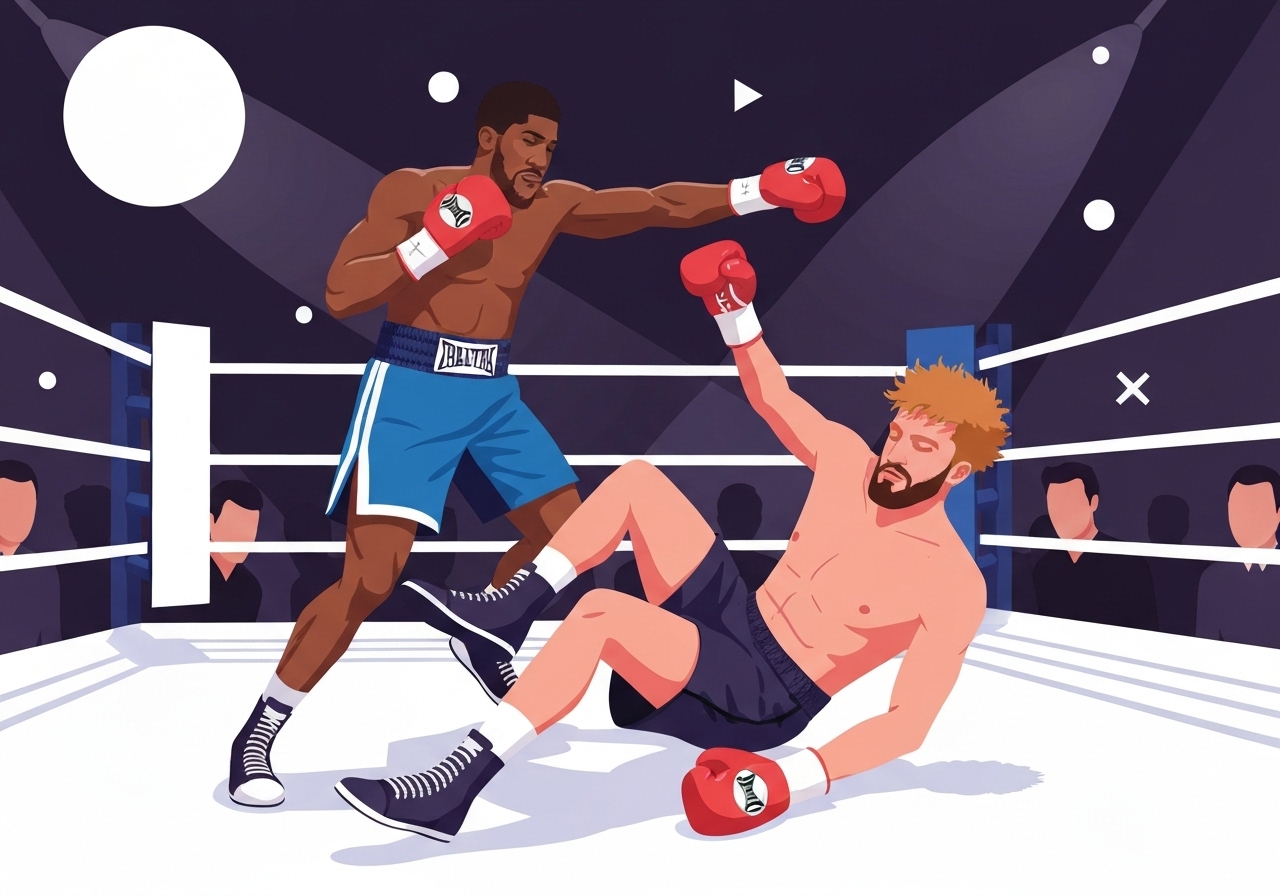
Lead: On December 20, 2025, in Miami, former unified heavyweight champion Anthony Joshua stopped Jake Paul in the sixth round, restoring — at least temporarily — conventional expectations about professional boxing. The bout ended when the referee halted the contest after a decisive right hand from Joshua that left Paul unable to continue. The result reinforced questions about the limits of influencer-driven boxing while giving Joshua a high-profile win after a long absence from the ring.
Key Takeaways
- Anthony Joshua won by referee stoppage in round six on Dec. 20, 2025, improving his record to 29-4 with 26 KOs.
- Jake Paul, listed at 12-2 entering the fight, was knocked down multiple times and left the arena with a double jaw fracture, according to his social post and team statements.
- Joshua had not fought since a fifth-round stoppage loss to Daniel Dubois in September 2024, marking roughly a 15-month ring layoff before this bout.
- The fight was presented on Netflix and staged in Miami, with ringwalks beginning near 11:30 p.m., lending the event a late-night, pay-per-view-style atmosphere.
- Paul showed improved durability versus prior opponents by lasting through five rounds of sustained pressure from a seasoned heavyweight.
- Promoters and camps are discussing a possible February 2026 outing for Joshua in Saudi Arabia as a tune-up ahead of a long-anticipated match with Tyson Fury.
Background
Anthony Joshua arrived at this matchup as a decorated but recently inconsistent figure in heavyweight boxing — an Olympic gold medalist and former WBO, WBA and IBF titleholder whose résumé includes high-profile defeats and comebacks. His loss to Daniel Dubois in September 2024 revived concerns about his chin and stamina, and it left observers wondering whether Joshua still belongs atop the division. The Miami fight was framed as both a commercial attraction and a chance for Joshua to reconnect with a global audience, many of whom know him more from highlight reels and championship belts than from recent wins.
On the other side, Jake Paul has built a boxing profile after rising to fame on social media, parlaying his platform into a professional ring career that mixed careful matchmaking with occasional step-ups in competition. Critics have long argued that celebrity-driven bouts blur lines between entertainment and sport, while advocates note the promotional boost and new viewers those contests bring. Promoters emphasized spectacle in the buildup, but both camps insisted the bout would be genuine and contested under standard professional rules.
Main Event
The opening rounds played out as a tactical mismatch of styles: Paul used lateral movement and the full space of the ring to avoid Joshua’s forward pressure, landing some counters early and even scoring the fight’s first punch. Joshua, mindful of his own ring rust, was patient and focused on cutting off the ring rather than forcing flashy exchanges. As the fight progressed, Joshua’s size and strength began to tell — Paul’s mobility diminished and his legs showed fatigue.
There were several notable moments of physicality: in the fourth round a tumble left Joshua atop Paul with a knee near Paul’s midsection, prompting a longer break from the referee; in the fifth, Joshua landed straighter, more hurtful shots that visibly affected Paul. Although Paul repeatedly rose from trouble and displayed resilience, the accumulation of punishment culminated early in the sixth round when a heavy right hand put Paul down and the referee waved the contest off.
In the ring after the stoppage Paul said, “My jaw is definitely broke,” a comment echoed by his entourage and later confirmed by images and a social-media update indicating a double jaw fracture. Joshua acknowledged the performance was far from his best, praising Paul’s heart while signaling his own desire to resume higher-stakes fights in 2026.
Analysis & Implications
For Joshua, the victory is multidimensional: it adds a high-profile stoppage to his ledger and reconnects him with mainstream viewers, thereby rebuilding marketplace momentum after a difficult period. The win does not erase the concerns raised by prior losses — observers will still scrutinize Joshua’s conditioning and timing — but it does provide a commercially valuable narrative that he can parlay into bigger matchups. Rumored dates and venues for follow-up fights will determine whether this bout functions as a genuine step toward the top of the division or only a high-visibility detour.
For Paul, the fight represents a mixed outcome. He gained credibility by absorbing legitimate heavyweight shots and surviving into the sixth round, an endurance milestone many did not expect. Yet the physical cost was high: a double jaw fracture changes short-term career planning and raises questions about his optimal weight class and readiness for further top-tier opposition. Paul’s camp has signaled a plan to move back down to cruiserweight after recovery, which would reflect a reassessment of where he can be most competitive.
More broadly, the bout underscores tensions in modern boxing between spectacle and sporting legitimacy. Celebrity boxers bring new audiences and large promotional purses, but repeated mismatches or serious injuries could prompt regulators, broadcasters and established fighters to demand clearer standards on matchmaking and medical oversight. Promoters will weigh that commercial upside against potential reputational and regulatory costs when planning future crossover events.
Comparison & Data
| Fighter | Record before fight | KOs |
|---|---|---|
| Anthony Joshua | 29-4 | 26 |
| Jake Paul | 12-2 | (varied opponents) |
The basic ledger highlights a clear experience gap: Joshua’s career reflects world-title campaigns against top heavyweights, while Paul’s record was built with a mix of boxing and celebrity-driven matchups. The stoppage in round six is consistent with Joshua’s power profile (26 career KOs) and illustrates the challenge for a lighter, less experienced fighter to absorb sustained power from a proven heavyweight.
Reactions & Quotes
Public and official reactions were immediate and varied. Below are representative excerpts with context.
“It wasn’t the best. It took a bit longer than expected. Jake Paul did well tonight; he got up time and again.”
Anthony Joshua, in-ring comments
Joshua framed the win modestly, acknowledging imperfections while underscoring the legitimacy of the victory and signaling readiness for future, higher-profile opponents.
“My jaw is definitely broke.”
Jake Paul, post-fight
Paul’s blunt in-ring remark captured the physical toll of the contest and was followed by social-media posts and team confirmations about the injury and his immediate medical care.
“He lost because of the size difference, not the skill difference.”
Nakisa Bidarian, Most Valuable Promotions
Paul’s promoter emphasized the physical mismatch and suggested the result was attributable to scale rather than a clear technical deficiency, a framing meant to preserve Paul’s standing while he recovers.
Unconfirmed
- Reports linking a specific February 2026 Saudi card as Joshua’s next scheduled fight remain discussions and have not been officially announced by Joshua’s team or a promoter.
- Details about the precise medical prognosis and timeline for Jake Paul’s full return, beyond the Instagram-confirmed double jaw fracture, have not been independently verified.
Bottom Line
Anthony Joshua’s sixth-round stoppage of Jake Paul on Dec. 20, 2025, was both a sporting result and a cultural milestone: a conventional heavyweight stoppage in a match that originated from an unconventional pairing. The outcome boosts Joshua’s marketability and buys him time to pursue higher-stakes fights while forcing Paul to confront the medical and career implications of a serious injury.
Looking ahead, the significance of this bout will depend on what comes next: whether Joshua faces a substantive top-tier opponent (notably Tyson Fury, if that fight materializes) and how quickly and fully Paul can recover and recalibrate his boxing path. Regulators, promoters and fans will watch those next steps closely as the sport balances commercial innovation with the traditions and safety standards of professional boxing.
Sources
- The New York Times — (news report)
- Netflix Sports (Twitter) — (broadcaster/social post)
- Jake Paul (Instagram) — (athlete social post)