
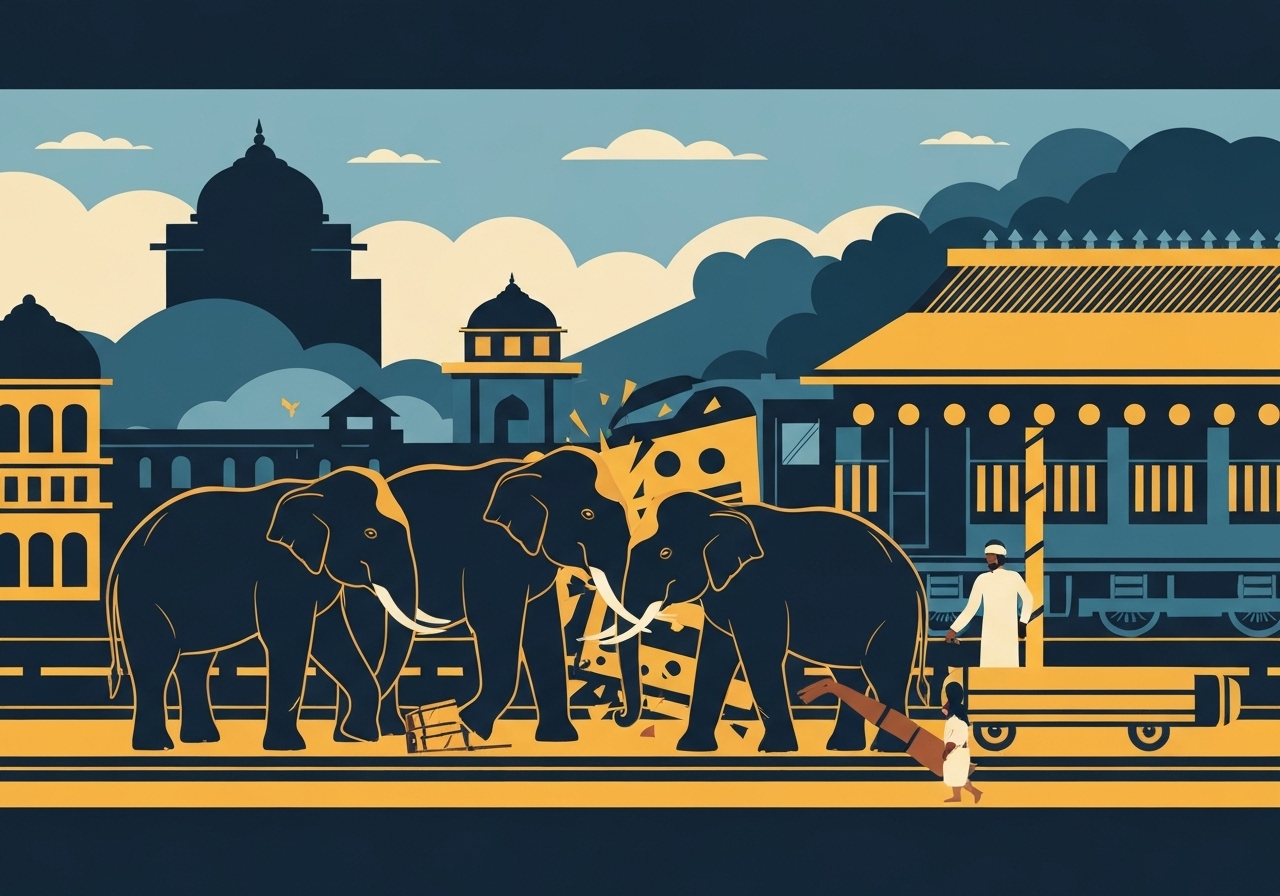
Lead: On Saturday in Assam, northeastern India, a high-speed passenger train struck a herd of wild Asiatic elephants as they attempted to cross railway tracks, killing seven animals and injuring one. The train driver reported seeing a herd of about 100 elephants and applied emergency braking, but several animals were still hit. Five coaches of the service derailed; none of the roughly 650 people aboard were hurt. Authorities later confirmed one initially reported dead elephant was alive but wounded.
Key Takeaways
- Seven wild Asiatic elephants were killed and one injured in a train collision on Saturday in Assam, northeastern India.
- The train driver observed a herd of about 100 elephants before impact and engaged the emergency brakes, according to Indian Railways spokesperson Kapinjal Kishore Sharma.
- Five coaches derailed on impact; approximately 650 passengers were aboard and no passenger injuries were reported.
- Around 200 passengers from the derailed coaches were transferred by rail to Guwahati; the remaining coaches were detached and the service resumed toward New Delhi.
- The collision occurred outside a designated elephant corridor, officials said; Assam hosts India’s second-largest elephant population and the largest in North India.
- National data show 81 wild elephants were killed in train collisions across India between 2019 and 2024, per the Ministry for Environment, Forest and Climate Change.
Background
Assam is a state with extensive forested tracts and hosts one of the country’s largest concentrations of wild Asiatic elephants. Decades of agricultural expansion, road and rail development, and deforestation have fragmented traditional elephant ranges and increased encounters between elephants and infrastructure. Authorities and conservationists have identified formal elephant corridors—stretches of habitat prioritized to allow safe movement—yet many crossings still intersect transport routes where animals and trains meet unexpectedly. Human-elephant conflict in Assam is among the highest in India, producing both crop and property loss and occasional fatalities for people and wildlife.
Railway expansion across the Northeast and other regions has raised concern among conservationists and planners because tracks can bisect migration routes and foraging areas. The Indian government and state agencies have documented collisions as a recurring hazard; official figures from 2019–2024 record 81 wild elephants killed by trains nationwide, underscoring a persistent problem. Various mitigation measures—speed restrictions, warning signage, underpasses, and technology trials—have been proposed or piloted, but implementation and enforcement have varied by region. Local communities, railway authorities, and conservation bodies remain key stakeholders in crafting workable protections that balance transport needs and wildlife safety.
Main Event
The incident took place on Saturday when a high-speed passenger service encountered a herd attempting to cross the track in Assam. The driver reported seeing roughly 100 elephants and used the emergency brakes before impact; despite that response, several animals were struck. Initial reports cited eight fatalities, but subsequent on-site checks found one elephant alive with injuries, revising the death toll to seven. Debris and remains on the track complicated rescue and clearance operations.
Five coaches of the train derailed after the collision. Indian Railways spokesman Kapinjal Kishore Sharma said that none of the approximately 650 passengers aboard were injured, and that coaches which remained intact were decoupled so the train could continue toward New Delhi. About 200 passengers from the derailed coaches were transferred to Guwahati on another service. Local rail services to upper Assam and other northeastern routes were disrupted while teams cleared the line and removed animal remains.
Officials noted the collision did not occur at an area designated as an elephant corridor, suggesting either an unregistered crossing point or a change in elephant movement patterns. Railway staff, forest department teams and local police were involved in site management, clearing wreckage and documenting the scene for investigation. Authorities are collecting evidence to reconstruct timings and to assess possible preventive steps for that stretch of track. Local conservation groups visited the site and demanded a review of rail operations in known elephant ranges.
Analysis & Implications
Transport routes that cut through or close to elephant habitat create recurrent collision risks for both animals and trains. High-speed services have less margin to avoid large-bodied wildlife once visibility is limited or animals move suddenly onto tracks. Even with emergency braking, stopping distances for heavy passenger trains at speed often exceed the available sightline, making avoidance unlikely in some encounters. This incident underscores the tension between rail connectivity and wildlife protection across rapidly developing regions.
The loss of seven animals in a single event is significant for local elephant populations and for broader conservation goals; Asiatic elephants reproduce slowly, and each mortality can have outsized effects on small, fragmented herds. Economically, derailments and service interruptions carry direct costs for rail operators and passengers, and indirect costs through emergency response, investigations and potential reputational damage. Repeated incidents also heighten local public concern and can strain relations between rail authorities and communities that depend on both wildlife and reliable transport.
Policy measures that reduce future collisions can include better mapping of movement corridors, reduced speeds in high-risk stretches, physical barriers where appropriate, and deployment of detection systems. Emerging tools—motion sensors, thermal cameras, and artificial-intelligence alerts—are being trialed in parts of India and elsewhere to warn drivers and managers in real time. However, technology alone is not a panacea: long-term solutions require integrated land-use planning, community engagement, and funding to retrofit legacy rail lines that now run through animal landscapes.
Comparison & Data
| Measure | Count |
|---|---|
| Elephants killed in this incident | 7 (plus 1 injured) |
| Elephants killed by trains across India (2019–2024) | 81 (total, Ministry data) |
This table places the Assam collision in national context: seven deaths in one event represent a substantial fraction of single-incident mortality compared with aggregated national totals for multiple years. The Ministry for Environment, Forest and Climate Change’s figure of 81 deaths from 2019–2024 signals that train strikes are an ongoing national conservation challenge rather than an isolated regional problem. Comparing single-event losses to multi-year totals highlights both the acute impact of specific collisions and the chronic pressure on elephant populations from linear infrastructure.
Reactions & Quotes
Indian Railways provided operational details and immediate passenger outcomes while noting ongoing clearance and investigation efforts. The spokesman described the on-site response and actions taken to restore the service.
“We delinked the coaches which were not derailed, and the train resumed its journey for New Delhi,”
Indian Railways spokesperson Kapinjal Kishore Sharma
Rail officials emphasized passenger safety—no injuries were reported among the roughly 650 people onboard—and the logistical steps to move affected travelers to Guwahati. They also signalled that an internal review and coordination with forest authorities would follow to determine causes and possible mitigation.
Conservation groups and local media highlighted the frequency of such collisions and called for faster adoption of protective measures. Observers pointed to long-term habitat fragmentation and urged mapping and enforcement of corridors to prevent repeat incidents.
“This incident is part of a worrying pattern of rail-wildlife collisions in the region,”
Regional conservation group (local media statement)
Environmental authorities referenced national data to frame the incident as part of a larger trend that requires cross-sector response. Forest department sources said they would examine fence lines, potential signage, and wildlife movement records to identify immediate and medium-term actions for the affected stretch.
Unconfirmed
- Exact classification of the crossing: authorities state the collision was outside a designated corridor, but independent mapping of elephant paths for that specific location is pending verification.
- Precise train speed at the moment of impact and whether additional operational factors contributed to the collision remain under investigation.
- Reports of the initial death toll (eight) were corrected after follow-up checks; further forensic details on timing and which animals were struck are still being compiled.
Bottom Line
The Assam collision that killed seven elephants and injured one is both a localized tragedy and a symptom of a broader conflict between expanding transport infrastructure and wildlife ranges in India. Although no passengers were hurt, the event caused derailment, service disruptions and a significant loss for elephant conservation in a state that hosts large but increasingly fragmented populations. This incident underscores that engineering responses (speed restrictions, fencing) and technology (sensors, AI detection) need to be paired with land-use planning and community engagement to reduce future collisions.
Watch next for official investigation findings on speed and visibility at the site, any short-term operational changes by Indian Railways in that corridor, and announcements on mitigation funding or faster rollout of detection pilots. Long-term progress will depend on coordinated action across rail authorities, state forest departments and conservation organizations to align transport needs with wildlife protection.
Sources
- DW — international broadcaster (original report)
- Associated Press — international news agency (on-driver statement cited)
- NDTV — Indian news broadcaster (local reporting on service disruption)
- Press Trust of India / national agencies — national news agency reporting casualty revision
- Ministry of Environment, Forest and Climate Change — Government of India (data on train-elephant collisions 2019–2024)