
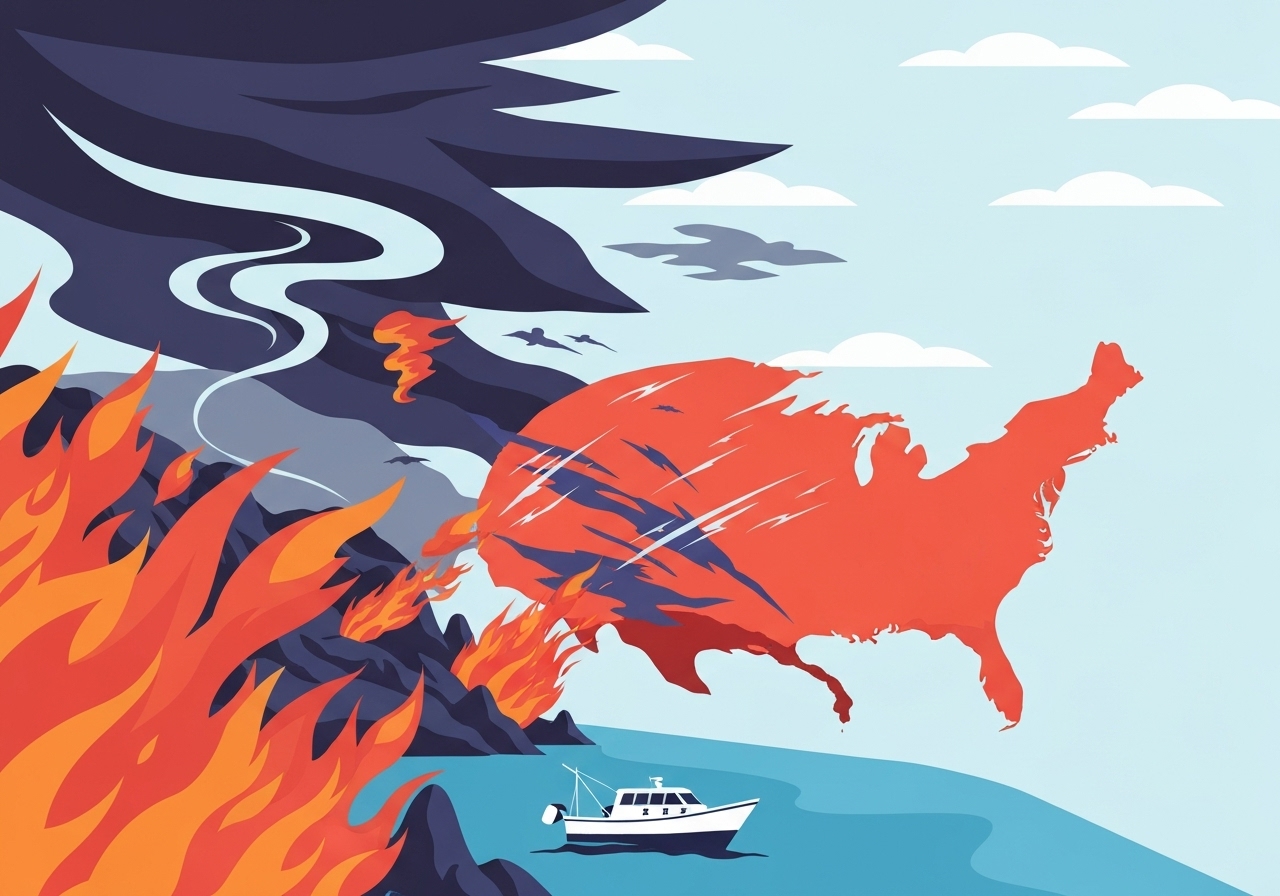
Lead: A broad storm system moving across the United States on Friday threatens holiday travel from coast to coast. Gusty winds and steady rain will impact the Northeast and the West Coast, while parts of the Rockies and the High Plains face extreme fire conditions. Airport delays and lake-effect snow are possible in the Northeast, and Red Flag Warnings remain in place across sections of Colorado, Wyoming and the Plains. The weather pattern is expected to ease in many areas over the weekend, but risks will persist in localized pockets.
Key Takeaways
- Large cross-country storm is moving east on Friday, producing rain and gusts up to about 60 mph across parts of the Northeast.
- Strongest wind threats are focused on Appalachia, New England and coastal Maine, with travel impacts expected from Washington, D.C., to Boston through the evening.
- Red Flag Warnings cover areas around Denver (rare “Particularly Dangerous Situation” designation) with sustained winds 45–55 mph and gusts reported as high as 80–110 mph in some exposures.
- Additional Red Flag Warnings extend to the Texas Panhandle, west-central Nebraska, and other parts of Colorado and Wyoming with gusts near 50 mph under dry conditions.
- West Coast storm will drop 1–4 inches of rain in western Oregon, southwest Washington and northwest California Friday, with a Flood Watch through 4 a.m. Saturday for coastal zones.
- Weekend precipitation: an additional 2–6 inches of rain expected from Washington down through California, and some mountain resorts have paused early-season operations.
- Lake-effect snow will begin near the northern Great Lakes area before conditions moderate later Friday evening.
Background
The current pattern features a strong low-pressure system that has tracked from the northern Plains into the Great Lakes and is now sweeping moisture and frontal energy toward the Northeast. Such cross-continent storms commonly produce a wide range of weather across different regions — from heavy rain and coastal gusts to dry, windy conditions favorable for wildfire spread on the lee side of the mountains. In the West, a series of Pacific storms has already saturated some coastal basins while leaving inland valleys dry, creating a volatile contrast between moisture and wind. Local authorities and the National Weather Service have issued a mix of Flood Watches, Red Flag Warnings and wind advisories to reflect these divergent threats.
Holiday travel typically raises exposure because more people are on the road and in airports, compressing the margin for weather-related disruption. Airports in the Northeast are particularly vulnerable to delays from wind, rain and the onset of lake-effect snow, where localized bands can quickly reduce visibility and force deicing work. Meanwhile, utility operators in fire-prone regions have taken precautionary measures after earlier outages and elevated fire risk in Colorado left tens of thousands without power. Mountain resorts, which rely on both safe access and snowpack development, balance closures against the need to protect guests and staff.
Main Event
On Friday, northeasterly travel corridors face sustained rain and strong gusts as the frontal system pushes through. Forecasts indicate gusts approaching 60 mph in exposed areas of Appalachia and coastal northeastern states, with conditions most acute from coastal Maine down through southern New England. Transportation officials warned that airport schedules could see delays and cancellations, and state transportation departments advised motorists to plan for slower travel and potential detours.
Across the Rockies and adjacent Plains, markedly dry air combined with strong downslope winds has driven fire danger to critical levels. Around the Denver metro area, the National Weather Service issued a rare “Particularly Dangerous Situation” Red Flag Warning citing sustained winds of 45–55 mph and localized gusts reported between 80 and 110 mph on exposed ridges. Fire crews and county emergency managers have been put on heightened alert given the potential for very rapid fire spread under these conditions.
Along the West Coast, a lingering Pacific system continues to move southward, producing an initial 1–4 inches of rain across western Oregon, southwest Washington and northwest California on Friday. Coastal rivers and streams are expected to rise, prompting a Flood Watch through 4 a.m. Saturday for portions of coastal Oregon and Washington. Some mountain resorts in California — including Boreal Mountain and Soda Springs — paused operations temporarily, citing safety concerns and staff preparations during the storm.
Analysis & Implications
The concurrent hazards — high winds in the interior West and heavy rain on the coast — illustrate how a single synoptic pattern can produce very different threats across the country. For emergency managers, the challenge is allocating limited response resources across wildfire-prone zones and flood-prone coastal watersheds. High wind events in dry terrain significantly increase the odds of large, fast-moving wildfires, which can require mass evacuations and lead to prolonged utility outages.
Economically, travel disruptions over a major holiday can ripple through airlines, freight networks and local tourism. Airport delays, even if localized, often cascade through hub-and-spoke schedules, stranding passengers and complicating baggage handling. For mountain communities, early-season storms that temporarily close resorts also aid snowpack development, which has downstream benefits for winter recreation and water supply — a trade-off operators acknowledged in public statements.
From a public-safety standpoint, communication is key. Agencies must convey evolving conditions without overstating uncertain forecasts. The risk profile changes quickly: gusts and fire behavior depend on fine-scale terrain and fuel moisture, while flood impacts hinge on the timing and intensity of precipitation. Officials advising the public have emphasized preparedness measures — alternate routes, travel buffers, and readiness to follow evacuation orders if directed.
Comparison & Data
| Region | Primary Threat | Forecasted Peak | Warning |
|---|---|---|---|
| Northeast (D.C. to Boston) | Rain, strong gusts | Gusts up to ~60 mph | Wind advisories, airport delays possible |
| Denver area & Rockies | Extreme wildfire spread risk | Sustained 45–55 mph; gusts 80–110 mph | Red Flag Warning (Particularly Dangerous Situation) |
| Coastal OR/WA/CA | Heavy rain, coastal flooding | 1–4 in Friday; +2–6 in weekend | Flood Watch through 4 a.m. Sat |
The table above condenses the main numeric threats for Friday into a single snapshot. These values are taken from National Weather Service guidance and regional forecasts; local variations are possible, especially in mountainous terrain and narrow coastal river basins. Travelers and residents should consult county-level advisories for the most actionable information.
Reactions & Quotes
Officials in the Denver metro area and nearby counties publicly urged residents to limit outdoor activities and to secure property because of the unusually severe wind forecast. Emergency managers noted that any human-caused ignition under such conditions could produce a fast-moving incident.
“The combination of dry fuels and those wind speeds can produce very dangerous fire behavior in minutes,”
Local emergency management official
On the West Coast, resort operators framed the closures as precautionary while noting the longer-term benefit of the moisture coming in. Staff described weekend work to ready terrain and facilities for reopening when it is safe.
“This storm will help build our snowpack; our teams are working throughout to protect terrain and prepare for reopening,”
Boreal Mountain (resort statement)
Transportation authorities in the Northeast advised travelers to check airline and road conditions before departing, emphasizing that lake-effect bands could form and produce sudden localized disruptions.
“Expect possible delays at major airports today as the frontal band moves through and lake-effect snow sets up,”
Regional transportation official
Unconfirmed
- Reports of specific wind gust measurements above 110 mph at populated elevations remain preliminary until verified by official observing stations.
- Claims of widespread, long-duration power outages tied directly to this event are being assessed; some outage reports relate to precautionary disconnections in high-risk areas.
- Projections of exact river crest levels during the Flood Watch are model-dependent and may change with shifts in storm track and rainfall timing.
Bottom Line
For holiday travelers, the key message is to plan for disruption and allow extra time. The Northeast should expect rain and strong gusts that can delay flights and reduce road travel efficiency, while lake-effect pockets may produce sudden snow bands. In the interior West, unusually strong winds combined with dry fuels present a high wildfire risk that can necessitate evacuations and trigger utility actions.
Those in coastal Oregon and Washington should heed Flood Watches and avoid travel in low-lying areas if rivers rise. Over the weekend the major storm threat will largely shift, but secondary impacts — lingering gusts, localized flooding, and increased fire danger in dry, windy zones — will require continued vigilance. Monitoring official channels for updates and following local guidance remains the best way to stay safe.
Sources
- ABC News (national news outlet reporting summary)
- National Weather Service (official forecasts and hazard warnings)
- Boreal Mountain (Facebook) (resort statement)