
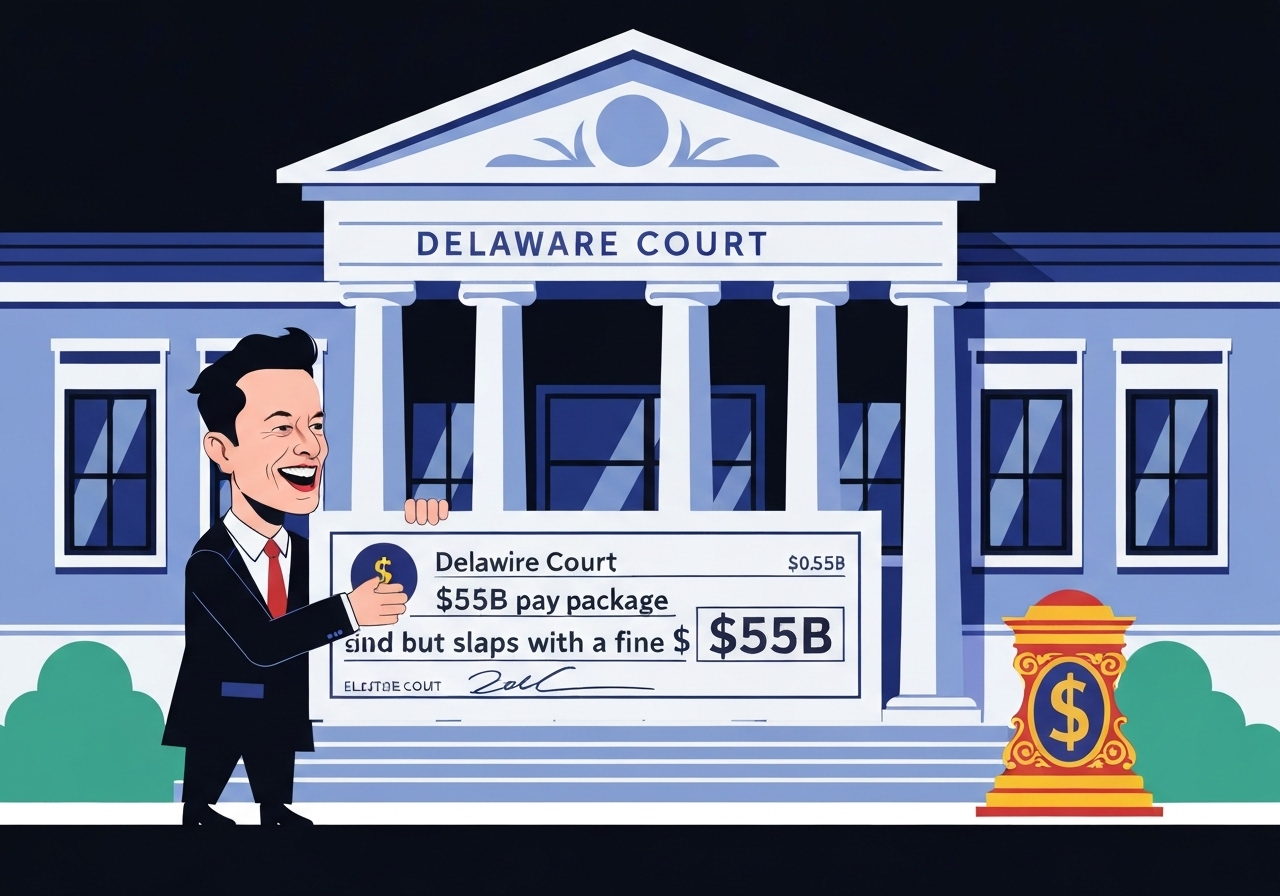
Lead: On December 20, 2025, the Delaware Supreme Court reversed the Court of Chancery and reinstated the 2018 compensation plan that could award Elon Musk roughly $55 billion in option value, a sum that by recent share prices would be worth far more. The high court nonetheless found the award merited only a nominal penalty of $1 and allowed the plaintiffs to recover attorneys’ fees. The decision resolves a multi-year dispute over whether Tesla’s board and proxy disclosures improperly steered shareholders to approve the package, while leaving open sharp questions about corporate governance and shareholder remedies.
Key Takeaways
- The Delaware Supreme Court reinstated the 2018 pay plan that was originally described as a $55 billion package; at recent TSLA share prices the award’s full grant-equivalent can be valued much higher.
- The court awarded Musk nominal damages of $1 but permitted plaintiffs to recover attorneys’ fees, which are expected to amount to hundreds of millions of dollars.
- The original 2018 plan would have diluted other shareholders by roughly 8%; a later shareholder vote produced a separate package that could dilute holders by up to 12% and has a headline potential value reported near $1 trillion.
- An interim board grant of approximately $26 billion was issued without a shareholder vote as a partial restoration; that award is subject to forfeiture depending on final legal outcomes.
- The Court of Chancery originally rescinded the package on grounds tied to proxy disclosures and board independence; the Supreme Court found rescission too extreme given the remedies plaintiffs sought.
- The ruling is widely viewed as the final appellate step in this litigation in Delaware, though it fuels debate about state corporate law, board accountability, and shareholder remedies.
Background
Shareholders approved a performance-based compensation plan in 2018 that tied very large option grants to aggressive operational and market milestones. The package, promoted by Tesla’s board at the time, was described to investors as difficult-to-achieve targets; if all milestones were met, the award’s face value was reported at about $55 billion in 2018 terms. Plaintiffs later sued, alleging the proxy disclosures were materially misleading and that Tesla’s board was insufficiently independent from Musk, creating a conflict in evaluating director action.
The Delaware Court of Chancery found those arguments persuasive and ordered rescission of the award, concluding that the process and disclosures failed to protect shareholder interests. That decision prompted criticism and a broader conversation about Delaware’s business-friendly reputation, and it spurred commentary about whether high-profile litigants and corporate departures could reshape state corporate law. After the Chancery ruling, Tesla’s board held additional internal actions, including a $26 billion grant to Musk and subsequent shareholder votes on related compensation proposals.
Main Event
Late in the appeal, the Delaware Supreme Court determined that the Court of Chancery’s remedy — full rescission — exceeded the relief the plaintiffs had actually requested and that the appellate court could not simply affirm a complete cancellation without an adequate record on a narrower remedy. The Supreme Court therefore reversed the rescission and reinstated the 2018 grant while concluding a lesser remedy was appropriate for the procedural defects the Chancery court identified.
As a remedial matter, the high court awarded nominal damages of $1 to reflect the court’s finding of unfairness in process while rejecting total rescission. In addition, the court permitted the prevailing plaintiffs to recover attorneys’ fees; filings and reporting indicate those fees may reach into the hundreds of millions, though the precise figure will be set in subsequent proceedings.
The opinion emphasized that plaintiffs had sought complete rescission rather than proposing partial rescission or alternative tailored relief, limiting the Chancery court’s available responses. Because the lower court did not fashion a partial rescission, and because the plaintiffs did not brief or seek that remedy, the Supreme Court said it could not endorse a middle-ground cure on the appellate record and therefore restored the plan with a nominal damage award.
Practically, the ruling leaves in place several significant corporate actions taken during the litigation: the $26 billion board grant to Musk and the more recent shareholder-approved package with a reported headline potential near $1 trillion (and dilution estimates up to 12%). How those grants operate in light of attorneys’ fees and potential forfeitures depends on follow-on administrative steps and filings.
Analysis & Implications
The ruling sharpens debates over how Delaware courts balance remedy and principle when corporate procedures are flawed. Plaintiffs argue process failures — misleading proxy materials and weak board independence — can justify undoing an award that transfers vast value. The Supreme Court’s approach signals a reluctance to apply an all-or-nothing cure where plaintiffs did not seek tailored relief, which will influence counsel strategy in future fiduciary litigation: claimants must plead and pursue specific remedial paths or risk losing the chance for partial recovery.
For boards and compensation committees, the decision offers a cautionary note: procedural defects can be recognized by courts while still leaving lucrative awards intact if plaintiffs fail to propose precise remedies. That reduces immediate prospect of wholesale reversal for contested packages, but it does not eliminate reputational or financial consequences — notably, the award of plaintiff fees and continued investor scrutiny. Shareholders and governance investors may press for clearer disclosure, stronger independence safeguards, and voting processes that make remedial arguments easier to fashion if defects arise.
The case also has political and jurisdictional overtones. Delaware has long marketed itself as a predictable forum for corporate law, and critics have argued that high-profile adverse rulings can prompt companies to consider redomesticating to other states. The Supreme Court’s narrower remedial stance may be read either as upholding predictable limits on appellate relief or as a bid to reassure corporations about stable outcomes; both interpretations will be debated by corporate counsel and state policymakers.
Market implications are mixed. Reinstating the award reduces the legal overhang that would have followed a rescission but confirms the plaintiffs’ success in obtaining fee recovery and a judicial finding of procedural unfairness. That combination can depress investor confidence in governance while producing only modest direct cash transfer from Musk (a $1 nominal penalty), leaving the economic reality of dilution and executive capture as the primary investor concern.
Comparison & Data
| Item | Reported Value | Notes |
|---|---|---|
| 2018 approved package | $55 billion (face value) | Board-presented performance package; shareholders approved in 2018 |
| Estimated present-value headline | ~$139 billion (reported) | Value cited at recent TSLA share prices; headline valuation, not guaranteed cash |
| Interim board grant | $26 billion | Issued without new shareholder approval; described as partial restoration |
| Newer shareholder vote | Potential ~$1 trillion; up to 12% dilution | Reported headline figure if all milestones met |
These figures illustrate scale rather than cash-in-hand realities: option grants convert to actual compensation only if milestones are met and depending on vesting, exercise, taxation, and market movements. The court’s $1 nominal damages award does not seek to claw back grant value; instead, fee recovery and corporate process reforms are the concrete judicial outcomes to monitor.
Reactions & Quotes
Official actors and market watchers quickly parsed the opinion. The Supreme Court’s written opinion used terse remedial language to explain its choice.
“We conclude that rescission, as applied here, is too extreme on the record before us and that nominal damages are warranted.”
Delaware Supreme Court (opinion)
Commentators pointed to the court’s emphasis on the scope of relief sought by the plaintiffs as decisive in the outcome.
“The procedural posture of this appeal constrained the chancery court and this court in fashioning a remedy, which is why we see reinstatement alongside nominal damages and fee recovery.”
Delaware Supreme Court (opinion)
Unconfirmed
- Whether the Supreme Court’s remedial choice was influenced by concern over Delaware’s business reputation is a matter of commentary and not proven by the opinion.
- The final tally of plaintiffs’ attorneys’ fees is not yet set; reports estimate hundreds of millions, but the exact figure remains to be determined in subsequent filings.
- The long-term effect of this decision on other states’ redomiciliation choices and legislative responses remains speculative and will depend on legislative and corporate behavior going forward.
Bottom Line
The Delaware Supreme Court’s decision to reinstate the 2018 compensation plan while awarding only nominal damages and permitting fee recovery closes a major appellate chapter but leaves substantive governance questions open. Plaintiffs secured a judicial finding that process was flawed and achieved fee recovery; Musk and Tesla retain the potentially massive economic upside tied to the grants. For investors and governance watchdogs, the case underlines that proving fault is not the same as obtaining a proportional remedial outcome unless that relief is carefully pleaded and supported in the record.
Going forward, corporate boards, plaintiffs’ counsel, and institutional investors will likely recalibrate: boards should tighten disclosure and director independence processes to avoid procedural attack; litigants should craft precise remedial requests when seeking equitable cures; and shareholders should assess how dilution and extraordinary executive awards affect long-term value. The ruling will be studied as a template for remedial limits in fiduciary litigation and as a signal about where Delaware’s courts will draw the line between recognizing unfair process and reversing major corporate transfers.
Sources
- Electrek — independent news coverage and analysis of the decision (source provided by user)
- Delaware Supreme Court (official) — official court opinions and docket (official judicial source)
- U.S. Securities and Exchange Commission (official) — Tesla public filings and proxy materials referenced in litigation (official regulatory filings)