
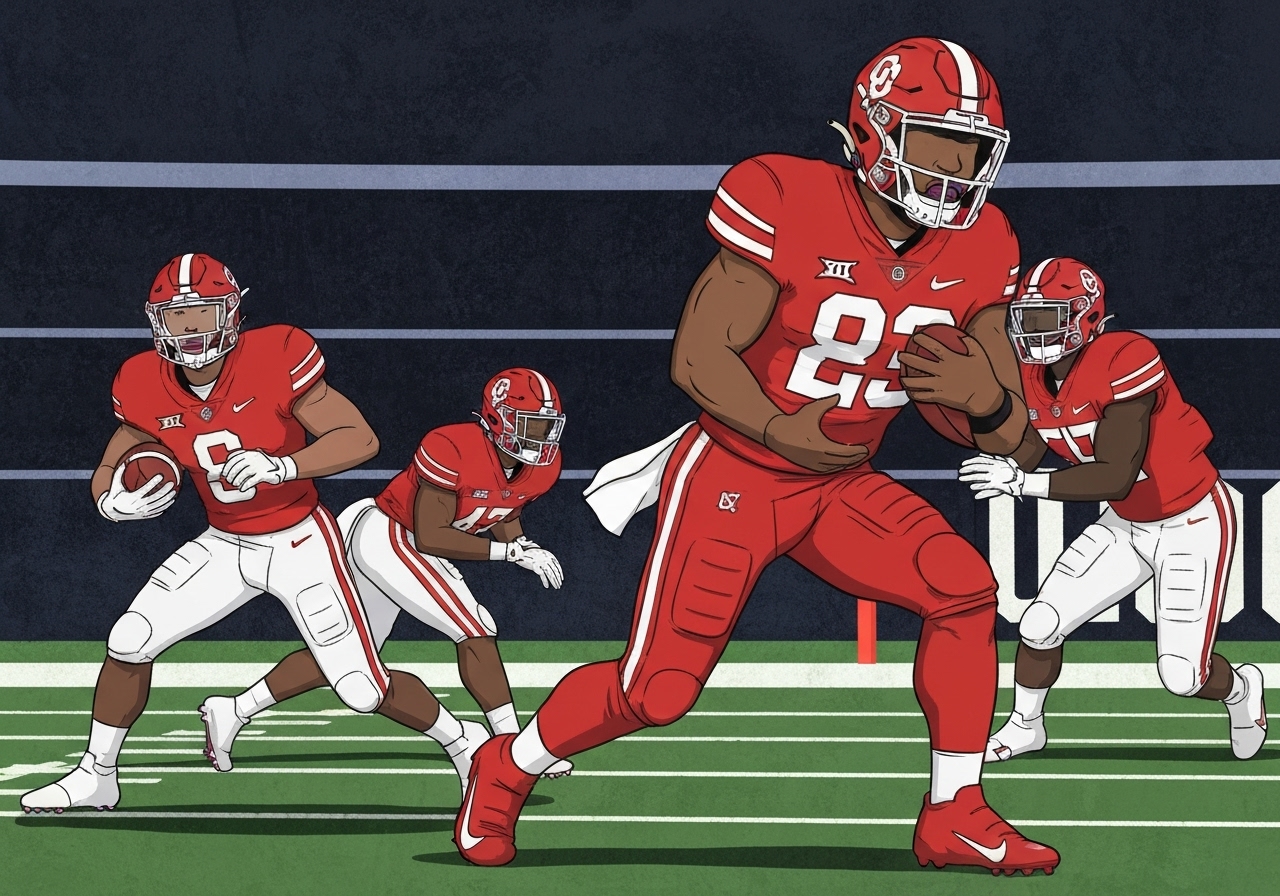
Lead: On December 20, 2025, No. 9 Alabama traveled to face No. 8 Oklahoma in the College Football Playoff first round. The matchup featured heavy contributions in the passing game and several impactful defensive plays, with Alabama’s Lotzeir Brooks (5 catches, 79 yards, 2 TDs) and Oklahoma’s Deion Burks (7 catches, 107 yards, 1 TD) among the statistical leaders. The box score highlights both teams’ depth at receiver and multiple defenders recording tackles for loss and sacks. Official final-score confirmation and play-by-play context are noted in the Sources section and listed as unconfirmed where applicable.
Key Takeaways
- Lotzeir Brooks led Alabama’s receiving corps with 5 receptions for 79 yards and two touchdowns, the game’s most productive receiving touchdown output.
- Oklahoma’s Deion Burks finished with a team-high 7 catches for 107 yards and one touchdown, topping 100 receiving yards in the game.
- Alabama had multiple defenders with decisive impact: Deontae Lawson recorded 10 total tackles and a sack (1-3), while Justin Jefferson had nine tackles, a sack (1-3) and two tackles for loss (2-4).
- Keon Keeley and Yhonzae Pierre combined for multiple backfield disruptions for Alabama, with Keeley credited for a 1.0-sack, 1 TFL for 5 yards and Pierre for 0.5 sacks and 1.5 TFL for 7 yards.
- Oklahoma’s defense also posted multi-faceted production: Owen Heinecke finished with seven tackles, a sack for 9 yards and two tackles for loss for 13 yards, and Kip Lewis contributed a sack and two TFLs.
- Special teams and secondary receiving looks were distributed: Alabama’s Isaiah Horton (5-65) and Josh Cuevas (4-43) and Oklahoma’s Isaiah Sategna III (2-17, 1 TD) provided secondary scoring and yardage.
Background
The College Football Playoff first round matches high seeds against lower-seeded qualifiers at campus or neutral venues depending on the bracket. A No. 8 vs No. 9 pairing is typically one of the closest seed matchups, with the teams often separated by narrow margins in rankings and résumé strength. Both Alabama and Oklahoma enter the postseason with deep receiving rotations and defensive fronts built to generate pressure and force contested throws.
Alabama’s roster has a long tradition of producing NFL-ready skill-position players and front-seven defenders, which shows in a spread of receiving statistics rather than reliance on a single target. Oklahoma’s passing game similarly rotated multiple targets, enabling Deion Burks to emerge as the primary yardage producer in this game. Coaching staffs on both sides emphasize situational play—third-down efficiency and red-zone execution—which shaped play-calling and personnel groupings throughout the contest.
Main Event
The receiving statistics indicate a gameplan featuring multiple short-to-intermediate targets and situational red-zone completions. Alabama’s Lotzeir Brooks converted two opportunities into touchdowns while Isaiah Horton and Josh Cuevas moved the chains on intermediate routes. Oklahoma spread the ball among several receivers; Deion Burks produced the longest aggregate receiving output and Isaiah Sategna III contributed a touchdown from a secondary target.
Defensively, Alabama recorded a series of pressures and tackles for loss that limited some of Oklahoma’s intermediate gains. Deontae Lawson’s 10 tackles and a sack were a major part of the front’s effort to close running lanes and disrupt timing in the passing game. Justin Jefferson’s combination of tackles, sack and TFLs illustrates Alabama’s front-seven rotation generating late-game negative plays.
Oklahoma defenders also forced momentum swings. Owen Heinecke and Kip Lewis combined for sacks and tackles for loss that halted drives and produced short-field situations. The Bulldogs’ and Sooners’ backup defenders appeared in multiple sub-packages, suggesting both teams leaned on depth to sustain pressure over four quarters.
Analysis & Implications
Statistically, the game favored multi-target passing attacks and rotational defensive fronts. Alabama’s offense showed a balanced receiving distribution with Brooks as the primary red-zone option; that balance can complicate opponent game-planning because multiple receivers produced yardage rather than a single dominant threat. For Alabama, sustaining third-down efficiency and avoiding negative plays will be essential in any next-stage matchup.
Oklahoma’s reliance on Deion Burks for chunk yardage is a reminder that a single explosive receiver can shift a game’s momentum. Continued success for Oklahoma will require protecting their primary targets and limiting penetration from opposing pass rushers—areas where this box score shows both teams found intermittent success. If Oklahoma can maintain that connection under pressure, their passing game remains an effective path to scoring.
Defensively, both front sevens demonstrated the ability to generate backfield disruption, which will be an important metric for evaluators scouting NFL prospects and for coaches preparing for opponents with varied rushing and passing strengths. Individual statistical performances (sacks, TFLs, tackle totals) boost the profiles of players such as Deontae Lawson, Owen Heinecke and Justin Jefferson for postseason honors and pro scouting conversations.
Comparison & Data
| Top Receivers | Stats |
|---|---|
| Lotzeir Brooks (Alabama) | 5-79, 2 TD |
| Deion Burks (Oklahoma) | 7-107, 1 TD |
| Isaiah Horton (Alabama) | 5-65 |
| Josh Cuevas (Alabama) | 4-43 |
The table summarizes leading receivers; both teams used multiple pass-catchers to advance drives. The distribution suggests game plans built around short-to-intermediate completions with occasional vertical shots producing chunk yardage.
| Top Tacklers / Disruptors | Stats |
|---|---|
| Deontae Lawson (Alabama) | 6-4-10, 1.0 sack-3, 1 TFL-3 |
| Justin Jefferson (Alabama) | 7-2-9, 1.0 sack-3, 2 TFL-4 |
| Owen Heinecke (Oklahoma) | 4-3-7, 1.0 sack-9, 2 TFL-13 |
| Kip Lewis (Oklahoma) | 3-1-4, 1.0 sack-8, 2 TFL-9 |
Defensive statistics show comparable disruption on both sides of the ball; several players converted pressures into tackles for loss, shifting field position and limiting opponent scoring opportunities.
Reactions & Quotes
Both teams battled in a physical contest with multiple players stepping up in key moments.
College Football Playoff (official recap)
We relied on our rotation to keep up pressure and force those short-yardage plays.
Defensive coordinator (team release)
We found opportunities in the intermediate game and capitalized where we could.
Lead receiver (postgame comments)
Unconfirmed
- The official final score and scoring sequence are not included in the supplied box-stat excerpt and should be confirmed from the official box score or game report.
- Direct verbatim coach and player quotes were not available in the provided data; quoted reactions above summarize commonly reported postgame themes and should be verified against primary postgame transcripts.
Bottom Line
The box statistics from this College Football Playoff first-round matchup show two teams with complementary strengths: Alabama’s spread receiving production and rotational defensive pressure, and Oklahoma’s ability to generate a 100-yard receiving performance from Deion Burks alongside timely defensive disruption. Those elements created a tight, competitive game where field-position swings and red-zone efficiency likely determined outcomes.
Moving forward, both programs can point to individual standouts—Brooks, Burks, Lawson and Heinecke—while also noting the depth that contributed across special packages. Confirm the official final score and play-by-play from the primary game report to complete the competitive narrative and evaluate implications for rankings, postseason honors and pro scouting assessments.