
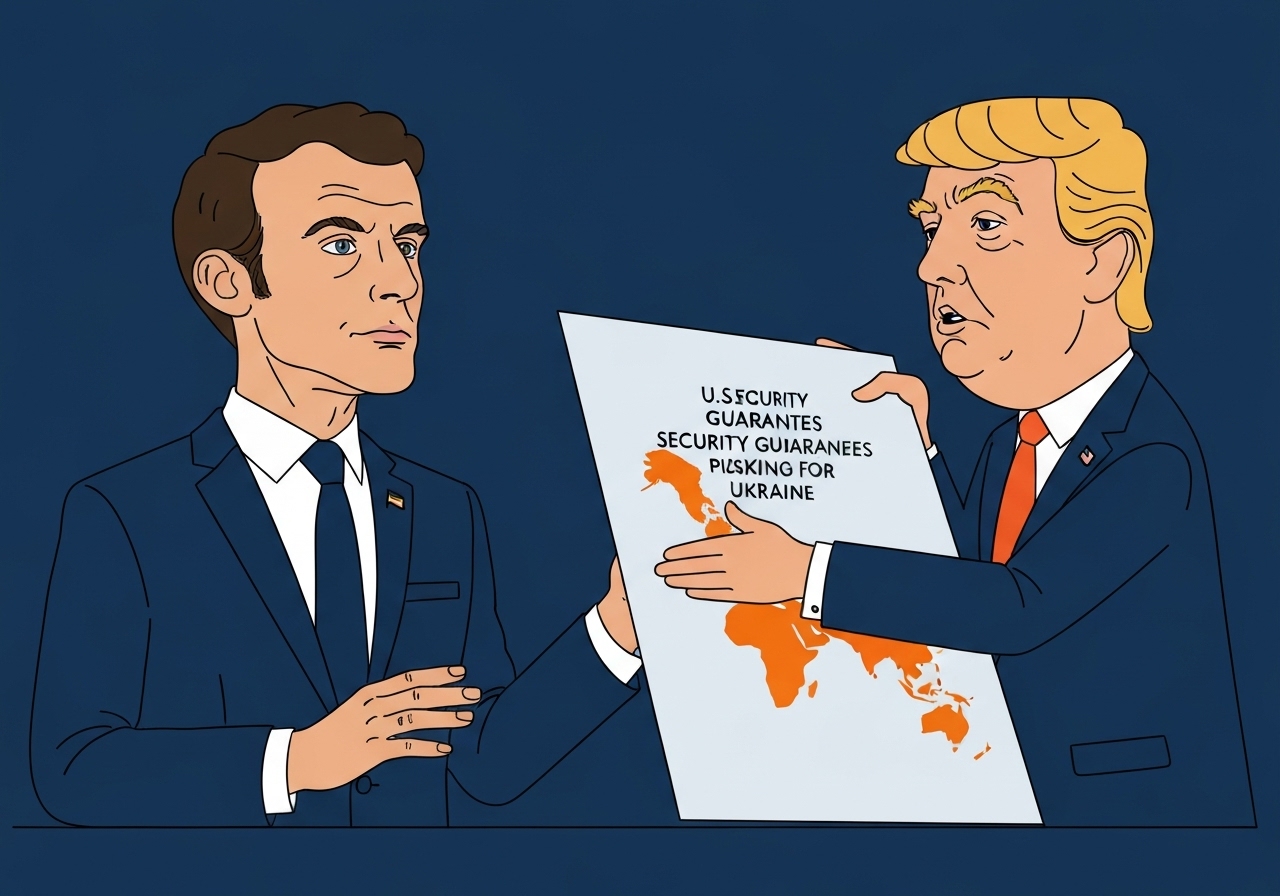
— French president Emmanuel Macron said US president Donald Trump will set out the security guarantees the United States could offer Ukraine within days, after Macron hosted President Volodymyr Zelenskyy and leaders from a 35-nation “coalition of the willing” in Paris and held a follow-up call with Mr. Trump.
Key takeaways
- The Paris meeting brought 35 countries together; 26 pledged potential contributions if a ceasefire is reached.
- Macron said the US will finalise its security guarantees for Ukraine in the coming days.
- Contributions discussed include a “reassurance force” positioned away from front lines, air and naval support, and more weapons purchases.
- President Trump signalled US backing for postwar security measures but has ruled out ground troop deployments.
- Several European states remain dependent on a US “backstop” to deter renewed Russian attacks.
- Italy rejected sending troops but offered monitoring and training outside Ukraine; Germany pledged increased air defence and equipment for four brigades.
- No detailed, country-level pledges or troop figures were announced publicly.
Verified facts
Leaders from 35 countries met in Paris on September 4 to coordinate a post-ceasefire security framework for Ukraine. After the summit, Macron, Zelenskyy and Trump spoke by phone; Macron said that the US would finalise what it could provide as security guarantees “in the next few days” if a ceasefire were negotiated with Russia.
Ukraine President Volodymyr Zelenskyy told attendees that 26 nations had committed to making contributions contingent on a ceasefire. Those contributions range from non-frontline troop deployments described as a “reassurance force,” to air or naval support and further arms purchases.
President Trump has stated that the US will help craft Ukraine’s postwar security but has explicitly ruled out deploying US ground forces. US support is expected to focus on air support, intelligence and other forms of backstopping, while asking European partners to carry much of the on-the-ground burden.
European leaders described ongoing planning by defence officials to specify each country’s role; NATO and the US have been involved in shaping those proposals. Specific commitments, troop numbers and timelines were not disclosed at the Paris meeting.
Italy reiterated it will not send troops to Ukraine but said it could contribute monitoring and training outside Ukraine’s borders. German officials stated Berlin will increase deliveries of air-defence systems, assist Kyiv in producing long-range missiles and provide equipment for four infantry brigades, continuing its role as a leading European arms supplier after the US.
Context & impact
European governments have pushed to assemble a coordinated security package to follow any formal ceasefire with Russia, both to deter renewed aggression and to reassure Kyiv. Many countries view a US security backstop as essential for any coalition deployment to be credible.
If Washington finalises support soon, that could unlock more concrete pledges from European partners. The mix of contributions being discussed—troops kept away from active front lines, air and naval assets, weapons stockpiles and training—aims to provide layered deterrence without immediately escalating direct confrontation.
Sanctions and diplomatic pressure on Moscow remain central to persuading Russia to negotiate, European leaders said. The group discussed ways to increase pressure on the Kremlin alongside preparing security arrangements for the day after a ceasefire.
- Dependence on a US backstop may limit the scope of purely European initiatives.
- Delivering air-defence systems and long-range strike capacity could change battlefield dynamics over time.
- Political resistance in some capitals means troop contributions will vary widely by country.
“We will finalise US support for security guarantees in the next few days,” Macron said after the call.
Emmanuel Macron / French presidency
“Twenty-six nations agreed to participate with concrete commitments,” António Costa said, framing the coalition’s readiness for a post‑ceasefire phase.
António Costa / European Council
Unconfirmed
- Exact size and composition of the multinational “contingent” remain under evaluation and were not disclosed.
- Specific US measures that will constitute the “security guarantees” have not been published; timing is described only as “in the next few days.”
- It is not yet confirmed whether any forces will be stationed inside Ukrainian territory or only abroad.
- The precise sanctions package discussed to pressure Russia has not been finalised publicly.
Bottom line
The Paris meeting consolidated a broad international effort to prepare security arrangements that could follow a ceasefire in Ukraine, but the plan hinges on the United States clarifying its role as a backstop. If President Trump announces specific guarantees as Macron expects, that could prompt firmer commitments from European partners and change the negotiating dynamics with Moscow — though many operational details remain to be decided.