
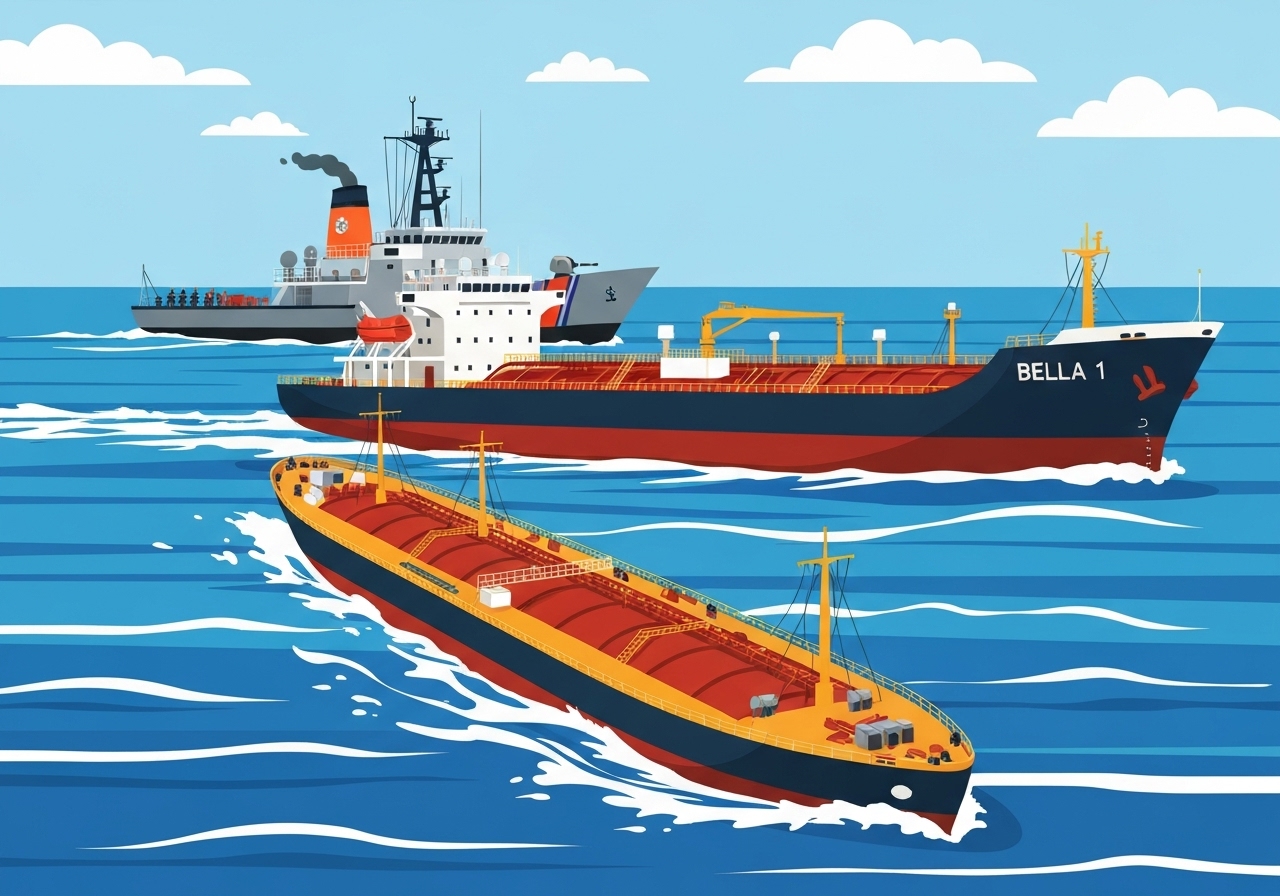
On Dec. 21, 2025, U.S. Coast Guard units attempted to intercept the oil tanker Bella 1 as it sailed in the Caribbean after reportedly heading to Venezuela to pick up cargo. According to three U.S. officials who spoke on the condition of anonymity, the vessel refused boarding and continued to move away, prompting an ongoing pursuit. The Bella 1 has been under U.S. sanctions since last year for prior shipments of Iranian oil, a designation that led U.S. authorities to obtain a federal seizure warrant. The episode occurred amid an intensifying U.S. pressure campaign on Venezuela’s oil trade and rising Venezuelan orders for naval escorts of some tankers.
- The Bella 1, identified by U.S. officials, was en route to Venezuela on Dec. 21, 2025, and was reported to be without cargo when approached by U.S. forces.
- U.S. officials say the vessel was not flying a valid national flag when approached, rendering it stateless and legally subject to boarding under international law.
- Federal authorities obtained a seizure warrant from a magistrate judge based on the Bella 1’s previous involvement in transporting Iranian oil; the warrant was not sought for its Venezuela connections.
- The ship refused to allow boarding and kept sailing; a second official described the situation as “an active pursuit.”
- The Coast Guard successfully boarded a different tanker earlier on Dec. 21, and the U.S. took possession of another tanker on Dec. 10 that is now in port in Texas.
- The incident heightens tensions after Venezuelan President Nicolás Maduro ordered navy vessels to escort some tankers leaving Venezuelan ports, raising risk of maritime confrontation.
Background
The confrontation sits at the intersection of U.S. sanctions enforcement and Venezuela’s efforts to maintain crude exports amid sustained pressure. Since 2019 and intensified in subsequent years, the U.S. has imposed sanctions targeting Venezuela’s oil sector and has separately sanctioned vessels accused of facilitating Iranian oil shipments. Washington’s stated aim has been to cut revenue streams it says prop up designated actors; those enforcement steps now include interdictions and seizures at sea when legal grounds exist.
For its part, the Maduro government has sought to shield shipments by arranging naval escorts for some tankers leaving Venezuelan ports, signaling a willingness to protect flows against external interdiction. Shipping companies and intermediaries have adapted practices—changing flags, ship names, or routing—to evade detection and sanctions, complicating enforcement. Those evasive practices are a primary reason U.S. authorities are using maritime law tools, such as boarding rights for stateless vessels and seizure warrants tied to prior conduct.
Main Event
Late on Dec. 21, U.S. Coast Guard personnel approached the tanker Bella 1 as it transited the Caribbean en route to Venezuela, according to U.S. officials and ship-tracking data compiled by maritime monitors. Inspecting parties determined the vessel was not displaying a valid national flag; under customary international law, a stateless ship can be boarded on the high seas. Because the Bella 1 has a sanctions history tied to Iranian oil transfers, federal prosecutors secured a magistrate judge’s warrant authorizing seizure if boarding succeeded.
When U.S. forces attempted to board, the vessel did not comply. One official said the ship “did not submit to being boarded” and instead continued sailing; another official called the response “an active pursuit.” The Bella 1, according to tracking data, was not carrying cargo at the time and had not yet reached Venezuelan territorial waters, where the legal and tactical environment would differ.
On the same day U.S. forces boarded another tanker successfully, and U.S. authorities had earlier taken possession of a different vessel on Dec. 10 that is now at a Texas port. Together, these actions represent a stepped-up enforcement posture by U.S. agencies that handle maritime interdiction, including the Coast Guard and Justice Department prosecutors working from warrants based on past vessel conduct.
Analysis & Implications
The pursuit of the Bella 1 underscores a sharper U.S. strategy of using maritime interdiction to enforce sanctions beyond port and on the high seas. Legally, boarding is most straightforward when a vessel lacks a recognized flag; operationally, it requires coordination among patrol assets and intelligence to locate and approach a single ship among thousands at sea. Securing seizure warrants ties enforcement to specific allegations—here, prior Iranian oil transfers—reducing legal risk for U.S. actions, but still raising diplomatic friction.
Politically, the move escalates pressure on Nicolás Maduro’s government by targeting one component of Venezuela’s crude-export network. Maduro’s order that some tankers sail with Venezuelan naval escorts increases the odds of close encounters; if escort vessels confront U.S. forces during an interdiction, the potential for miscalculation would rise. For maritime insurers, ship operators and charterers, the trend raises costs and complicates commercial decisions about routing, flagging and cargoes bound for or near Venezuela.
Internationally, the episode will test partners’ willingness to support U.S. enforcement measures. Nations that rely on Gulf shipping lanes or have competing political ties to Tehran or Caracas may push back diplomatically if they view seizures as overreach. At the same time, firms that previously facilitated opaque transfers of sanctioned oil may seek more aggressive obfuscation tactics, prompting a cat-and-mouse cycle between enforcement and evasion.
| Date | U.S. action |
|---|---|
| Dec. 10, 2025 | U.S. took possession of a tanker now in Texas port |
| Dec. 21, 2025 (earlier) | Coast Guard boarded a different tanker successfully |
| Dec. 21, 2025 (later) | Attempted boarding of Bella 1; vessel refused and is being pursued |
The table shows recent, discrete enforcement steps in December 2025; each action is linked to allegations about vessels’ prior cargoes or flag status rather than Venezuela port calls per se. These events illustrate a short period of intensified operations, but they do not alone reveal long-term enforcement patterns—those will depend on legal outcomes, diplomatic responses and whether vessels continue to resist boarding.
Reactions & Quotes
U.S. officials described the operation in guarded terms while citing legal grounds for boarding. Their accounts emphasized that the seizure authority rested on the Bella 1’s sanctions history rather than any new charge tied to Venezuela.
“An active pursuit,”
U.S. official (anonymous)
The officials also stressed that when approached, the vessel lacked a valid national flag, a condition that underpins the decision to attempt boarding under international law.
“It did not submit to being boarded,”
U.S. official (anonymous)
Unconfirmed
- Whether the Bella 1’s immediate destination was to load Venezuelan crude is not independently confirmed beyond U.S. officials’ ship-tracking data.
- It is unconfirmed whether Venezuelan naval escorts will attempt to interpose themselves between the Bella 1 and U.S. forces in this incident.
- The identity of the ultimate beneficial owners or operators of the Bella 1 and their intent for any proceeds remains unclear in public records.
Bottom Line
The attempted boarding and ensuing pursuit of the Bella 1 demonstrate a more assertive U.S. enforcement posture against vessels tied to prior Iranian oil shipments, even when those ships are operating near Venezuelan trade routes. Legal authority in this case rested on the ship’s sanctions history and its lack of a valid flag, giving U.S. agencies a clearer basis to act on the high seas.
But the incident elevates the risk of maritime friction: Venezuela’s use of naval escorts and continued reliance on unconventional shipping practices increase the chances of hazardous encounters. Observers should watch for whether U.S. forces complete a seizure, how Caracas responds diplomatically or operationally, and whether insurers and operators alter behavior in ways that reshape regional crude movements.
Sources
- The New York Times (media report; Dec. 21, 2025)
- TankerTrackers.com (ship-tracking/monitoring organization; image and tracking data referenced)