
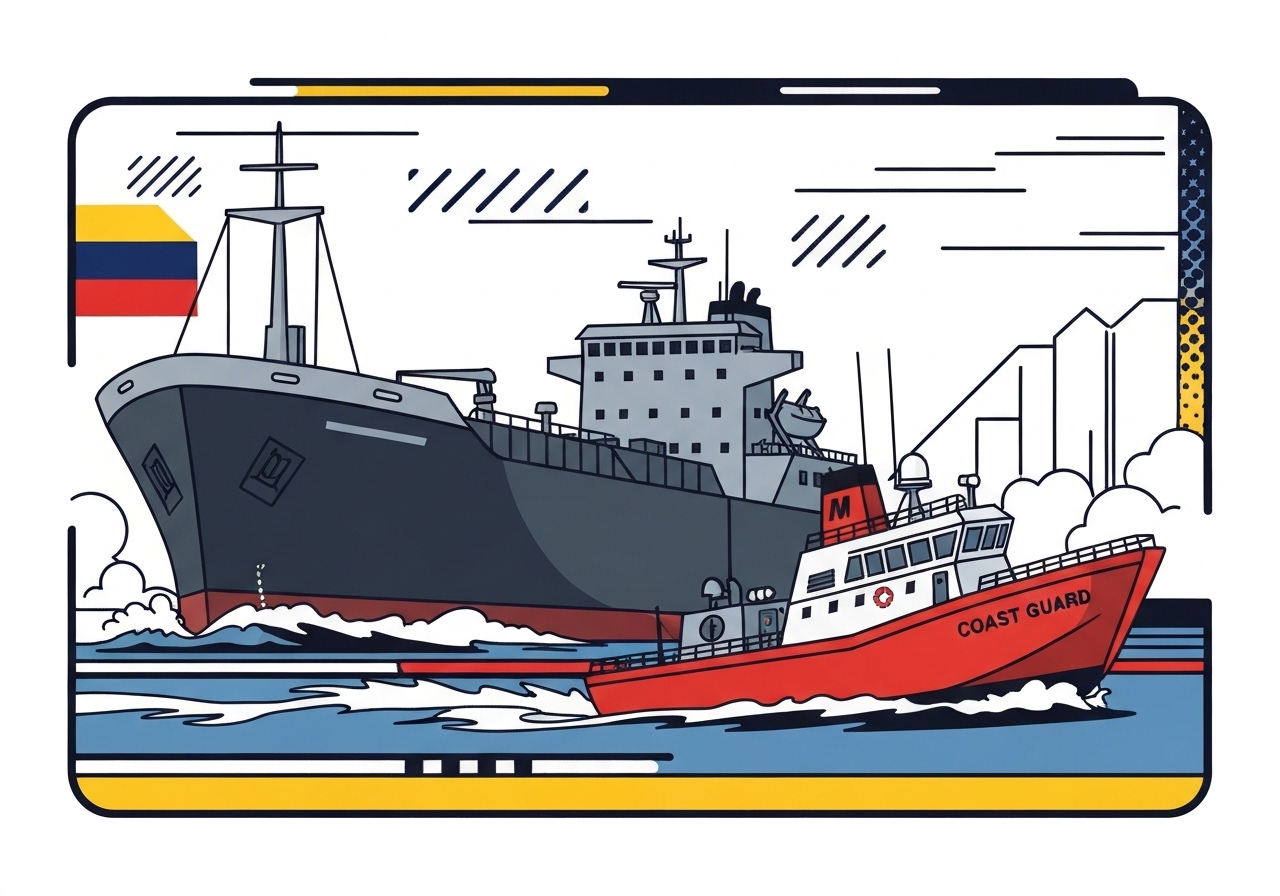
Lead: The U.S. Coast Guard, operating in the Caribbean Sea, on Sunday pursued a sanctioned oil tanker that U.S. officials say is part of Venezuela’s so-called “shadow fleet.” The action, confirmed by an official briefed on the operation, came days after U.S. authorities announced the seizure of another tanker and follows a Dec. 10 boarding of a different vessel. U.S. officials described the pursued vessel as flying a false flag and subject to a judicial seizure order; the White House declined to comment on the ongoing operation.
Key Takeaways
- The pursuit was confirmed by a U.S. official on Sunday and involves a vessel the U.S. says is part of Venezuela’s sanctioned “dark fleet.”
- The administration announced the seizure of a Panama-flagged tanker named Centuries in a predawn action described as occurring Saturday; this is the second such action in less than two weeks.
- The Coast Guard, with Navy assistance, seized the tanker Skipper on Dec. 10; that vessel was operating without a nation’s flag when boarded.
- Officials say the currently pursued vessel was using a false flag and is under a judicial seizure order; the Pentagon and DHS deferred questions to the White House.
- President Donald Trump has publicly discussed a blockade on Venezuela and tied the actions to claims of recovered U.S. assets and alleged illicit activities linked to Maduro’s government.
- Separately, the administration has ordered strikes on vessels accused of smuggling fentanyl and other drugs; U.S. monitoring reports at least 104 people killed in 28 strikes since early September.
- Critics in Congress and human rights groups have demanded evidence and, in some cases, congressional authorization for military actions related to these maritime operations.
Background
For years the Venezuelan oil sector — once dominated by U.S. companies — has been nationalized in stages under Hugo Chávez and later Nicolás Maduro. Disputes over compensation led to international arbitration: in 2014 an arbitration panel ordered Venezuela to pay ExxonMobil $1.6 billion. Sanctions imposed by the United States have pushed Caracas and allied operators to rely on a network of tankers and middlemen that Washington calls a “shadow” or “dark” fleet to move crude and refined products.
The U.S. government has responded to sanctions evasion with financial penalties and, more recently, with direct maritime interdictions. U.S. officials describe some vessels as falsely flagged or operating without legitimate registry to obscure their links to sanctioned cargoes. The current actions are situated amid broader U.S. policy priorities: pressure on the Maduro government, claims about lost U.S. investments, and a parallel campaign targeting ships accused of smuggling fentanyl into the Americas.
Main Event
The operation announced Sunday involved a Coast Guard pursuit in the Caribbean of a vessel that U.S. officials say is part of Venezuela’s sanctioned logistics network. A U.S. official who spoke on condition of anonymity said the vessel was operating under a false flag and subject to a judicial seizure order; details on boarding or custody were not released at the time. The Pentagon and Department of Homeland Security declined to answer questions and referred reporters to the White House, which offered no public comment on the ongoing action.
Saturday’s predawn seizure of the Panama-flagged tanker Centuries was described by the White House as an interception of a “falsely flagged vessel operating as part of the Venezuelan shadow fleet to traffic stolen oil.” That action was framed as the second high-profile interdiction in under two weeks, after the Dec. 10 seizure of Skipper — a vessel the Coast Guard said was not flying any national flag when it was boarded.
Administration officials say these operations are intended to disrupt networks that move Venezuelan oil in violation of U.S. sanctions. President Trump has publicly linked the maritime actions to demands that Venezuela return assets seized from U.S. oil firms and described stronger measures, including a blockade, to cut off sanctioned cargoes. Some tankers reportedly are already diverting away from Venezuelan ports in response to the stepped-up enforcement.
Analysis & Implications
Operationally, pursuing and seizing foreign-flagged or unflagged vessels in international waters raises complex questions under maritime law. A judicial seizure order gives U.S. authorities a domestic legal basis to act, but actions on the high seas can provoke diplomatic disputes with flag states and third parties involved in shipping and insurance. If multiple interdictions continue, shipping firms may reroute, insure at higher rates, or withdraw capacity, further isolating Venezuela’s oil exports.
Politically, the interdictions fit a broader strategy of escalating pressure on Nicolás Maduro while signaling to domestic audiences that the administration is protecting U.S. economic interests. Critics argue the moves risk unintended escalation: some members of Congress and international observers are calling for clearer evidence and formal authorization when kinetic action is used. Legal scholars warn that unchecked use of force at sea, especially when evidence is not publicly shared, could set precedents other states might emulate.
Economically, the shadow fleet is a work-around for sanctions and has kept some volumes of Venezuelan oil flowing to global markets. Disrupting that network may reduce immediate exports but could also push operators to more clandestine methods, raising costs and lengths of voyages. Over time, tighter enforcement could accelerate declines in export volumes or incentivize new trading partnerships that insulate Venezuela from U.S. pressure.
Comparison & Data
| Vessel | Reported Action | Flag/Status |
|---|---|---|
| Skipper | Seized by Coast Guard | Unflagged at boarding (Dec. 10) |
| Centuries | Seized (announced Saturday) | Panama-flagged, described as falsely flagged |
| Unnamed tanker (pursued) | Pursuit reported Sunday | Reported false flag; under judicial seizure order |
The table summarizes public descriptions from U.S. officials and the White House. While dates and vessel names for Skipper (Dec. 10) and Centuries (announced Saturday) are reported by U.S. sources, finer operational details — such as exact coordinates, boarding team composition, or chain-of-custody for cargo evidence — have not been released publicly. Separately, monitoring of interdictions tied to alleged drug-smuggling vessels shows at least 104 fatalities across 28 strikes since early September; critics say public evidence tying each target to trafficking remains thin.
Reactions & Quotes
Political and public responses were immediate and divided. Some lawmakers saw the seizures as necessary enforcement of sanctions; others warned of escalation and urged congressional oversight.
“The tanker seizures are a provocation and a prelude to war,”
Sen. Rand Paul (R-Ky.), critic of the administration’s Venezuela policy
Venezuelan President Nicolás Maduro framed the interdictions as part of an external campaign and reaffirmed his government’s defiance.
“We are ready to accelerate the pace of our deep revolution!”
Nicolás Maduro, President of Venezuela (Telegram message)
A senior White House aide’s remark published in a media interview underscored the administration’s intent to apply persistent maritime pressure.
“He wants to keep on blowing boats up until Maduro cries uncle,”
Susie Wiles, White House chief of staff (quoted in a published interview)
Unconfirmed
- Whether the pursued vessel had direct operational orders from Maduro’s government remains unconfirmed by publicly released evidence.
- Precise cargo manifests and chain-of-custody proving the oil aboard seized ships was unlawfully taken have not been published by U.S. authorities.
- Independent verification of every link between the shadow fleet and sanctioned Venezuelan entities has not been publicly documented; some allegations remain disputed.
Bottom Line
The recent Coast Guard pursuit and the earlier seizures mark a clear intensification of U.S. maritime enforcement against vessels the administration ties to Venezuela’s sanctioned oil logistics. These operations combine legal tools (judicial seizure orders) with naval and Coast Guard assets to disrupt what the U.S. describes as illicit trade networks.
But the approach carries diplomatic, legal and operational risks: seizures on the high seas invite scrutiny from flag states, shipping insurers and international legal observers, and the public record on evidence released so far has been limited. Watch for congressional queries, potential international protests, and shipping-market responses — including rerouting and insurance-cost increases — as the situation unfolds.
Sources
- Associated Press — news report detailing Coast Guard pursuit and recent tanker seizures (news).