
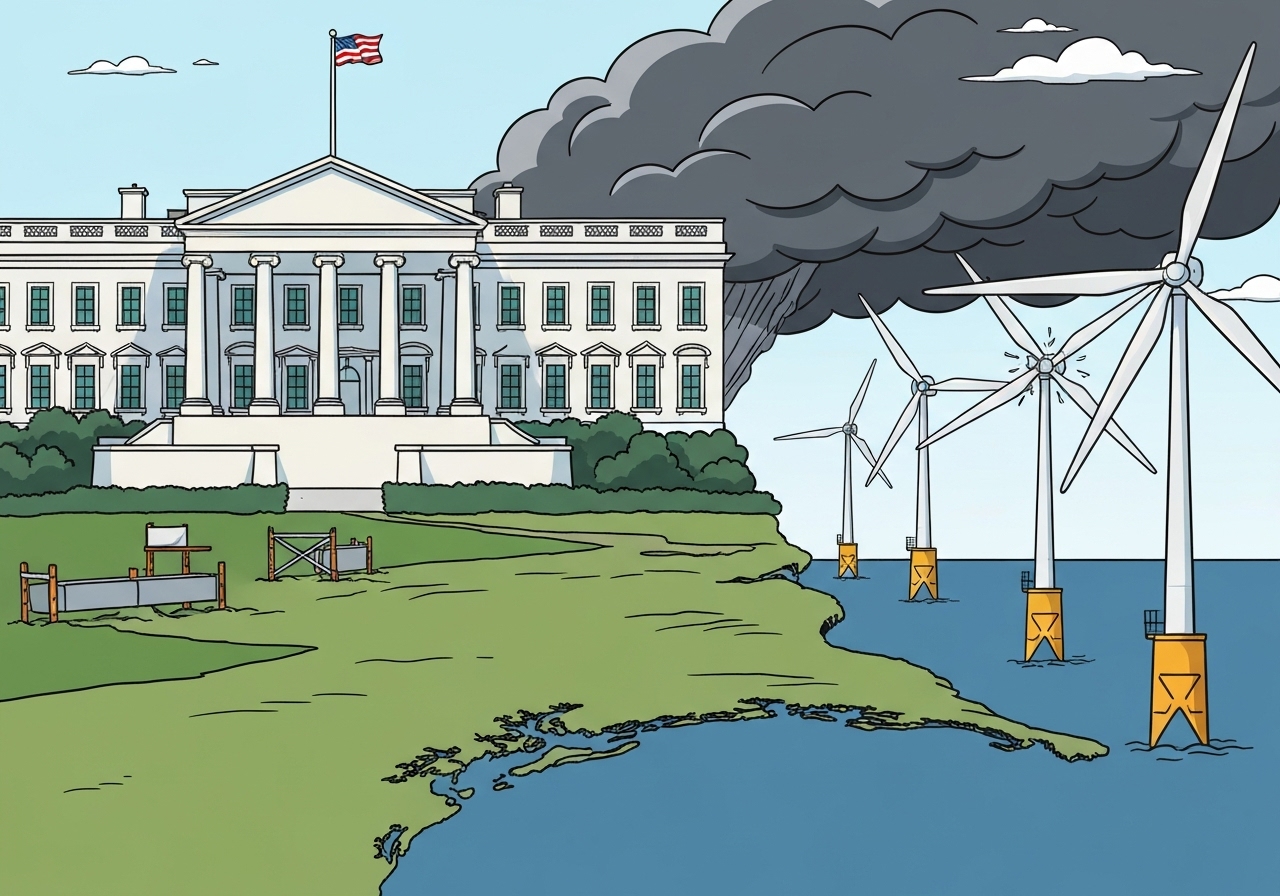
Lead: The Trump administration on Monday ordered an immediate suspension of leases for five large-scale offshore wind projects being built along the U.S. East Coast, citing national security concerns identified by the Pentagon. The pause affects Vineyard Wind (Massachusetts), Revolution Wind (Rhode Island/Connecticut), Coastal Virginia Offshore Wind (Virginia) and two New York projects, Sunrise Wind and Empire Wind. The Interior Department said the suspension will allow interagency work with the Defense Department to assess mitigation options; no end date was given. The action follows a federal judge’s ruling that vacated a Jan. 20 executive order blocking wind projects two weeks earlier.
Key Takeaways
- Five leases were suspended effective immediately: Vineyard Wind, Revolution Wind, Coastal Virginia Offshore Wind (CVOW), Sunrise Wind and Empire Wind.
- The Interior Department cited radar interference — “clutter” from turbine blades and towers — as a security concern that could obscure or create false moving targets near coastal population centers.
- CVOW is described by its developer as nearly 70% complete; the suspension therefore risks disrupting a project already well advanced.
- The move came about two weeks after U.S. District Judge Patti Saris vacated President Trump’s Jan. 20 executive order that had paused wind leasing and permitting.
- Wind proponents and state officials called the action illegal and harmful to jobs, energy costs and grid reliability; some anti-wind groups praised the suspension.
- Developers tied to U.S. offshore projects include Ørsted, Equinor and a subsidiary of Iberdrola; Ørsted’s stock moved more than 11% lower on the day of the announcement.
- Interior Secretary Doug Burgum framed the decision as protecting Americans in light of evolving adversary technologies; critics say Defense Department consultation had already occurred during permitting.
Background
Federal permitting of large offshore wind farms has been contentious for years, intersecting coastal economic interests, national security reviews and climate policy debates. Offshore projects require layered approvals from federal and state agencies, including environmental reviews, Coast Guard input and consultations with the Defense Department on potential impacts to radar and operations. The Trump administration has signaled opposition to many renewable projects, favoring fossil-fuel development; that political stance set the stage for aggressive executive action early in the term.
On Jan. 20, President Trump issued an executive order pausing leasing and permitting for wind energy on federal lands and waters. A coalition of 17 state attorneys general plus Washington, D.C., led by New York Attorney General Letitia James, challenged that order; Judge Patti Saris ruled the action unlawful and vacated the order. Despite that ruling, Interior’s new suspension targets specific East Coast projects the administration says warrant an additional national security review.
Main Event
The Interior Department announced the immediate suspension of five leases after citing unclassified U.S. government reports that describe turbine movement and reflective towers producing radar “clutter.” The department said the pause will allow it and the Defense Department to assess options to mitigate any risks. Officials did not publish a detailed list of the specific vulnerabilities or a timeline for completing the review.
Projects identified as paused include Vineyard Wind off Massachusetts; Revolution Wind, shared by Rhode Island and Connecticut; two New York projects, Sunrise Wind and Empire Wind; and the Coastal Virginia Offshore Wind project. Developers and state officials responded that the projects had undergone multi-agency review during permitting and that potential security concerns had been considered earlier in the process.
Interior Secretary Doug Burgum justified the action as a national-security precaution, emphasizing the government’s duty to protect the public and citing rapidly evolving adversary technologies. Opponents pushed back, noting that the Department of Defense and other agencies had been consulted at prior permitting stages and that judges had recently ruled against broad executive halts to wind leasing.
Analysis & Implications
The suspension raises immediate practical questions about construction schedules, supply chains and jobs. Coastal Virginia’s project is close to completion, and pausing work there could produce near-term contractor layoffs and delays in meeting regional demand, particularly where new data centers and other load additions are increasing electricity needs. Developers warn that stopping projects mid-build creates higher costs for ratepayers and risks investor confidence in U.S. offshore wind markets.
Legally, the administration’s invocation of national security may complicate court challenges. Courts give deference to national security claims, but plaintiffs can still press procedural or factual challenges if evidence of specific harms is lacking. Two weeks earlier, Judge Patti Saris found Trump’s Jan. 20 executive order arbitrary and unlawful; challengers may argue this targeted suspension repeats the same overreach unless new, project-specific evidence is produced.
Strategically, the decision could shift the U.S. energy trajectory by slowing a source of large-scale renewable generation that states view as critical to decarbonization and resilience. It may also affect international developers’ willingness to invest, prompting reassessments of project risk premia. Conversely, proponents of the pause argue that modernizing radar and mitigation measures may be necessary as offshore infrastructure grows, and that a deliberate interagency review could produce durable technical fixes.
Comparison & Data
| Project | Location | Noted Status |
|---|---|---|
| Vineyard Wind | Massachusetts | Under construction |
| Revolution Wind | Rhode Island / Connecticut | Permitted, in development |
| Coastal Virginia Offshore Wind (CVOW) | Virginia | Nearly 70% complete |
| Sunrise Wind | New York | Permitted, in development |
| Empire Wind | New York | Permitted, in development |
Putting the pause beside the Jan. 20 executive order shows different legal strategies: the earlier order aimed broadly at leasing and permitting across federal waters, while the current step targets discrete leases based on cited security assessments. The economic contrast is also clear: one action sought wide policy change, the other interrupts specific projects, some of which are already delivering economic activity and construction employment.
Reactions & Quotes
Interior Secretary Doug Burgum framed the suspension as a protective measure; his statement tied the action to the “rapid evolution” of adversary technologies and the proximity of projects to population centers.
“The prime duty of the United States government is to protect the American people,”
Doug Burgum, Interior Secretary (statement)
Former Navy commander and national security analyst Kirk Lippold disputed the administration’s rationale, noting the projects had undergone multiagency review and suggesting diversified domestic energy could bolster security.
“The record of decisions all show that the Department of Defense was consulted at every stage of the permitting process,”
Kirk Lippold, former USS Cole commander (national security expert)
Environmental and state officials characterized the move as illegal and harmful to energy affordability and job creation. Ted Kelly of the Environmental Defense Fund warned of stalled investment and higher costs for consumers if projects are blocked.
“We should not be kneecapping America’s largest source of renewable power, especially when we need more cheap, homegrown electricity,”
Ted Kelly, Environmental Defense Fund (environmental group)
Unconfirmed
- Specific technical details of the national security risks cited by Interior were not released; the precise radar or operational vulnerabilities remain undisclosed.
- It is not publicly confirmed whether the Defense Department recommended a full suspension versus additional mitigations; the administration’s statement does not specify the Defense Department’s exact posture.
- No timeline or criteria for lifting the pause has been published, so the duration and ultimate outcome of the review are unknown.
Bottom Line
The administration’s suspension halts construction and permitting on five major East Coast offshore wind projects and elevates national security as the stated rationale. The decision injects new legal and economic uncertainty into a sector that states and developers view as central to decarbonization and long-term energy planning.
How agencies document and justify the specific vulnerabilities will shape the next phase: a narrow, evidence-based review that identifies mitigations could allow projects to resume; conversely, an open-ended pause risks causing sustained delays, higher costs and strained legal battles. Stakeholders from state governments to developers and defense officials will be watching for concrete technical findings and a clear timetable.