
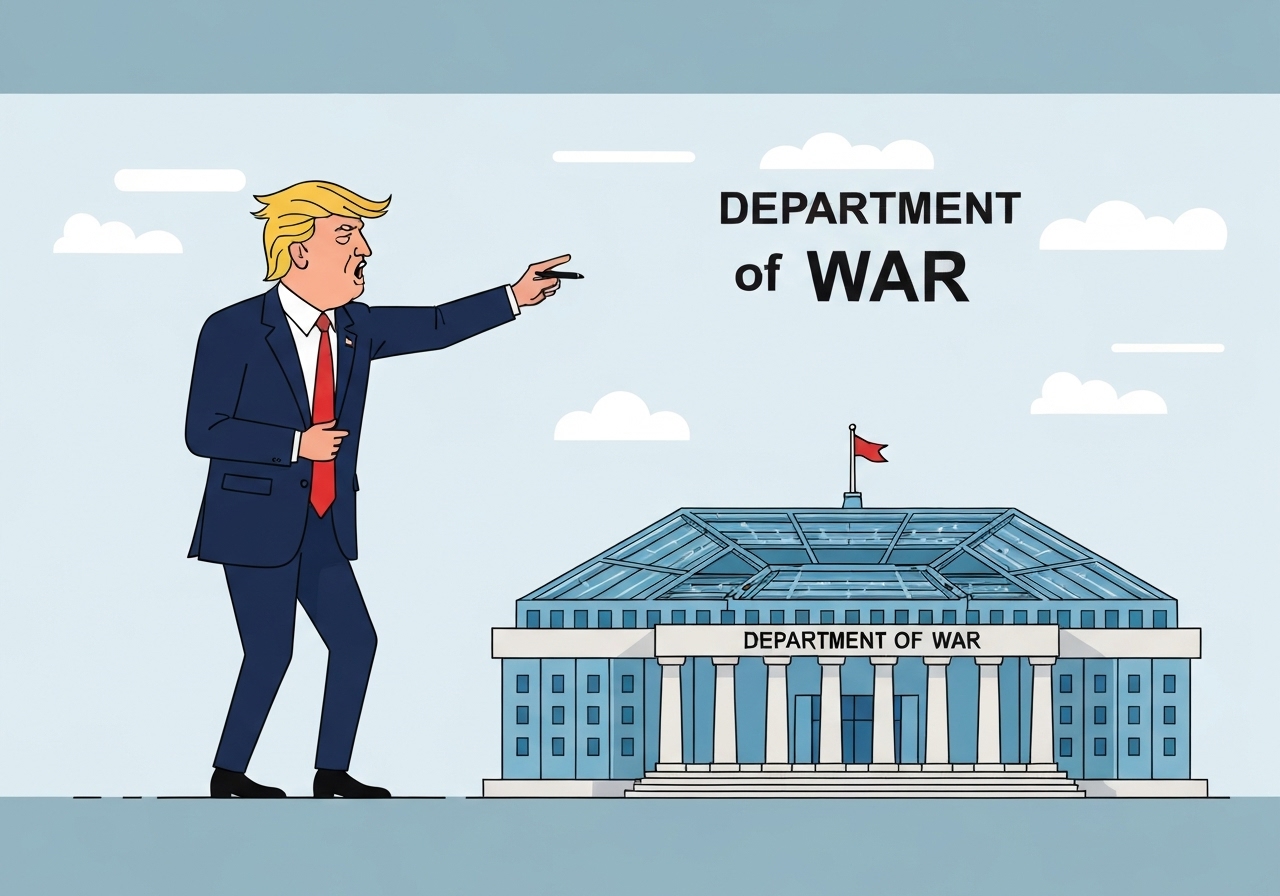
Trump directs Pentagon to be styled the ‘Department of War’
— President Donald Trump has ordered the Pentagon to be styled as the “Department of War” and directed that the Department of Defense use the name as a secondary title; the order also instructs that Defence Secretary Pete Hegseth be referred to as “Secretary of War,” according to an executive order text seen by the BBC.
Key takeaways
- The White House will issue an executive order naming the Department of Defense also as the “Department of War.”
- The order designates Defence Secretary Pete Hegseth as “Secretary of War” in official usage.
- Congress must amend statute to enact a legal name change; an executive order cannot alter department names in law.
- The Pentagon traces its lineage to the War Department created in 1789 and reorganised in 1947.
- The administration says the new styling emphasizes readiness and a stronger warfighting posture.
- Officials have criticised diversity, equity and inclusion programmes as a distraction from combat readiness.
Verified facts
The BBC has obtained the executive order text, which directs the Department of Defense to adopt “Department of War” as a secondary title and assigns the title “Secretary of War” to the current defence chief, Pete Hegseth. The White House plans a signing on Friday, according to the document.
Under current federal law, the names and existence of executive departments are set by Congress. Legal experts and congressional staff say a true change to the department’s statutory name would require legislation passed by both chambers and the president’s signature or a congressional override if vetoed.
| Item | Detail |
|---|---|
| War Department origin | Established as a cabinet agency in 1789; reorganised into the Department of Defense in 1947 |
| Executive order | Directs secondary use of the name “Department of War”; text reviewed by BBC |
| Legal effect | Administrative styling only; statutory change requires congressional action |
The administration frames the move as part of a broader push to prioritise “warfighting” and a “warrior ethos.” Senior officials have said the department has drifted toward social-policy initiatives they consider detrimental to military effectiveness.
Context & impact
Practically, an executive order directing alternative styling could change internal memos, ceremonial usage and some signage, but it would not rewrite federal statute or automatically change names on laws, appropriations, or international agreements. Agencies typically cannot unilaterally re-name themselves in statutes or treaties without congressional consent.
The announcement is likely to prompt rapid political response. Lawmakers who favour a tougher posture may back the idea; others will question the legal basis and the priority given to symbolic changes over procurement and readiness investments. Allies and partners track U.S. defence posture closely, and abrupt changes in language can create diplomatic confusion even if they are primarily symbolic.
- Administrative impacts: signage, letterhead, internal program names may be adjusted if the department follows the order.
- Legal impacts: statutory references to the Department of Defense would remain until Congress acts.
- Budgetary impacts: funding streams and authorisations are unchanged by administrative styling.
Official statements
“The name ‘Department of War’ conveys a stronger message of readiness and resolve compared to ‘Department of Defense’, which emphasizes only defensive capabilities,” the executive order text reads.
Executive order text (obtained by BBC)
“I’m sure Congress will go along if we need that. I don’t even think we need that,” the president said in public remarks last week about the possibility of congressional action.
President Donald Trump
Unconfirmed
- Whether and when Congress will introduce or pass legislation to make “Department of War” the department’s legal name.
- The scope and timeline for implementation across all Defense Department materials and international communications.
- Whether other changes to personnel policy, including shifts in diversity or training programmes, will follow from this styling directive.
Bottom line
The executive order directs the Pentagon to adopt a historical, more bellicose styling as a secondary title and assigns a new ceremonial title to the defence secretary, but it does not itself change the department’s legal name. Any statutory renaming requires congressional action, making this move at present largely symbolic yet politically consequential.