
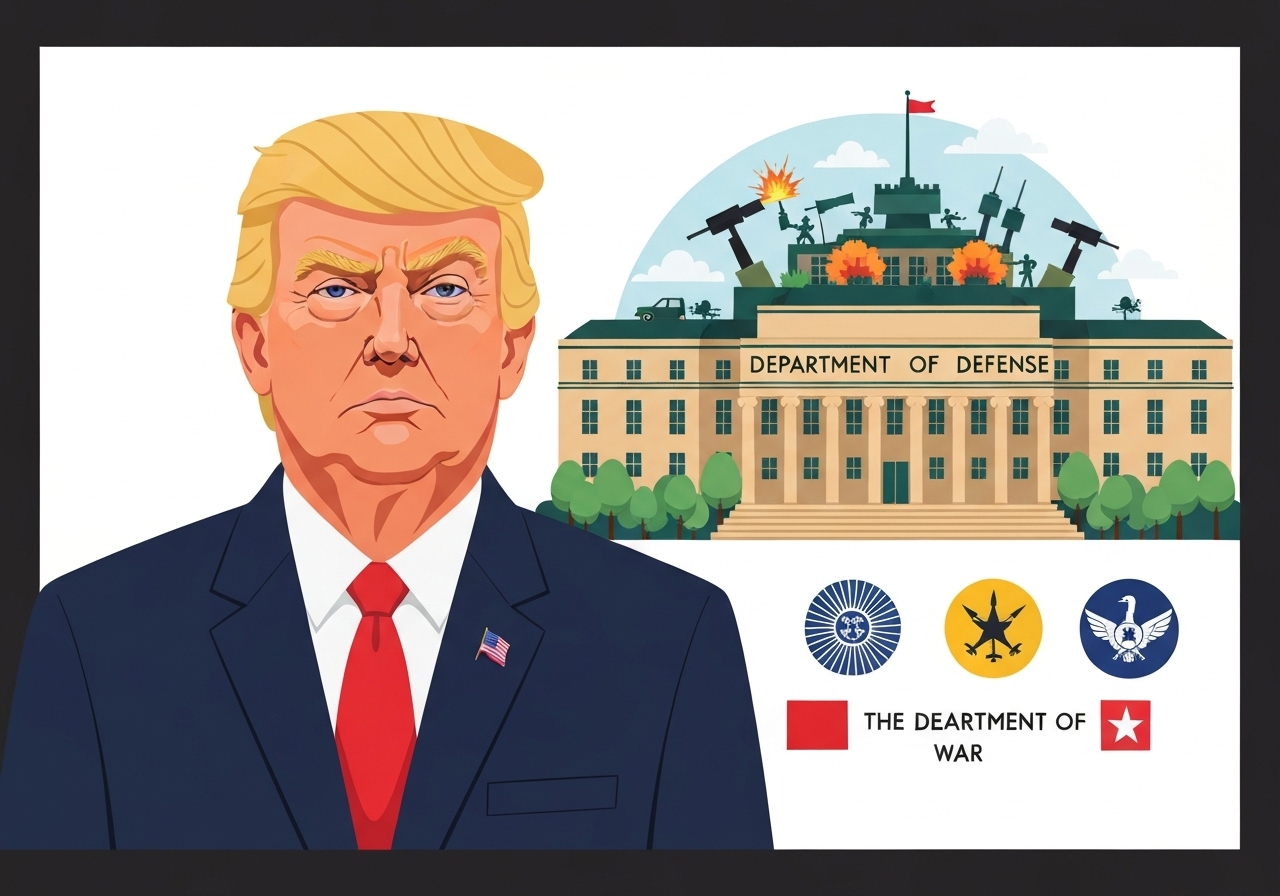
— President Trump announced he will sign an executive order renaming the Department of Defense the Department of War, a move his administration says will refocus the U.S. military on explicit war-fighting capabilities; the order’s immediate legal effect is uncertain because the department’s current name and the office of secretary were created by acts of Congress.
Key Takeaways
- President Trump plans to issue an executive order to rename the Department of Defense the Department of War.
- The administration frames the change as a return to a pre-World War II name and a shift toward combat emphasis.
- Secretary of Defense Pete Hegseth has been publicly praised by the president and referred to by the president as “Secretary of War”.
- Fox News first reported the imminent order; the White House confirmed the move on Sept. 4, 2025.
- Legal and procedural questions remain because the department’s name and the secretary’s title were established by Congress.
- Supporters say the change signals strength; critics warn it may militarize language and distract from civilian oversight.
Verified Facts
The White House announced on Sept. 4, 2025, that President Trump will sign an executive order renaming the Department of Defense the Department of War. The president has repeatedly said the older name “sounded better” and has framed the change as honoring historical wartime successes under that designation.
Secretary Pete Hegseth, nominated by the president and serving as the Pentagon’s civilian leader, has been publicly praised by Mr. Trump. In a recent social post the president referred to Hegseth using the term “Secretary of War,” reflecting the administration’s messaging on renewed emphasis on combat operations.
The rename was first reported by Fox News and later confirmed by the White House. The Department of Defense was created and named through congressional legislation after World War II; the secretary’s office likewise exists by statute, which raises legal questions about whether an executive order alone can change the department’s formal name and associated statutory authorities.
Context & Impact
The move fits a broader pattern in the administration of sharpening military rhetoric and prioritizing visible war-fighting capabilities. Officials say the new name will make the department’s mission clearer to service members and the public.
Legal scholars and some members of Congress have signaled the change could require legislative action to take full effect. Because the department’s name and the secretary’s role are defined in statutes, an executive order may be symbolic unless followed by Congressional legislation or administrative steps aligning documents, insignia, contracts, and international references.
Policy implications extend beyond symbolism. Critics argue that renaming could erode civilian-military norms by foregrounding combat as the defining mission and that it may complicate cooperation with allies who work with a “defense” ministry concept. Supporters counter that the label clarifies priorities and boosts deterrence messaging.
“It just sounded better,” the president said in August when first discussing the idea, adding that restoring the old name would remind Americans of wartime victories.
President Trump / Public remarks
Unconfirmed
- Whether the executive order alone will cause the department’s formal legal name to change without Congressional approval.
- Any exact timeline for implementation, including when signage, letterhead, and statutes would be updated.
- The full range of reactions from military leadership and rank-and-file service members beyond public statements.
Bottom Line
The president’s planned renaming of the Department of Defense to the Department of War signals an explicit shift in messaging toward combat readiness and aggressive posture. While the declaration is immediate, its legal and administrative permanence likely depends on follow-up actions by Congress and detailed implementation across the department.