
Lead
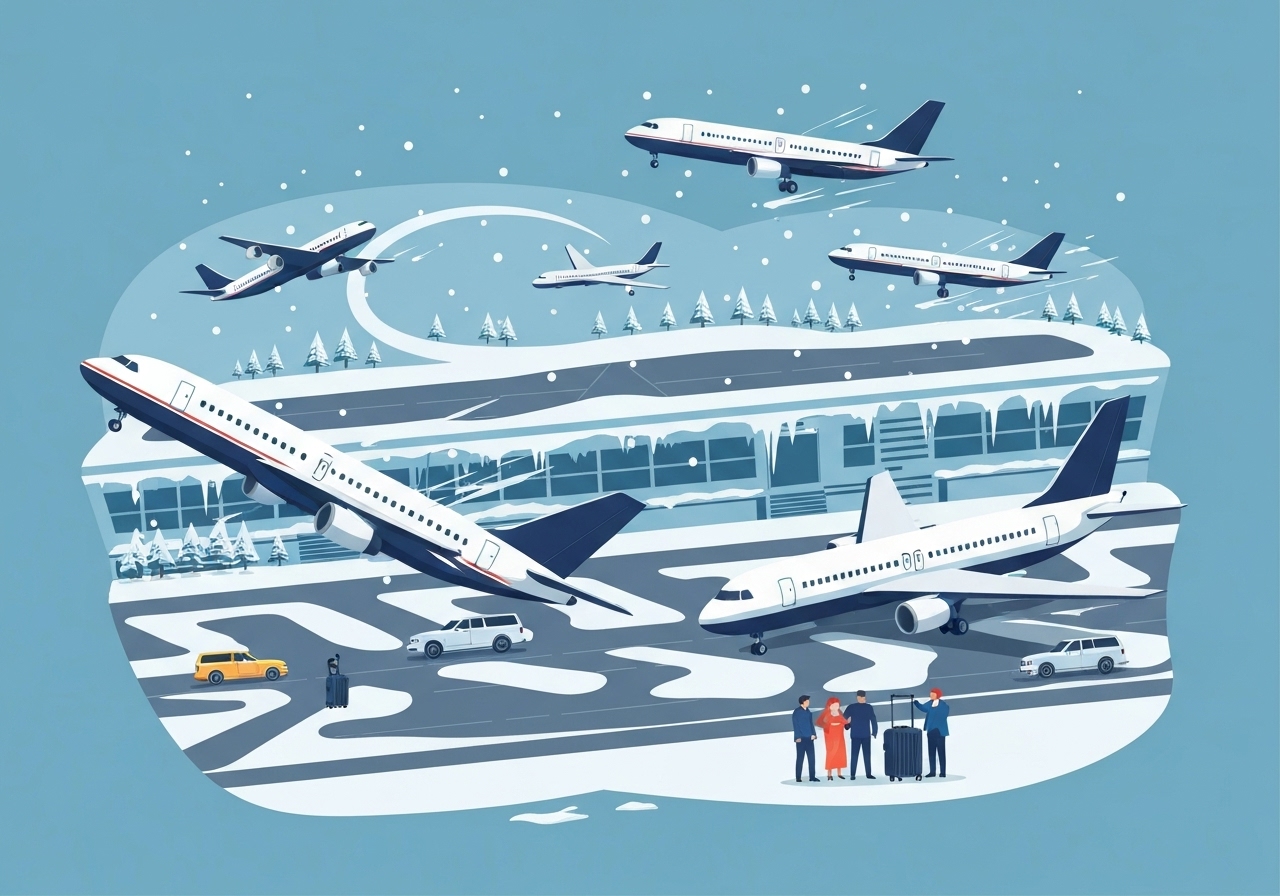
A major winter storm is set to challenge U.S. carriers during one of the busiest travel periods of the year. A winter storm warning takes effect Friday afternoon for New York City, New Jersey and Long Island, with the National Weather Service forecasting up to 9 inches of snow, much falling overnight. Major U.S. airlines including American, Delta, United, Southwest and JetBlue have waived change fees for restrictive basic-economy fares and agreed not to charge a fare difference for rebookings at several regional airports. Travelers are advised to rebook as soon as possible; airlines say any voluntary changes must be completed with travel by the end of the year.
Key Takeaways
- National Weather Service issued a winter storm warning starting Friday afternoon for New York City, New Jersey and Long Island, with snowfall totals up to 9 inches, concentrated overnight.
- American, Delta, United, Southwest, JetBlue and other carriers waived change fees for basic-economy tickets and will not collect a fare difference for flights in and out of select airports, including JFK, EWR and PHL.
- Airlines require rebooked travel to be completed by Dec. 31 for customers who change their itineraries under the waivers.
- Airlines for America projects a record 52.6 million passengers between Dec. 19 and Jan. 5, raising the risk of limited seat availability during Christmas week.
- Carriers recommend flying as early as possible; operational disruptions during peak travel days (this Friday and Sunday) could produce cascading delays and missed connections nationwide.
Background
The late-December holiday window is among the busiest stretches for U.S. aviation, with millions of passengers moving across a compressed set of dates. Airlines prepare months in advance for increased crew requirements, additional flights and contingency plans, but weather events remain the single largest source of large-scale disruption. Winter storms concentrated on major East Coast hubs can quickly ripple through national networks because New York-area airports—John F. Kennedy International (JFK), Newark Liberty (EWR) and Philadelphia International (PHL)—serve as key connecting points for domestic and international itineraries. Historically, snowfall and high winds during peak travel periods have led to widespread cancelations, long rebooking queues and ground delays that last beyond the immediate storm window.
In response, carriers often issue schedule waivers or fee exemptions to help customers adjust plans without penalty. Those operational choices reflect a trade-off: accommodating voluntary changes reduces customer disruption but adds complexity to seat inventory and crew assignments during a period when many flights are already near capacity. Industry groups and airports coordinate advisories, but the ultimate decision to cancel or hold flights rests with individual carriers and their real-time assessments of runway conditions, de-icing capacity and crew duty-time limits.
Main Event
Airlines announced waivers covering restrictive basic-economy tickets and said they would not collect a fare difference for customers rebooking through designated airports affected by the storm, specifically citing JFK, Newark Liberty and Philadelphia. The policy allows travelers to move to earlier or later flights without paying typical change or fare-difference penalties, provided the rebooked travel is completed by the end of the year. Carriers emphasized the waivers are intended to reduce stranded passengers and give customers flexibility around expected disruptions.
The National Weather Service issued the warning with a forecast that snowfall could reach about 9 inches in the most affected zones, with the heaviest accumulation overnight starting Friday. Airport operations crews typically accelerate snow- and ice-removal procedures when warnings are posted, but heavy overnight accumulation can still reduce runway throughput and increase taxi times. That reduction in runway capacity tends to force airlines to trim schedules, hold aircraft on the ground longer and sometimes cancel flights that cannot be recovered within crew-time rules.
Airlines for America, the industry trade group, projects an unprecedented 52.6 million travelers between Dec. 19 and Jan. 5, a peak that leaves few spare seats during Christmas week. Industry forecasts highlight that the busiest travel days in that window—this coming Friday and Sunday—may see particularly acute pressure, both from volume and weather-related limits on how many flights can operate on time. As a result, even modest storm impacts in the New York metro area can cascade into delays and missed connections across the U.S. network for several days.
Analysis & Implications
Operationally, the combination of high passenger volumes and concentrated weather risk increases the probability of cancellations and long rebooking queues. When major hubs slow or close, crew and aircraft are displaced across the network; regulations on crew duty time can force airlines to cancel downstream flights rather than hold crews beyond permitted hours. That makes preemptive rebooking waivers a practical tool to reduce customer harm and prevent last-minute gate-side congestion.
From a customer perspective, the waivers offer short-term relief but do not guarantee seats on alternate flights—especially during a period when load factors are high. Travelers who delay action in hopes of last-minute openings may find fewer options and higher chance of being reaccommodated on multi-leg itineraries. For international connections routed through affected U.S. hubs, missed domestic segments can lead to lost international departures and additional lodging or re-accommodation costs.
Economically, weather-induced disruptions impose costs on carriers (recovery flights, crew overtime, ground handling) and airports (snow removal, gate reassignments). Retail and ground-transport partners also see knock-on effects when large passenger flows are delayed or concentrated. On the other hand, transparent waiver policies can reduce customer complaints and regulatory scrutiny after the event, and may preserve longer-term loyalty if executed smoothly.
Comparison & Data
| Period | Projected Passengers |
|---|---|
| Dec. 19, 2025 – Jan. 5, 2026 | 52.6 million (Airlines for America projection) |
The projection of 52.6 million passengers across the holiday window illustrates constrained spare capacity: with daily volumes concentrated on a limited set of travel dates, airlines have little buffer to absorb weather-related reductions in runway and gate capacity. Even a single day of reduced throughput at major hub airports can force airlines to reallocate aircraft and crews, amplifying disruptions into subsequent days across the schedule.
Reactions & Quotes
“We are monitoring conditions closely and have issued targeted waivers to give customers flexibility during the storm window,”
Airline spokesperson (company statements)
“A winter storm warning is in effect; expect significant snow accumulation and possible travel impacts starting Friday afternoon,”
National Weather Service (official advisory)
“High holiday volumes mean that even limited weather disruptions can have outsized operational effects—book earlier if you can,”
Industry analyst (operations specialist)
Unconfirmed
- Exact numbers of anticipated cancellations have not been released by any carrier; operational decisions will depend on real-time runway and de-icing capacity.
- Seat availability on alternate flights varies by carrier and route; while waivers remove fees, they do not guarantee immediately available seats on every affected day.
- Some local airport-level contingency plans (gate reassignments, staffing surges) have been announced in part by individual airports but full operational timelines are subject to change as conditions evolve.
Bottom Line
The approaching Northeast winter storm increases the probability of travel disruption during an exceptionally busy holiday window. Airlines have issued targeted waivers for basic-economy travelers and agreed not to collect fare differences at key New York-area airports, but those measures do not eliminate the potential for cancellations or limited alternate-seat availability.
Travelers should rebook to earlier flights where possible, confirm waiver terms with their carrier, and plan for extended airport time if traveling through affected hubs. Monitoring airline alerts and National Weather Service updates will help passengers make timely decisions as conditions evolve.
Sources
- CNBC (news)
- National Weather Service (official advisory)
- Airlines for America (industry group)