
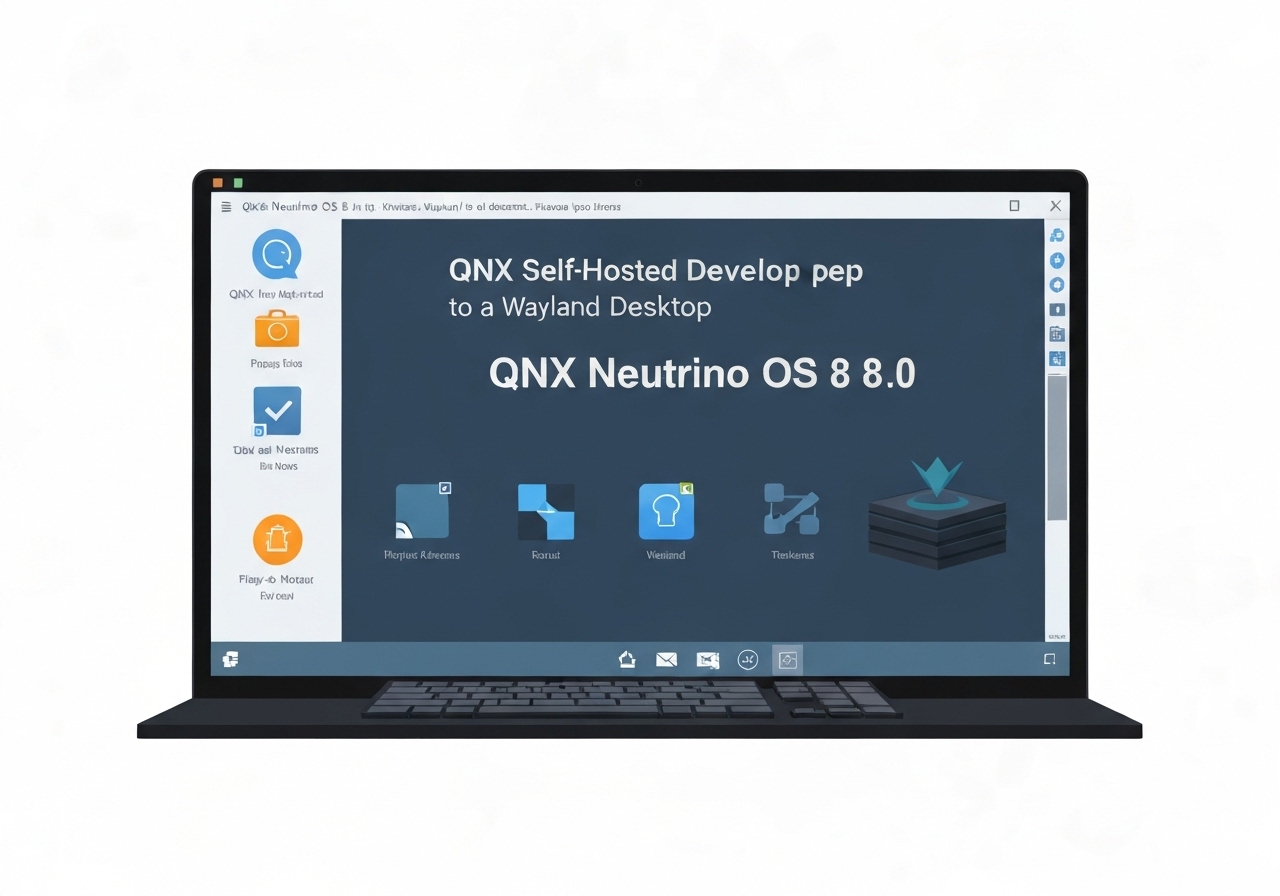
Earlier in December the QNX project published an initial release of the QNX Self-Hosted Developer Desktop, a developer-focused environment that runs a full desktop on QNX 8.0. The package aims to remove the need for cross-compilation when building QNX-targeted software by providing native build tools and editors inside a QNX guest. The debut release runs an Xfce desktop layered on Wayland and is distributed as a QEMU virtual machine image tested on Ubuntu Linux. QNX says the environment is available under the free personal license for non-commercial use, with the team also exploring a native Raspberry Pi image.
Key Takeaways
- The first public release of the QNX Self-Hosted Developer Desktop ships on QNX 8.0 and was announced earlier in December.
- The desktop environment uses Xfce on Wayland, combining a lightweight UI with a modern compositor stack.
- Standard developer toolchains are included: GCC and LLVM/Clang, plus Python and common build utilities.
- Popular editors such as Emacs, Geany, and Neovim are available in the image to support different workflows.
- The distribution is currently provided as a QEMU virtual machine and has been tested running on Ubuntu Linux.
- QNX retains its licensing model: the free personal license covers non-commercial hobbyists, students, and professionals; commercial use remains governed by other terms.
- The project plans to investigate a native image for Raspberry Pi hardware, but no release date was specified.
Background
QNX is a real-time operating system long used in embedded domains such as automotive, industrial control, medical devices, and consumer electronics. Historically, most QNX development workflows have relied on cross-compilation: developers build binaries on a host system and then deploy them to target hardware. That model can complicate iterative development and debugging, particularly for newcomers or small teams without dedicated embedded hardware.
The concept of a self-hosted developer desktop aims to reduce entry barriers by letting developers build and test directly inside the target OS environment. By packaging a desktop environment and native toolchains atop QNX 8.0, the project attempts to mirror workflows common on general-purpose Linux distributions while preserving QNX’s real-time characteristics for testing. Stakeholders include embedded system vendors, automotive suppliers, academic users, and individual hobbyists who use QNX for experimentation or prototyping.
Main Event
The released image runs an Xfce desktop on a Wayland compositor atop QNX 8.0, a combination chosen to balance responsiveness and a familiar user interface. Both GCC and LLVM/Clang toolchains are preinstalled, together with Python and typical build utilities, enabling compilation and testing entirely within the QNX environment. Editors such as Emacs, Geany, and Neovim are available to cater to different developer preferences and workflows.
Distribution is via a QEMU virtual machine image, which the QNX team tested primarily on Ubuntu Linux. Packaging the desktop as a VM sidesteps the usual hardware compatibility constraints that limit QNX to specific embedded platforms, making it easier for developers to get started on commodity x86 hosts. The project documentation indicates that a native Raspberry Pi image is under consideration, but that work remains exploratory at this stage.
The release is explicitly positioned under QNX’s free personal license for non-commercial use, so hobbyists, students, and non-commercial professionals can try the environment without purchasing a commercial license. Commercial development and deployment on physical embedded hardware continue to be subject to QNX’s standard commercial licensing and support arrangements.
Analysis & Implications
Providing a self-hosted desktop on QNX 8.0 reduces friction for developers who previously had to maintain separate host toolchains and deployment pipelines. For iterative development, running compilers and editors directly on the target OS can shorten edit-compile-test cycles and simplify debugging of OS-specific issues. This convenience could increase experimentation with QNX in academic settings and among hobbyist communities.
From an industry perspective, the VM-based approach makes it easier for systems programmers and integrators to prototype on standard laptops before committing to embedded hardware. That may accelerate early-stage development and proofs-of-concept for automotive plugins, IoT prototypes, and industrial controllers. However, a VM cannot fully replicate hardware-specific constraints such as real-time I/O latency, specialized drivers, or SoC peripherals, so final validation will still require target hardware tests.
Toolchain parity—shipping both GCC and LLVM/Clang—helps interoperability and testing across compiler ecosystems, reducing surprises when moving code between development and deployment. The inclusion of common editors and Python also aligns the environment with modern developer expectations, making QNX less foreign to engineers who primarily work on Linux desktops.
Comparison & Data
| Aspect | QNX Self-Hosted Desktop (this release) |
|---|---|
| Base OS | QNX 8.0 |
| Desktop | Xfce running on Wayland |
| Toolchains | GCC, LLVM/Clang, Python |
| Editors | Emacs, Geany, Neovim |
| Distribution | QEMU virtual machine image (tested on Ubuntu) |
The table summarizes the key components shipped with the initial release. Packaging as a QEMU VM favors portability and ease of setup, while the toolchain and editor selection aim to cover a broad range of developer preferences. Readers should note that performance characteristics and hardware support will differ between the VM image and native embedded deployments.
Reactions & Quotes
QNX’s own announcement framed the release as a step to simplify development workflows on the platform; the project highlighted native build tools and a desktop UI in the initial image.
“A developer desktop image that lets you build and run QNX code without cross-compiling.”
QNX official blog (announcement)
Independent coverage noted the technical choices—Wayland + Xfce and inclusion of both GCC and Clang—as practical trade-offs to make a lightweight but capable desktop environment.
“This image provides a familiar desktop experience while keeping the footprint suitable for embedded-focused development.”
Phoronix (technology press)
Community reaction is expected to focus on ease of setup and whether the VM approach will meet the needs of those who require hardware-accurate testing. Early responders on forums have welcomed the lowered barrier but emphasized that production validation still needs hardware tests.
Unconfirmed
- Exact timeline and feature set for an official native Raspberry Pi image have not been announced and remain unconfirmed.
- Performance characteristics of the VM image versus native hardware—particularly for real-time I/O—have not been independently verified.
- Whether the self-hosted desktop will be permitted under QNX commercial licensing for production development on customer hardware is not clarified in the announcement.
Bottom Line
The QNX Self-Hosted Developer Desktop for QNX 8.0 is a pragmatic first step toward reducing development friction on a traditionally cross-compiled platform. By bundling desktop UI, compilers, and editors into a QEMU image, the project lowers the barrier for experimentation and education while acknowledging that production validation still requires target hardware tests.
For hobbyists, students, and non-commercial users the free personal license offers a convenient way to explore QNX development. For industry users, the VM image can accelerate prototyping phases but should be supplemented by hardware-based testing and a review of commercial licensing before deployment.
Sources
- Phoronix — technology news report summarizing the release and technical details.
- QNX official site / blog — official project announcements and documentation (official).