
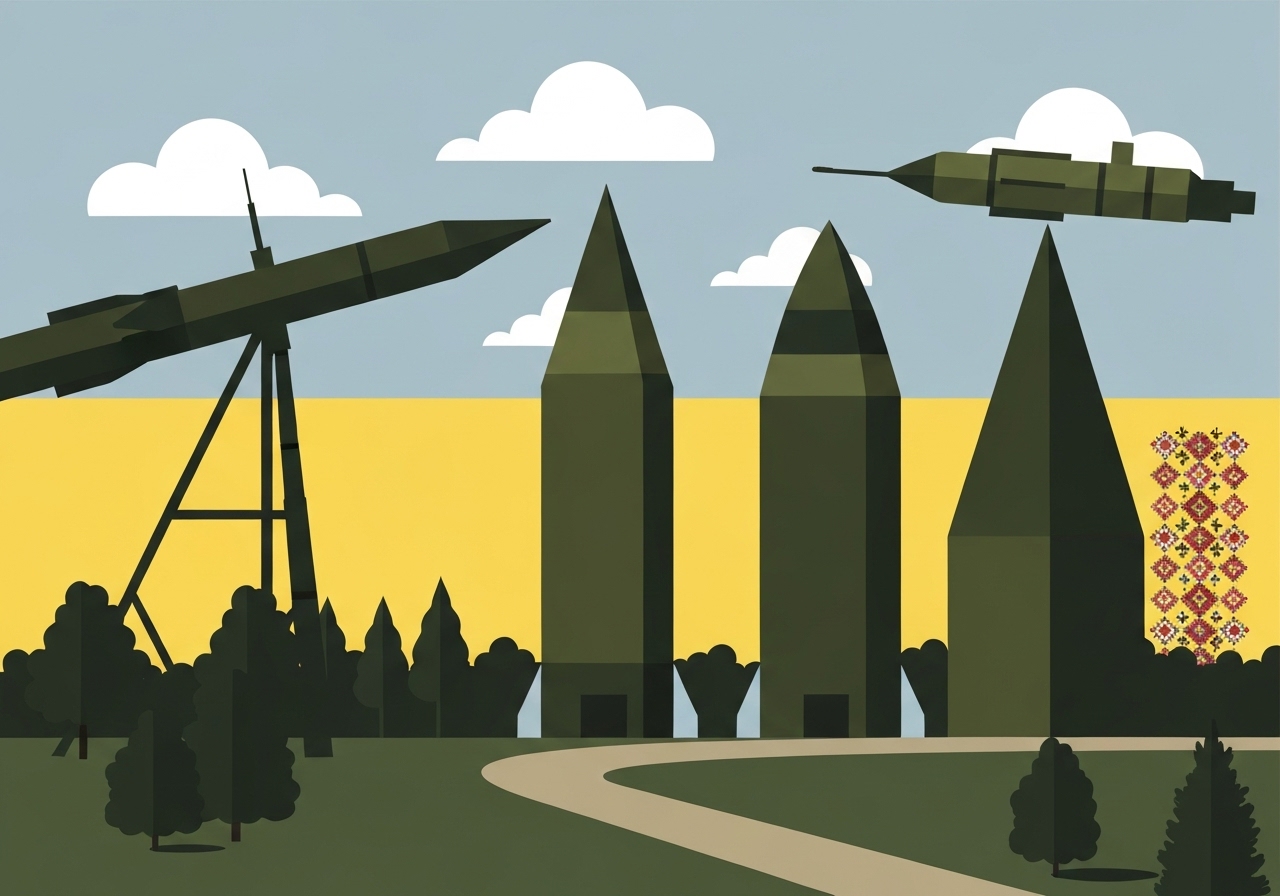
In southern Ukraine, an underground Cold War launch complex has been repurposed as the Museum of the Strategic Missile Forces, where visitors trace the history of Soviet strategic arms and the choice Ukraine made to dismantle its nuclear arsenal after independence. The site documents that 10 intercontinental ballistic missiles once stood on this base, each capable of carrying multiple warheads and reaching the U.S. East Coast in about 25 minutes. The museum frames the 1994 Budapest Memorandum—under which the U.S., Britain and Russia guaranteed Ukraine’s territorial integrity in return for denuclearization—as a pivotal moment now viewed by many Ukrainians as a mistake. On a blustery December day, guides and visitors recount pride, anger and regret as the exhibits underscore how that decision still shapes Ukraine’s security debate.
Key takeaways
- Ukraine inherited the world’s third-largest nuclear arsenal after the 1991 Soviet breakup and agreed to remove those weapons by 1994 under the Budapest Memorandum.
- The former 309th Missile Regiment site displayed here once hosted 10 ICBMs; each missile could carry up to 10 warheads and reach the U.S. East Coast in roughly 25 minutes.
- Museum exhibits include a preserved silo and a simulation showing the potential global devastation those missiles could cause — figures shown claim a single missile’s destructive radius at about 200,000 km2 (roughly Nebraska).
- Visitors and some diplomats now describe the denuclearization deal as a miscalculation because promised security assurances from Russia proved ineffective after the 2014 and 2022 invasions.
- Former U.S. President Bill Clinton has publicly expressed regret for his role in persuading Ukraine to relinquish its nuclear arms following Russia’s 2022 full-scale invasion.
- The site juxtaposes Cold War hardware with material from more recent conflicts, including destroyed Russian tanks from the ongoing war, reinforcing the museum’s theme of continuity between past and present threats.
Background
When the Soviet Union dissolved in 1991, Ukraine found itself in possession of strategic nuclear weapons and delivery systems, making it the third-largest nuclear power by stockpile. Kyiv’s leaders faced intense international pressure and incentives—security guarantees, diplomatic integration and economic support—to transfer warheads to Russia and pursue denuclearization. In January 1994, U.S. President Bill Clinton visited Kyiv en route to Moscow; later that year Ukraine, the U.S., Britain and Russia signed the Budapest Memorandum, which pledged respect for Ukraine’s sovereignty in return for giving up nuclear arms.
At the time many policymakers and experts argued that removing nuclear weapons would reduce proliferation risk and help Ukraine consolidate its independence and ties to the West. The physical dismantling took place in the mid-1990s: missiles were destroyed, launchers disabled and jets able to carry nuclear arms were decommissioned. On the museum grounds, ten silos were filled with concrete except for one preserved as an exhibit so visitors can see a decommissioned missile in situ.
Main event
The Museum of the Strategic Missile Forces occupies a once-secret ICBM base in the village of Pobuzke. The former deputy commander of the 309th Missile Regiment, Hennadiy Vladimirovitch Fil, now guides tours and leads visitors through control rooms, maps and artifacts that recreate the atmosphere of the Cold War rocket forces. He points out wall charts that show the planned mutual strike capability between the United States and the Soviet Union and explains that the 10 missiles at this site could each carry multiple warheads.
On a December visit described by museum staff, a preserved silo and a subterranean command post are major attractions. Guests descend a narrow elevator about 150 feet to see cramped living quarters intended to keep a launch crew operational for up to 45 days. The museum runs a launch simulation that requires two operators to act together, dramatizing how two gestures would have been needed to initiate a launch and underscoring the human procedures behind the hardware.
Visitors include local residents, soldiers and diplomats. Some, like a recent National Guard visitor, describe the museum as an essential part of national memory. Others, including guides who served in the unit, speak with bitterness about the later use of Ukrainian-made aircraft and equipment by Russian forces and about the perceived failure of international guarantees. Denmark’s ambassador to Kyiv who toured the site called the diplomatic assurances in 1994 a breach of trust.
Analysis & implications
The museum’s narrative highlights a broader security dilemma: denuclearization reduced the number of states with nuclear arms, but it also removed a deterrent that some Ukrainians now believe might have prevented Russian aggression. This is a counterfactual claim—whether nuclear weapons would have deterred Russia cannot be proven—but it shapes public sentiment and policy demands for strong, enforceable security guarantees in any negotiations.
Politically, the Budapest Memorandum’s failure to prevent aggression has eroded trust in diplomatic assurances and strengthened Ukrainian calls for binding, multilateral security arrangements. That erosion complicates future nonproliferation messaging: other states may view legally nonbinding promises as insufficient if guarantees are not backed by robust verification and enforcement mechanisms.
Strategically and militarily, the museum juxtaposes past strategic capabilities with present-day conventional conflict, suggesting a shift from nuclear deterrence debates to immediate requirements for air defense, modernized armed forces and NATO-style interoperability. Economically, the long-term cost of rebuilding and rearming under sustained conflict pressures Ukraine’s budget and international aid priorities.
Internationally, the museum functions as a symbolic indictment of how security assurances were handled in the 1990s; diplomats visiting the site sometimes express publicly that stronger mechanisms should have been negotiated, and such statements feed current European discussions over collective security and conventional deterrence investments.
Comparison & data
| Item | Reported figure |
|---|---|
| ICBMs at site | 10 |
| Warheads per missile (capacity) | Up to 10 |
| Estimated target reach | U.S. East Coast in ~25 minutes |
| Destructive area cited | ~200,000 km² (≈77,000 mi²) |
| Subterranean descent | ~150 feet |
The table above summarizes figures presented at the museum and in official accounts of the 309th Missile Regiment. While the physical metrics (numbers of missiles, silo depth) are verifiable on site, some impact estimates—such as the area of destruction attributed to a single missile—are models intended to convey scale rather than precise casualty projections. The comparison underscores how the museum blends hardware, operational detail and visualizations to communicate the stakes of strategic nuclear forces.
Reactions & quotes
If we had kept these weapons, probably Russia would not have attacked. The nuclear weapons were our insurance.
Ihna Kravchuk, museum visitor (translated)
This visitor’s remark encapsulates a common sentiment among museum-goers who view denuclearization as a missed deterrent. It reflects public-level speculation rather than a verifiable causal chain.
They gave them up with the promises of the three powers, and clearly the guarantees given from Russia at the time were not worth the paper they were written on.
Thomas Lund-Sørensen, Denmark’s Ambassador to Kyiv
The Danish ambassador’s comment stresses a diplomatic judgment shared by some Western officials: that nonbinding assurances proved insufficient when tested by later events. Such assessments inform current debates about what forms of legal and military backing are credible.
I feel terrible about it… I feel a personal stake because I got them to agree to give up their nuclear weapons.
Bill Clinton (excerpt, RTE interview following 2022 invasion)
Former President Clinton has publicly acknowledged regret about his role in the denuclearization process, a rare admission from a senior participant that feeds public perception of policy error.
Unconfirmed
- The assertion that possessing nuclear weapons would have definitively deterred Russia from invading remains speculative and cannot be empirically verified.
- Claims that specific Ukrainian aircraft or hardware used by Russia were transferred only as direct payment for gas debts are contested in some accounts and require further documentary confirmation.
- Attribution of precise casualty or environmental outcomes from a hypothetical nuclear exchange shown in museum visualizations are model-based projections, not observed events.
Bottom line
The Museum of the Strategic Missile Forces is more than a Cold War exhibit: it is a physical and emotional focal point for contemporary debates about security, trust and the costs of diplomatic bargains. For many Ukrainians, the site crystallizes a narrative of lost deterrence and broken assurances that continues to shape public opinion and policy demands.
Whether those past decisions were strategic mistakes cannot be resolved definitively, but their political consequences are clear: Kyiv now seeks stronger, enforceable international guarantees and immediate conventional capabilities to manage current threats. The museum therefore functions as both memorial and argument, reminding domestic and international audiences why the form and credibility of security commitments matter.
Sources
- NPR (news report on museum visit and interviews)
- Budapest Memorandum (Wikipedia) (background summary of the 1994 agreement)