
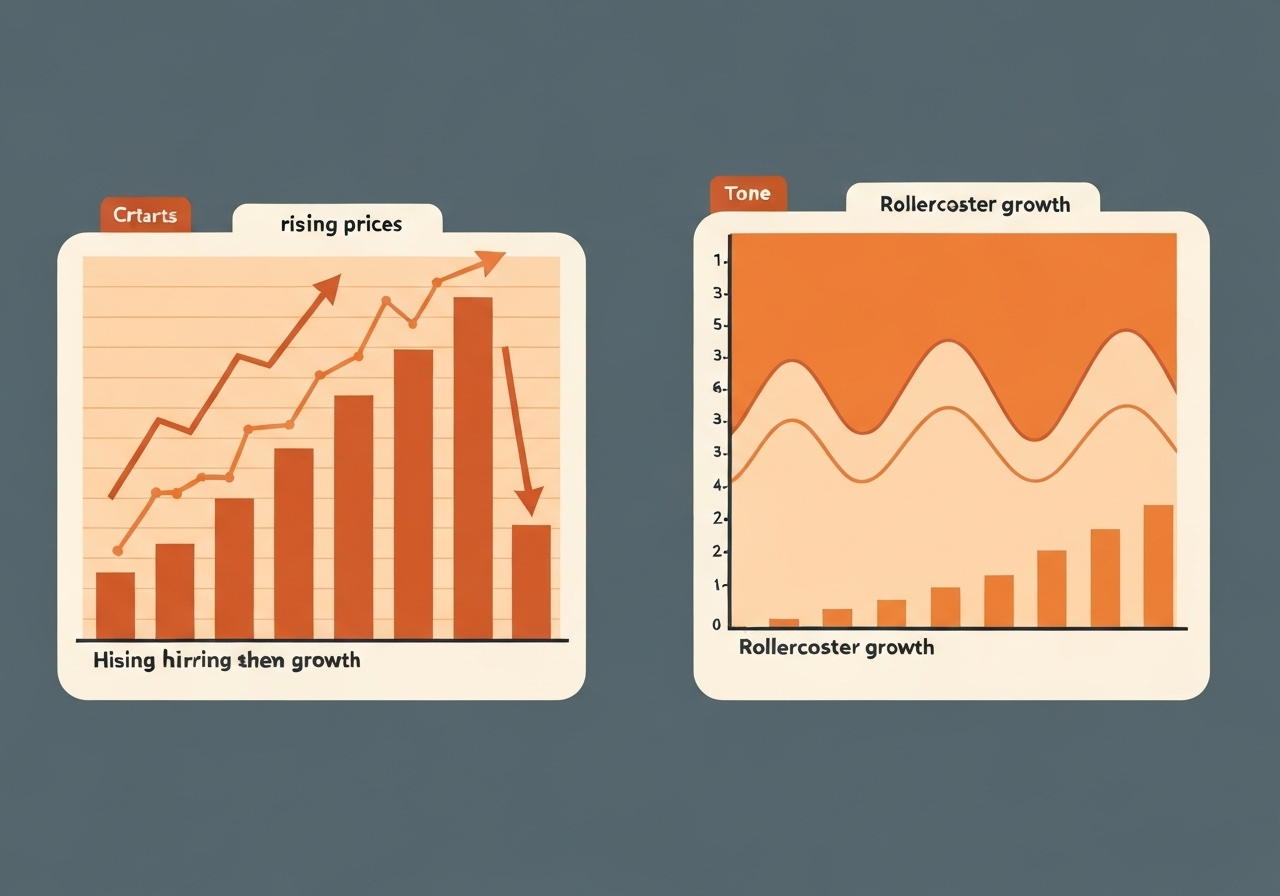
Lead: In 2025 the US economy produced mixed signals: an unexpectedly strong third-quarter GDP reading contrasted with persistent price pressures and signs of weakening labor-market momentum. President Donald Trump hailed the data as evidence of a renewed economic boom, while official statistics show unemployment rising and job counts dipping in several months. Policymakers at the Federal Reserve have begun easing rates from two-decade highs but remain cautious about reversing course too quickly. The picture is therefore one of stronger headline growth but fragile foundations beneath it.
Key Takeaways
- Q3 2025 GDP surprised on the upside, delivering a robust quarterly rebound that followed an earlier contraction in Q1.
- Inflation, after peaking in 2022, remained elevated through 2025 despite policy efforts; price levels have not fallen overall.
- The unemployment rate rose to 4.6% in November 2025, the highest since September 2021, according to Bureau of Labor Statistics data.
- Employment showed intermittent losses: job counts fell in June and August, and an estimated 105,000 jobs were lost in October amid the longest federal shutdown in US history.
- The federal civilian workforce has declined by about 271,000 since January 2025, while the number of unemployed Americans has risen by roughly 1 million in the same period.
- The Federal Reserve raised rates to a two-decade high to fight inflation, then began modest cuts by year-end; the Fed’s leadership and approach have become politically contentious.
- After 2.8% growth in 2024, forecasts indicate roughly 2.0% expansion for 2025 and 2.1% for 2026, leaving growth steady but not spectacular.
Background
Inflation became a dominant political and economic issue after the Covid-19 pandemic, peaking at multi-decade highs in 2022 and remaining a major concern for households. Rising prices shaped the 2024 presidential race: then-candidate Donald Trump campaigned on promises to bring down costs and even touted the goal of reducing prices themselves, not merely the rate of increase. In office, his administration pursued measures including tariffs intended to reshape trade flows and domestic production.
Monetary policy responded to the inflation shock with one of the steepest tightening cycles in modern US history: the Federal Reserve pushed its policy rate to levels not seen in about 20 years. By the end of 2025 the Fed had begun easing, but officials emphasized caution to avoid undoing progress on inflation. Political pressure has mounted on the central bank, and President Trump moved to fill rate-setting positions with figures closer to his outlook; he is also positioned to influence the Fed’s leadership next year.
Main Event
The official growth story for 2025 was uneven. GDP contracted in the first quarter—partly reflecting a surge in imports ahead of anticipated tariffs—and then recovered in subsequent quarters, culminating in a surprisingly strong third-quarter print. That recovery provided the headline that the White House seized to argue a major economic upswing was under way.
But labor-market data told a less uniform tale. After a post-pandemic hiring surge, job growth cooled: payrolls fell in June and August, and the October total dropped by an estimated 105,000 during an extended federal shutdown. The unemployment rate climbed through the year, reaching 4.6% in November as reported by the Bureau of Labor Statistics.
On prices, inflation remained sticky. Although the annual pace is down from its 2022 peak, many households continue to face high costs for essentials. Some economists warned that the administration’s tariffs on imports could raise consumer prices, offsetting gains from lower headline inflation rates. Meanwhile, the Fed’s cautious rate cuts signaled that policy makers were balancing growth support against the risk of reigniting price pressures.
Analysis & Implications
The divergence between headline GDP and everyday experience matters politically and economically. GDP reflects overall spending and production, and a strong quarter can mask distributional effects—where growth is concentrated in sectors that do not proportionally raise household incomes. Persistently high prices erode real purchasing power, particularly for lower-income families whose budgets are more weighted toward necessities.
Labor-market weakening is a central concern. Rising unemployment and month-to-month job losses suggest slack that could slow wage growth and consumer demand. The federal workforce reduction—271,000 fewer civilian federal employees since January 2025—helps explain part of the payroll decline, but the rise of roughly 1 million unemployed shows broader weakness beyond government staffing changes.
Policy decisions will be pivotal. The Fed faces a classic trade-off: ease too quickly and inflation risks re-accelerating; hold rates too long and the economy may cool, pushing unemployment higher. Political interference or shifts in Fed leadership could also change market expectations, affecting investment, exchange rates and long-term borrowing costs.
Comparison & Data
| Year | Annual GDP growth |
|---|---|
| 2024 | 2.8% |
| 2025 (estimate) | 2.0% |
| 2026 (forecast) | 2.1% |
These figures show a moderation from the 2024 outcome but a resilient expansion through 2025 overall. The quarterly path—Q1 contraction followed by Q2–Q3 rebound—underlines the volatility beneath headline annual numbers. When combined with labor-market metrics and inflation readings, the data suggest moderate growth that is vulnerable to shocks and policy shifts.
Reactions & Quotes
The White House used the Q3 GDP result to argue the administration’s policies are working, framing the number as the start of a sustained boom. Critics counter that headline GDP does not reflect persistent price pressures and uneven job gains.
“The Trump Economic Golden Age is FULL steam ahead,” the president wrote on social media after the Q3 report, celebrating the stronger GDP print.
Donald J. Trump (social media)
Federal Reserve officials stressed caution around rate cuts and rejected political pressure to move aggressively. Observers in central banking circles warned that premature easing could reverse inflation gains.
“We must be thoughtful in removing policy restraint to protect the progress made on inflation,” Fed officials said in public briefings late in the year.
Federal Reserve (official statements)
Economic analysts noted the contradiction between GDP strength and labor-market softness, underlining the risk that rising unemployment could undermine consumer confidence and spending. Public reaction was mixed: some households welcomed lower borrowing costs, while many expressed concern about persistent living-cost pressures.
Unconfirmed
- Claims that tariff measures have already reduced consumer prices nationwide lack clear evidence and require more granular price-series analysis.
- Attribution of all recent job losses to declines in the federal workforce is incomplete; private-sector and sectoral employment trends also contributed and need further breakdown.
- Whether the Fed will accept a full replacement of its chair next year and how quickly policy will change are contingent on appointments and are not yet settled.
Bottom Line
2025 delivered a mixed economic narrative: headline GDP strength coexisted with persistent inflation and cooling job growth. That combination leaves the recovery fragile—capable of producing surprising positives but vulnerable to setbacks that affect households unevenly.
Policymakers face a delicate path. The Federal Reserve’s cautious easing reflects concern about rekindling inflation, while political pressure for lower rates and rapid gains in hiring creates competing priorities. For many Americans, the key test will be whether wage growth and price relief reach their budgets, not just whether GDP prints appear favorable.
Sources
- The Guardian — media report summarizing official data and political statements (news coverage).
- Bureau of Labor Statistics — official labor-market releases and unemployment figures (official statistics).
- Federal Reserve — policy announcements and statements on interest rates (central bank, official).
- The White House — administration commentary and policy announcements (official communications).