
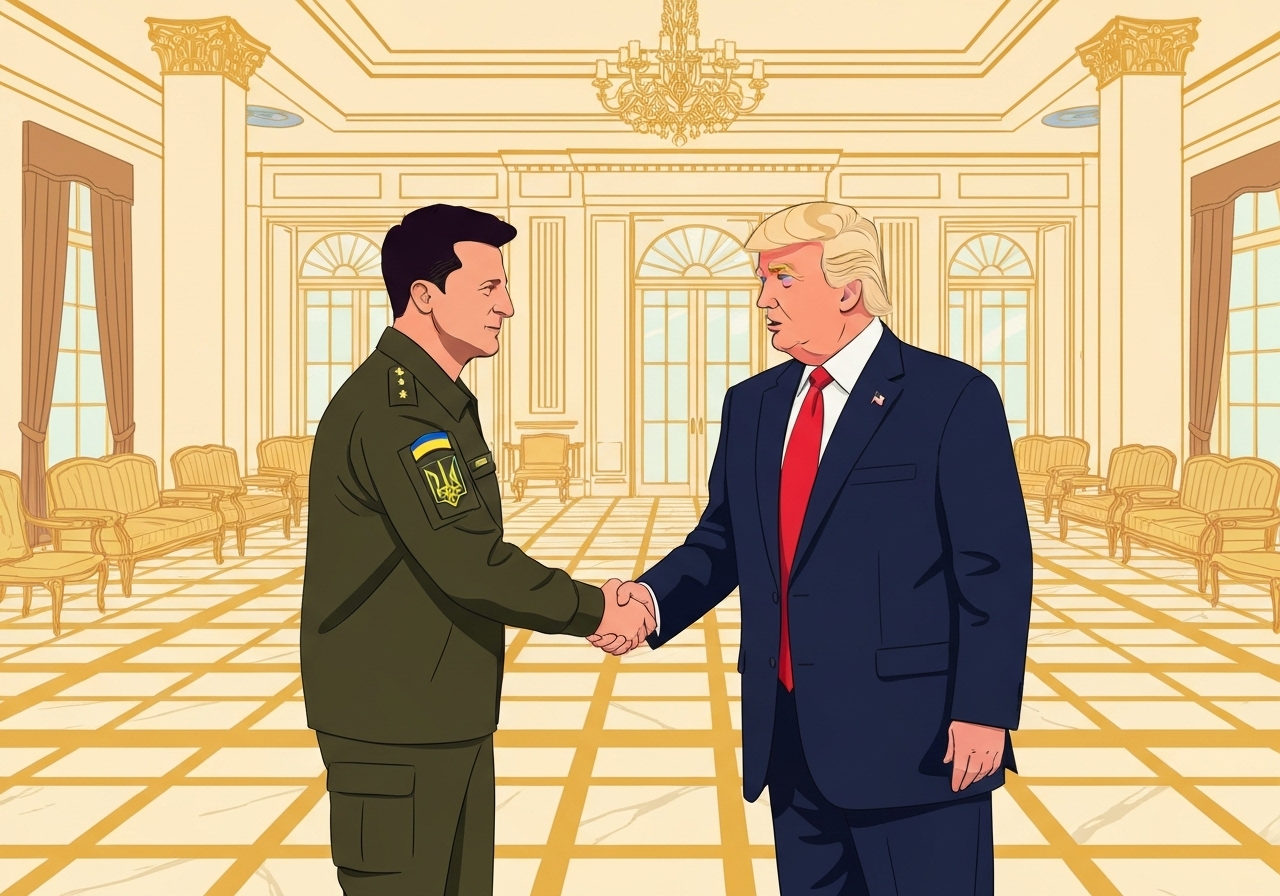
Lead: Ukrainian president Volodymyr Zelenskyy arrived at Mar-a-Lago in Palm Beach, Florida, on 28 December for a high-stakes summit with former US president Donald Trump. The two greeted each other publicly before moving inside for detailed discussions; Trump told reporters he believes the talks are in their “final stages” and signalled a follow-up call with European leaders. Both men said they aim to advance a 20-point peace proposal that Kyiv describes as roughly 90% complete. The meeting follows a lengthy Trump-Putin call earlier in the day and comes amid fresh Russian strikes on Ukrainian territory.
- Key Takeaways:
- Zelenskyy arrived at Mar-a-Lago on 28 December and met Trump, who said the negotiations were near completion and that he would brief Zelenskyy on his earlier call with Vladimir Putin.
- The Ukrainian 20-point plan is reported as about 90% complete and includes requests for Article-5‑style security guarantees and a target date for EU accession.
- Key specific proposals in the draft: maintaining Ukraine’s armed forces at 800,000 troops and a $800bn reconstruction package to rebuild infrastructure and the economy.
- On territory, the draft calls for freezing fighting in Donetsk at current lines and creating a demilitarised buffer zone overseen by international forces; details remain contested.
- Zelenskyy and Trump plan to place a joint call with European leaders during the Mar-a-Lago meeting to coordinate security guarantees and the diplomatic track.
- Russian officials, including Foreign Minister Sergey Lavrov, have criticised European roles and warned that European peacekeeping troops would be treated as legitimate targets, a claim that raises sharp geopolitical risks.
- Trump said he had a “good and very productive” call with Putin earlier on 28 December, and Kremlin aides reported the call lasted more than an hour.
Background:
The discussions at Mar-a-Lago come after nearly three years of war that has reshaped European security and drawn sustained Western military and economic support for Ukraine. Kyiv has framed a 20-point blueprint as the basis for a negotiated end to hostilities; the plan mixes security guarantees, territorial arrangements, economic reconstruction and institutional integration with the EU. Western capitals have varied in their responses — some have emphasised full Ukrainian territorial restoration while others weigh pragmatic compromises to halt further bloodshed. Russia has countered with its own demands and rhetoric, and senior Kremlin officials have already sought to influence the negotiating framework ahead of the Trump-Zelenskyy meeting.
Donald Trump’s re-engagement in direct talks with both Kyiv and Moscow is notable for its departure from the formal US government diplomacy channels used by the current administration. Trump’s team assembled a sizable delegation at Mar-a-Lago, and journalists were briefly admitted to the dining room before being escorted out, underscoring the tightly managed nature of the encounter. European leaders are being looped in during the meeting, reflecting the fact that any lasting security arrangements for Ukraine will need broad international endorsement beyond bilateral US-Ukraine commitments.
Main Event:
Zelenskyy arrived in Florida and met Trump in public at Mar-a-Lago, where both leaders posed for photographs and exchanged brief remarks. Reporters asked Trump whether he believed Vladimir Putin was sincere about making peace; Trump replied affirmatively and said both presidents wanted a deal, while stressing urgency to prevent further casualties. He also told Zelenskyy he would report on the earlier conversation with Putin and later planned to call Putin again to continue negotiations.
The Ukrainian delegation is discussing a 20-point document that Kyiv’s side says is about 90% agreed with US interlocutors. Among the items under active discussion are firm security guarantees modelled on NATO’s Article 5, a precise timetable for EU accession steps, and arrangements for contested territories such as Donetsk and parts of the south. Zelenskyy emphasised to reporters he hoped the talks would “bring peace as quick as possible,” while stressing continued need for military aid and international pressure on Russia.
The meeting occurred after senior Russian aides told state media that Trump initiated a more-than-one-hour call with President Putin. Russian officials, including an adviser who briefed reporters, argued that a temporary ceasefire proposed by the EU and Ukraine could prolong conflict and urged Kyiv to make rapid, politically difficult decisions over the Donbas. Separately, Moscow’s foreign ministry has framed the EU as an obstacle to negotiations and warned against European peacekeepers, escalating the stakes of any multinational force proposals.
Analysis & Implications:
If the parties inch toward an agreement, the diplomatic architecture will face immediate practical and political tests: how to write enforceable security guarantees, who will underwrite them, and whether Kyiv will accept territorial compromises sufficient to get Moscow to cease hostilities. An Article-5‑style pledge would require acting partners willing to respond to renewed aggression; finding that coalition and binding its commitments will be difficult, especially if some European governments oppose certain concessions. The $800bn reconstruction figure in the draft signals both the scale of rebuilding needed and the diplomatic leverage such aid could convey during talks.
Territorial arrangements—particularly a proposed freeze of fighting in Donetsk and the creation of an internationally monitored buffer zone—are sensitive because they touch directly on Ukrainian sovereignty and domestic politics. Any arrangement that leaves Russian forces de facto control over parts of Ukraine risks political backlash in Kyiv and among Western publics, potentially undermining long-term stability. Conversely, failing to achieve a ceasefire could mean continued escalation and more civilian casualties through winter and into 2026, as Trump himself warned about the human cost of delay.
Russia’s public warnings about treating European peacekeepers as legitimate targets complicate options for multinational forces and raise legal and operational questions about force protection and mandate. If Moscow sustains that position, Western planners must weigh whether peacekeepers would deter further fighting or become focal points for renewed confrontation. The involvement of several international actors — the US, EU states, and NATO-affiliated partners — will also determine whether any agreement can be implemented and monitored credibly.
| Plan element | Reported detail |
|---|---|
| Military size | Ukraine to maintain 800,000 armed forces |
| Reconstruction funding | $800 billion proposed for infrastructure and economy |
| Diplomatic status | EU accession date to be specified in draft |
| Territorial approach | Freeze fighting in Donetsk and create a demilitarised buffer zone |
| Plan status | Ukrainian team says 20-point plan ~90% complete |
Reactions & Quotes:
“I do, I do. I think he is, I think they both are.”
Donald Trump, on whether Putin is serious about peace
Context: Trump said he believed both presidents wanted a deal and later told Zelenskyy he would brief him on his conversation with Putin.
“We’ve got to make a deal, got to get it done … I think both presidents want to make a deal.”
Donald Trump, to reporters
Context: Trump repeated urgency about reaching an agreement and indicated he would continue direct outreach to Moscow after meeting Zelenskyy.
“I hope the talks will bring peace as quick as possible.”
Volodymyr Zelenskyy, arriving at Mar-a-Lago
Context: Zelenskyy reiterated the importance of security guarantees and continued military support while negotiating territorial questions.
Unconfirmed:
- Exact final text of any security guarantees — full wording and participating guarantor states have not been disclosed.
- Details on how control of the Zaporizhzhia nuclear plant would be split between Ukraine and the US remain reported but not independently verified.
- Whether Russia will accept a demilitarised buffer zone overseen by international forces — Moscow’s acceptance has not been confirmed.
- Precise terms or timetable for Ukraine’s EU accession as referenced in the draft have not been finalised.
Bottom Line:
The Mar-a-Lago meeting is a consequential, high-risk bid to accelerate a negotiated end to a war that has already exacted heavy human and material costs. Zelenskyy arrived seeking concrete security guarantees, financial pledges for reconstruction and a sustainable arrangement for contested territory; Trump signalled optimism about progress but provided few public specifics. Any breakthrough will depend on credible guarantees, enforceable mechanisms and buy-in from European partners — all of which face significant political and operational hurdles.
In the short term, expect intense diplomatic consultations among Washington, Kyiv, European capitals and Moscow; implementation would require months of legal, military and logistical work. The coming days will show whether the Mar-a-Lago encounter produces a framework that can be converted into verifiable, multilateral commitments or whether differences over territory and guarantees prevent a durable settlement.
Sources: