
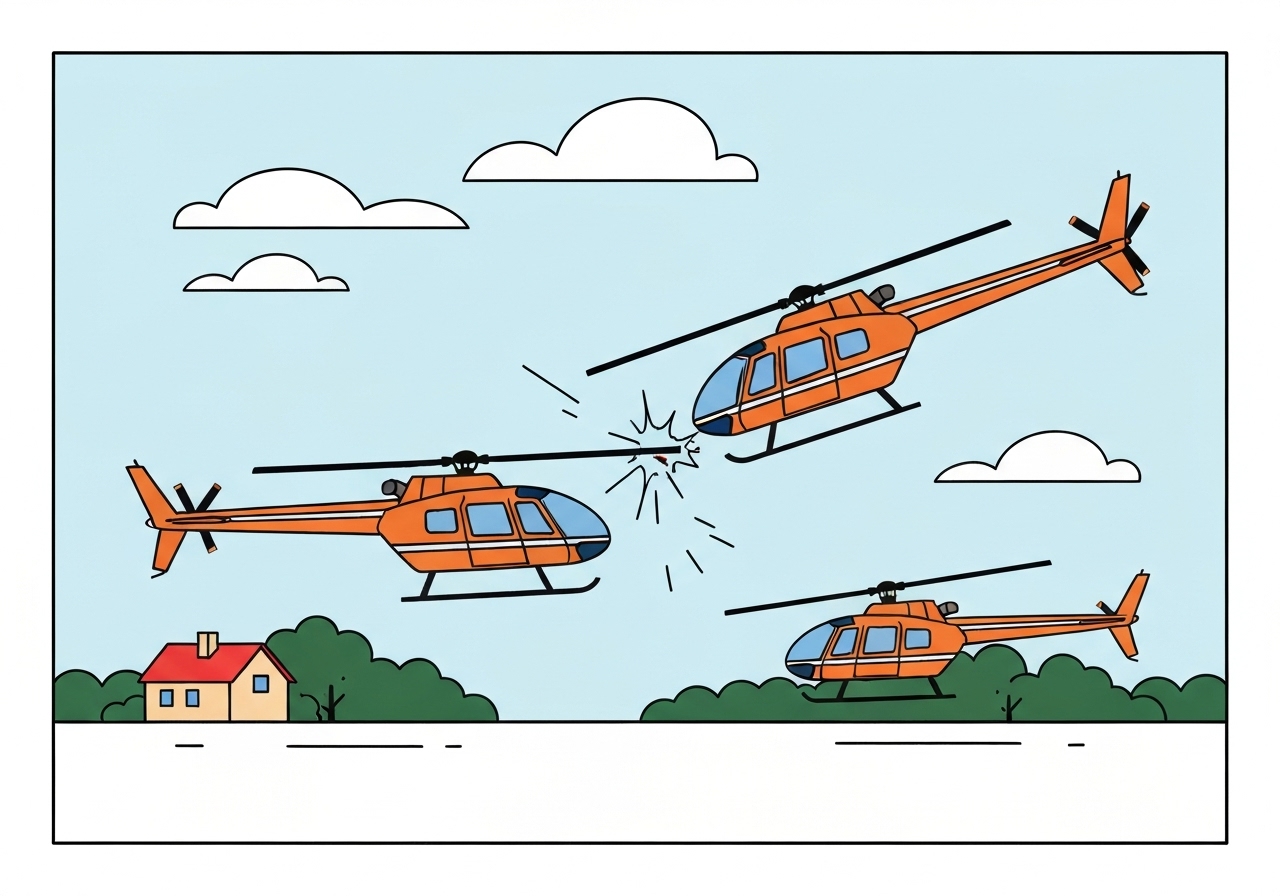
Two pilots were killed after two light helicopters collided in mid-air above Hammonton, New Jersey, on Sunday, officials said. The pilots were identified as Kenneth L Kirsch, 65, and Michael Greenberg, 71, both New Jersey residents. The National Transportation Safety Board said the aircraft involved were an Enstrom 280C and an Enstrom F-28A, and the collision occurred at about 11:25 EST (16:25 GMT). The Federal Aviation Administration has opened a federal investigation into the crash; only the two pilots were on board.
Key takeaways
- Two pilots died: Kenneth L Kirsch, 65, and Michael Greenberg, 71, both from New Jersey, according to Hammonton Police.
- The crash occurred above Hammonton, roughly 35 miles (56 km) southeast of Philadelphia and near the Atlantic City Expressway.
- The incident involved two Enstrom models — a 280C and an F-28A — at about 11:25 EST (16:25 GMT), per the NTSB.
- Only the two pilots were aboard the aircraft; no passengers were reported on either helicopter.
- One helicopter was reported to be engulfed in flames when it crashed; emergency crews worked to extinguish the blaze on scene.
- The FAA confirmed it will conduct a federal investigation into the cause, with the NTSB also involved in the factual record.
- FAA data indicate the rate of deadly helicopter accidents has declined on average over the past three years, though individual incidents still occur.
Background
Hammonton sits about 35 miles (56 km) southeast of Philadelphia and lies just off the Atlantic City Expressway, a corridor used by private and training flights as well as general aviation. Light helicopters such as the Enstrom 280C and F-28A are commonly used for private transport, instruction and utility work; both types typically carry three people or fewer. Mid-air collisions of small rotorcraft are rare but historically have prompted thorough federal probes because they often involve simple aircraft in busy low-altitude airspace. Federal oversight of such accidents typically includes FAA jurisdiction for regulatory concerns and the NTSB for on-scene factual investigation and safety recommendations.
Over the last decade, U.S. helicopter operations have seen changing safety profiles driven by maintenance standards, pilot training, and air-traffic integration at low altitudes. The FAA publishes accident and fatality trend data; recent summaries show a reduction in the rate of fatal helicopter accidents over the past three years, though year-to-year variation can be significant. High-profile collisions, including a deadly January incident in Washington, D.C., have underscored the consequences when aircraft trajectories intersect unexpectedly. Local emergency services in towns like Hammonton are typically first responders to crashes, stabilizing scenes for federal investigators to follow.
Main event
Local police reported the collision occurred on Sunday morning above Hammonton. The National Transportation Safety Board identified the aircraft involved as an Enstrom 280C and an Enstrom F-28A and estimated the time at roughly 11:25 EST (16:25 GMT). Hammonton Police later identified the deceased pilots as Kenneth L Kirsch, 65, and Michael Greenberg, 71, both residents of New Jersey; only the pilots were aboard each helicopter, officials said.
Police and fire units responded to the scene where one helicopter was reported to be engulfed in flames as it came down. Emergency personnel worked to extinguish the blaze and secure the crash site while awaiting federal investigators. The FAA said it will open a formal investigation to determine contributing factors and causal sequence. The NTSB typically coordinates on-site factual data collection, including wreckage mapping, medical and pathologic records, and recorded communications if available.
Witnesses in the area reported seeing the aircraft descend rapidly; investigators will combine eyewitness accounts with radar, telemetry and maintenance records. Because both aircraft were light helicopters carrying only their pilots, passenger lists did not factor into the initial response. Officials stressed that the investigation could take months, as with other mid-air collisions, to produce conclusive findings about causes or safety recommendations.
Analysis & implications
Mid-air collisions between small helicopters remain uncommon, but when they occur they prompt scrutiny of operational factors such as flight paths, see-and-avoid limitations, training, and airspace coordination. Light helicopters often operate under visual flight rules (VFR), relying on pilots to see and avoid other traffic; that reliance can be challenged by sun glare, cloud layers, or high closure rates between aircraft. If investigators find communication gaps or failures in traffic-awareness systems, that could lead to recommendations for improved radio procedures or better use of transponders and traffic-alert technologies in similar aircraft.
Regulatory implications may include renewed emphasis on pilot training for collision avoidance and potential measures to increase equipage of small helicopters with traffic-awareness tools. Economic and operator impacts follow: tighter requirements or mandated equipment can raise costs for private owners and small operators, but proponents argue such measures reduce fatal accident risk. The January mid-air in Washington that killed 67 people demonstrates how mid-air events can quickly become national safety priorities and trigger broad reviews of procedures and oversight across multiple categories of aircraft.
At a community level, the deaths of two local pilots will likely prompt local stakeholders to advocate for clearer flight routing and improved coordination among flight schools, private operators, and municipal authorities. For the wider aviation community, investigators’ findings could influence manufacturer advisories, maintenance guidance, or pilot-operating checklists. Because both aircraft involved are light Enstrom models, any model-specific findings could have implications for owners and maintenance facilities that service similar airframes.
Comparison & data
| Model | Typical seating | Role |
|---|---|---|
| Enstrom 280C | 2–3 | Light civilian helicopter; training/private use |
| Enstrom F-28A | 2–3 | Earlier Enstrom variant; light civilian operations |
The two Enstrom models involved are small, piston-engine helicopters typically used for private flights and instruction. Because both have limited seating and operate frequently under visual flight conditions, investigators will focus on visibility, flight rules in use and whether either aircraft was using a transponder or traffic-awareness system. FAA trend summaries indicate a reduction in the rate of fatal helicopter accidents over the last three years on average, but isolated crashes such as this one continue to generate detailed reviews to identify risk-reduction steps.
Reactions & quotes
Officials provided brief statements as the investigation began, emphasizing the fatal outcome and the opening of a federal inquiry.
“There will be a federal investigation into what led to the collision,”
Federal Aviation Administration (official statement)
Local authorities released the names of the pilots and described first responders’ actions on scene.
“Hammonton Police identified the pilots as Kenneth L Kirsch, 65, and Michael Greenberg, 71,”
Hammonton Police (local law enforcement)
The NTSB provided the aircraft models and the approximate time of the accident as part of its initial factual release.
“The crash involved an Enstrom 280C and an Enstrom F-28A at about 11:25 EST (16:25 GMT),”
National Transportation Safety Board (initial factual information)
Unconfirmed
- Whether weather, visibility or sun glare played a role has not yet been confirmed by investigators.
- It is unconfirmed whether either aircraft was equipped with or transmitting on a traffic-alerting transponder at the time of collision.
- Any communication between the two pilots or with air-traffic control has not been publicly released and remains unconfirmed.
Bottom line
The mid-air collision above Hammonton resulted in the deaths of two experienced pilots and has triggered a federal probe by the FAA with on-scene factual work by the NTSB. While helicopter fatality rates have declined on average in recent years, this incident underscores that intersection risks persist where light helicopters operate under visual flight conditions. The investigation will seek to determine causal factors — pilot actions, equipment, airspace coordination or environmental conditions — and may yield safety recommendations that affect small helicopter operations nationwide.
For residents, operators and regulators, the focus now is on an evidence-based inquiry to prevent similar tragedies. The full sequence of events and any policy implications will depend on months of data collection and analysis; readers should expect periodic official updates as investigators complete their factual record and issue findings or recommendations.
Sources
- BBC News (news report summarizing local and federal statements)
- Federal Aviation Administration (official press releases) (federal investigator and oversight statements)
- National Transportation Safety Board (official) (on-scene factual reporting and investigation coordination)