
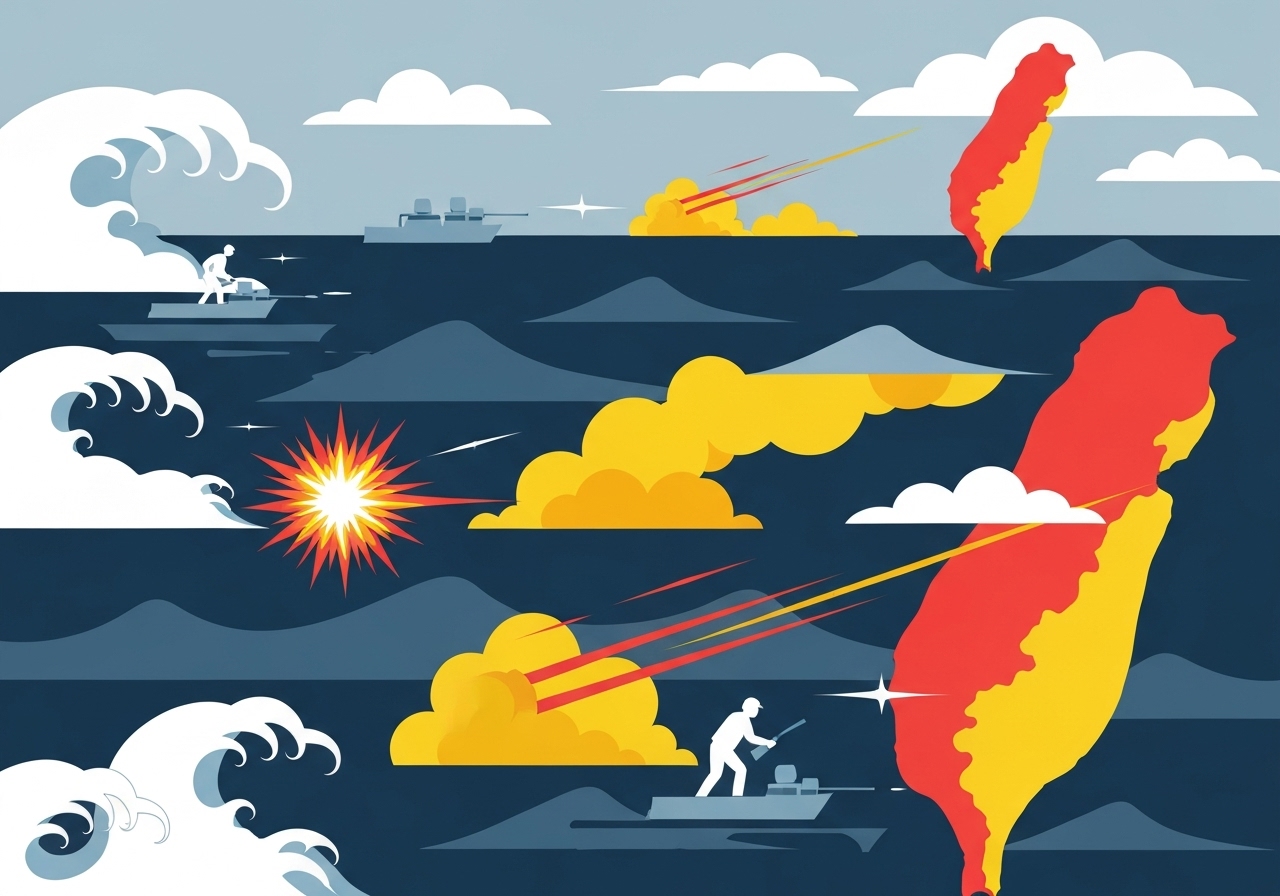
Lead: On Monday, China deployed air, naval and missile units to conduct joint live-fire drills around Taiwan, which Beijing described as a “stern warning” against separatists and foreign interference. Taiwan placed its military on heightened alert and said the exercises disrupted more than 100,000 international travelers through flight cancellations and diversions. Chinese state and military spokespeople framed the maneuvers as necessary to defend sovereignty after recent U.S. arms-sale developments and comments from Japan’s prime minister. Authorities in Taipei and regional aviation officials warned the drills could continue into Tuesday and carry broader regional implications.
Key Takeaways
- China’s Eastern Theater Command launched combined live-fire drills on Monday around the Taiwan Strait, deploying destroyers, frigates, fighters, bombers, UAVs and long-range rockets.
- Taiwan reported 89 aircraft and drones operating near the strait by 3 p.m., with 67 entering Taipei’s defined “response zone.”
- the Taiwanese Defense Ministry detected 14 navy vessels near the strait, four warships in the Western Pacific, and 14 coast guard ships monitoring the situation.
- Taiwan’s aviation authority said more than 850 international flights were scheduled during the exercise window, affecting over 100,000 international travelers and canceling about 80 domestic flights (≈6,000 passengers).
- Beijing described the drills as a reply to a proposed U.S. arms sale valued at more than $10 billion and recent political statements from Japan’s leadership.
- Chinese officials also announced sanctions last week on 20 U.S. defense-related firms and 10 executives, citing the arms-sale announcement.
- Chinese spokespeople emphasized objectives including sea-air combat readiness, joint superiority, and blockades of key ports in the region.
Background
China and Taiwan have been governed separately since 1949, when the Chinese civil war left the Communist Party in control of the mainland and the Nationalists relocating to Taiwan. Since then, Taiwan has maintained its own government and armed forces, while Beijing continues to assert a claim of sovereignty over the island.
In recent years, Beijing has increased the frequency and scale of military sorties and exercises near Taiwan, citing the need to deter what it calls separatism and foreign interference. Washington has longstanding obligations under U.S. law to help Taipei maintain defensive capabilities; that framework has been at the center of repeated Chinese objections to U.S. arms sales.
Main Event
China’s Eastern Theater Command said the drills centred on the Taiwan Strait and adjacent areas to the north, southwest, southeast and east of the island. The command described tasks including sea-air coordination, precise target acquisition and simulated blockades of critical ports.
Taiwan’s Defense Ministry reported sustained rapid-response exercises and forces on high alert. By midafternoon on Monday, Taipei counted 89 aircraft and drones operating around the strait, 67 of which entered its response zone; it also tracked 14 nearby navy vessels and multiple coast guard ships.
Beijing framed the operation as both a deterrent to Taiwan independence and a message to external powers considering military support for Taipei. Chinese spokespeople published themed posters and social-media messaging alongside the drills, under slogans emphasizing justice and the removal of perceived threats.
Taiwanese civil aviation authorities said Chinese notifications designated seven temporary danger zones for rocket-firing exercises from 08:00 to 18:00 on Tuesday, forcing reroutes and cancellations that impacted scheduled flights and thousands of passengers.
Analysis & Implications
The drills serve multiple tactical and strategic purposes: they allow the PLA to practise integrated sea-air operations and blockades while signaling political displeasure with recent U.S. policy and remarks from Japan. Operationally, repeated live-fire exercises increase the complexity of air- and maritime traffic management in a dense commercial corridor.
Politically, Beijing’s messaging ties the exercises to a narrative of sovereignty and anti-separatism intended for both domestic and international audiences. For Taipei and its partners, the drills test response protocols and crisis communication, while raising concerns among regional allies about escalation risks.
Economically and logistically, the interruption to hundreds of flights and the rerouting of international traffic highlight the collateral costs of military activity in the Taiwan Strait — from supply-chain delays to higher insurance and reroute expenses for airlines.
Looking ahead, the drills complicate diplomatic prospects. If the U.S. Congress approves the proposed arms sale exceeding $10 billion, Beijing may respond with further sanctions or additional military demonstrations, which could in turn influence Tokyo, Washington and other Indo-Pacific partners’ posture and contingency planning.
Comparison & Data
| Metric | Monday (reported) | Typical prior patrols (recent years) |
|---|---|---|
| Aircraft/drones near strait | 89 (67 entered response zone) | Varies; dozens regularly |
| Navy vessels detected | 14 near strait + 4 in Western Pacific | Several ships periodically |
| International flights affected | 850 scheduled; >100,000 travelers impacted | Occasional reroutes during drills |
| Domestic cancellations | 80 flights (~6,000 passengers) | Less common outside major exercises |
The table places Monday’s reported activity against the pattern of near-daily sorties and intermittent larger drills. While sorties toward Taiwan are common, the scale and combination of live-fire weapons, rockets and explicit port-blockade training mark this operation as broader than routine patrols.
Reactions & Quotes
Taipei officials publicly condemned the drills and framed them as destabilizing for the region. Below are representative official and expert responses with brief context.
The Chinese Communist Party’s targeted military exercises further confirm its nature as an aggressor and the biggest destroyer of peace.
Taiwan Defense Ministry (official)
Context: Taipei’s defense ministry released that statement while publishing footage of its own rapid-response drills and listing assets deployed to monitor the exercises.
External forces’ attempts to use Taiwan to contain China and to arm Taiwan will only embolden independence forces and push the Taiwan Strait toward a dangerous situation.
Chinese Foreign Ministry spokesperson Lin Jian (official)
Context: Beijing’s foreign ministry linked the drills to U.S. arms-sale actions and commentary from Japan, positioning the exercises as a response to perceived external meddling.
Conducting live-fire exercises around the Taiwan Strait … may bring more complex impact and challenges to the international community and neighboring countries.
Hsieh Jih-sheng, Deputy Chief of General Staff for Intelligence, Taiwan Defense Ministry (military official)
Context: Hsieh summarized both the immediate military picture (aircraft and ships) and the broader regional risk posed by large-scale exercises near commercial routes.
Unconfirmed
- Any immediate, long-term blockade of Taiwanese ports has not been confirmed beyond tactical blockade exercises described by Chinese commanders.
- No independent verification yet that all themed social-media posts by Chinese command were coordinated centrally rather than produced by subordinate accounts.
- There was no immediate official U.S. statement on the drills at the time of reporting; future U.S. responses remain subject to policy reviews and Congressional approval processes.
Bottom Line
The Monday live-fire drills represent a calibrated blend of operational training and political signaling by Beijing in response to U.S. weapons sales and public comments from Japan. For Taipei, the exercises are both a stress test for rapid-response forces and a reminder of the persistent military pressure from the mainland.
Regionally, the drills raise the risk of miscalculation in a crowded theater of civilian and military traffic and will likely factor into allied planning and diplomatic engagement. Observers should watch whether China sustains similar large-scale activities, how Taiwan adapts its defensive posture, and whether the U.S. and Japan issue coordinated responses in coming days.
Sources
- ABC News — international news report summarizing official statements and flight impacts (media).
- Taiwan Ministry of National Defense — official statements and operational tallies released by Taipei (official government).
- Civil Aeronautics Administration, Taiwan — flight-impact notices and passenger figures (official aviation regulator).
- Ministry of Foreign Affairs of the People’s Republic of China — public remarks and diplomatic position on Taiwan and external interference (official government).