
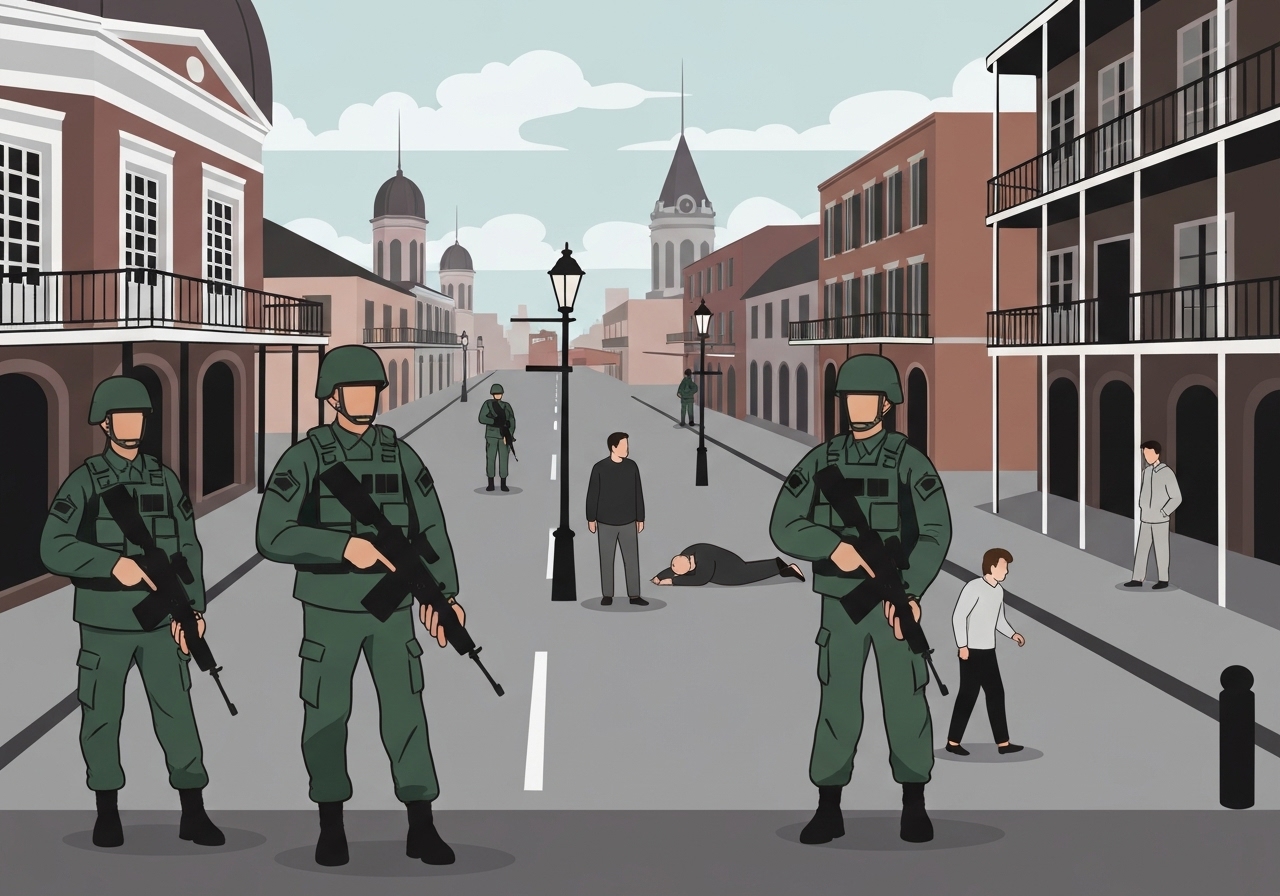
Federal authorities authorized a National Guard deployment to New Orleans beginning Tuesday to bolster security for New Year’s events, officials said. The move comes nearly one year after a Jan. 1 vehicle attack on Bourbon Street that killed 14 people and left the French Quarter on high alert. The current mission will station about 350 Guardsmen in and around the French Quarter through Carnival season, augmenting more than 800 local, state and federal officers assigned to traffic control, searches and visible patrols. City and state officials emphasize the deployment is intended to increase public safety and will not be used for immigration enforcement.
Key Takeaways
- About 350 Louisiana National Guard members will begin patrolling the French Quarter on Tuesday and remain through mid-February Carnival events.
- More than 800 total law-enforcement personnel will be deployed to close Bourbon Street to vehicles, conduct bag checks and redirect traffic.
- The deployment follows the Jan. 1 Bourbon Street attack that killed 14 people and prompted the discovery of several unexploded devices in coolers.
- Authorities say Guardsmen will focus on visibility and force-multiplying support for local police, not immigration enforcement.
- Earlier in 2024, 100 National Guard members were sent to New Orleans immediately after the attack to secure the area.
- In September, Governor Jeff Landry formally requested up to 1,000 troops for Louisiana cities; some local leaders opposed that scale of deployment citing falling violent-crime rates in New Orleans.
Background
The decision follows the Jan. 1, 2024 vehicle-ramming attack on Bourbon Street, when Shamsud-Din Jabbar drove through a police barricade and fatally struck revelers. Law enforcement later located multiple explosive devices in coolers around the French Quarter; none detonated. Authorities identified the attacker as a U.S. citizen and Army veteran who had posted statements of support for the Islamic State on social media, and he was killed at the scene by police.
Since the attack, New Orleans has regularly increased visible security for large events; National Guard troops also assisted during the Super Bowl and earlier Mardi Gras security operations in 2024. The governor’s September request for 1,000 troops reflected statewide concerns about crime, while some city leaders pushed back and pointed to recent declines in violent crime locally. The current deployment is shaped by those competing priorities: bolstering deterrence while avoiding broader mission creep into immigration or unrelated enforcement.
Main Event
Officials announced the Guard will be concentrated in the French Quarter, the tourist-dense neighborhood centered on Bourbon Street, beginning Tuesday and remaining through Carnival. Guardsmen will operate in support roles: visible patrols, perimeter presence, and coordination with city and federal partners rather than routine policing or immigration tasks, officials said. The city also plans to close Bourbon Street to vehicular traffic, increase checkpoint-style bag inspections and reroute traffic to reduce the risk posed by hostile vehicles.
At a Monday news conference, city and state representatives outlined staffing: roughly 350 Guardsmen plus deputies, state troopers and federal agents bringing the combined force over 800 personnel. Local police spokesperson Reese Harper said the Guard is “an added layer of visibility” and stressed that their presence mirrors past security operations for major events. Louisiana National Guard Lt. Col. Noel Collins issued a written statement saying the Guard will “support local, state, and federal law enforcement to enhance capabilities, stabilize the environment, assist in reducing crime, and restoring public trust.”
The operational footprint will be limited to public, high-traffic areas frequented by visitors; officials said Guardsmen will not engage in immigration enforcement and will function under state command in coordination with New Orleans Police. In 2024’s immediate aftermath of the Jan. 1 attack, 100 Guard members were temporarily assigned to patrol the area—this deployment is larger and scheduled for a longer duration to cover Carnival. City officials emphasized planning for crowd management, emergency response access and visible deterrence as primary objectives.
Analysis & Implications
The expanded Guard presence reflects a post-attack security posture that prioritizes deterrence and reassurance for residents and tourists. High-visibility deployments can reduce certain kinds of opportunistic crime and may deter lone-actor tactics, but their effectiveness depends on integration with policing, intelligence-sharing and community trust. Critics warn that military-style visibility risks intimidating residents and can strain police-community relations if not carefully managed and transparently explained.
Politically, the deployment sits at the intersection of public-safety politics and civil-liberties concerns. Governor Jeff Landry framed a larger request for troops in September as necessary to address crime statewide, while some New Orleans leaders argued the city’s violent-crime rates have fallen and that large-scale troop presences are unnecessary. The current, targeted deployment—focused on the French Quarter and event-period coverage—appears calibrated to balance those positions.
Operationally, Guard forces can augment manpower for checkpoints and perimeter control but cannot replace investigative, judicial or long-term community-policing functions. Sustained improvements in safety depend on prosecution, social services and local policing strategies. Internationally, U.S. cities increasingly debate the role of militarized assets in domestic security; New Orleans’ approach this season will be watched as a case study in limited-duration, event-focused Guard missions.
Comparison & Data
| Situation | Guard or Troop Count | Notes |
|---|---|---|
| Immediate post-Jan. 1, 2024 response | 100 | Short-term surge after vehicle attack |
| Current Carnival deployment (starting Tuesday) | 350 | Assigned to French Quarter through mid-February |
| Total law enforcement assigned for New Year’s/Carnival | 800+ | Combined local, state and federal personnel |
| Governor’s September request | 1,000 | Requested for Louisiana cities; met with local pushback |
The table summarizes the scale of recent and requested force levels. The present mission is larger than the immediate post-attack surge but smaller than the governor’s requested cap citywide; planners emphasize a limited, geographically focused mission rather than a broad, long-term occupation. These numbers frame operational trade-offs between visibility, sustainability and civil liberties.
Reactions & Quotes
City officials have publicly framed the Guard presence as supportive and temporary. New Orleans Police Department representatives described the troops as a visibility and safety supplement rather than a replacement for local policing.
“They’re not here for immigration purposes; they’re here to provide an added layer of visibility.”
New Orleans Police spokesperson Reese Harper
The Louisiana National Guard described its role as assistance to stabilize the environment and help restore public confidence while coordinating with civilian law enforcement.
“We will support local, state and federal partners to enhance capabilities and reduce crime.”
Lt. Col. Noel Collins, Louisiana National Guard (written statement)
Some elected officials supported the request for more troops, arguing that visible forces reassure the public, while local leaders cautioned against overreliance on military assets for civic safety.
“We requested additional resources to help address public-safety concerns across the state.”
Governor Jeff Landry (statement)
Unconfirmed
- No public confirmation that the Guard deployment will include armed checkpoints beyond standard bag checks and vehicle closures.
- The long-term effect of the deployment on overall city crime rates has not been demonstrated; causal links remain unproven.
- Specific intelligence justifying the exact troop numbers and geographic limits of the mission has not been publicly released.
Bottom Line
The 350-member National Guard deployment to the French Quarter is a precautionary, event-focused measure aimed at deterring incidents and reassuring visitors after last year’s deadly Bourbon Street attack. Officials emphasize visibility and coordination with civilian agencies, and they say the troops will not conduct immigration enforcement. While high-visibility forces can reduce certain risks during mass gatherings, they are not a substitute for long-term policing strategy, prosecutions or community-based interventions.
As Carnival progresses, authorities should publish clear operational objectives, metrics for success and transparency about soldier roles to maintain public trust. Observers—both supporters and critics—will assess whether the mission reduces acute threats without eroding civil liberties or community relationships; the outcome will inform future decisions about when and how to use Guard forces in U.S. cities.