
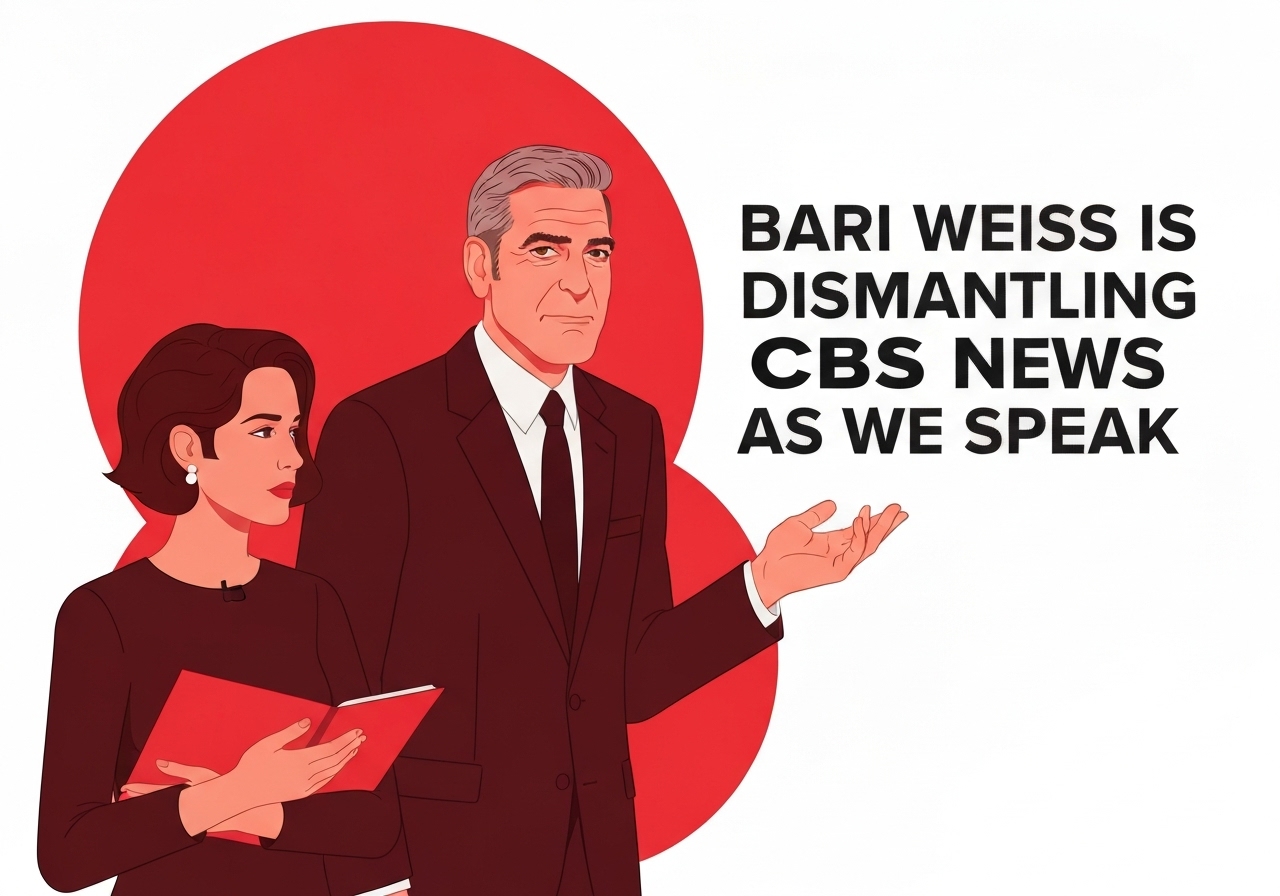
Lead: George Clooney told Variety in November that he sees a direct threat to American journalism as corporate and legal pressures reshape major outlets. Speaking ahead of his film Jay Kelly, Clooney said CBS and other institutions ceded ground when faced with lawsuits tied to former President Trump, and he warned that recent leadership changes at CBS News risk weakening the network’s ability to hold power to account. He linked those concerns to broader anxieties about media consolidation, the rise of AI-generated deception, and the stakes of reporting under a second Trump administration.
- Key Takeaways:
- Clooney says he invited 60 Minutes to observe rehearsals for his Murrow role and used that moment to compare McCarthy-era pressures to present political attacks on the press.
- He criticized major law firms, universities and networks for settling lawsuits brought by Trump and associates rather than fighting them, arguing settlements damaged press freedom.
- Variety reports Clooney’s concern that Paramount’s August sale to Skydance followed a move by Shari Redstone to quiet a lawsuit involving 60 Minutes; that motive remains publicly unproven.
- Clooney called David Ellison’s appointment of Bari Weiss to lead CBS News a direct threat to the network’s mission and said he believes Weiss is already changing coverage.
- He expressed anxiety about AI’s capacity to produce believable fake video — citing the risk of fabricated footage of leaders — and how that undermines the long-held trust in what people see.
- Clooney is worried about studio consolidation (Netflix, Warner Bros. discussions) and said “grown-up” theatrical cinema is endangered even as his film is financed by Netflix.
Background:
George Clooney’s comments are part of a longer Variety profile timed to the release of his film Jay Kelly. He has for years voiced concerns about threats to civil liberties and media independence, and he framed his remarks around historical comparisons to Edward R. Murrow’s challenge to McCarthy-era abuses. The interview took place in November; at that time Variety reported that Netflix had not finalized any deal for Warner Bros., and that Paramount had recently completed a sale to Skydance in August.
The broader context includes a wave of litigation and settlements involving media organizations, plus ownership shifts across Hollywood and newsrooms. High‑profile legal threats from political figures have prompted some outlets and institutions to settle or narrow coverage rather than litigate, a pattern critics say can chill investigative reporting. Separately, corporate consolidation in entertainment — including potential mergers and studio sales — is reshaping incentives for both news and film production.
Main Event:
Clooney recalled inviting 60 Minutes to rehearsals for his portrayal of Murrow and used the occasion to warn that the press must succeed where other branches of government falter. He singled out networks, elite law firms and universities for what he called a failure of backbone when faced with lawsuits tied to former President Trump. Clooney suggested that defensive legal choices by institutions contributed to a weakening of public-oriented journalism.
On CBS specifically, the article relays Clooney’s fear that owner actions during the lawsuit involving 60 Minutes were politically motivated to smooth a corporate transaction. He told Variety he was alarmed that David Ellison, after Skydance acquired Paramount in August, appointed Bari Weiss to an editorial leadership role at CBS News and that this appointment has already altered coverage priorities in ways Clooney finds troubling.
Beyond institutional critique, Clooney addressed cultural and technological currents. He said the consolidation of studios into large conglomerates risks erasing the distinct identities that once drove different kinds of filmmaking. At the same time, he warned that AI tools are making it easier to create convincing fabricated videos, raising the possibility of false visual evidence used to manipulate public opinion or trigger crises.
Throughout the conversation Clooney balanced industry concerns with political forecasts: he expressed confidence Democrats could retake the House in 2026, argued economic pain will shape voter reactions, and said he does not believe former President Trump’s low popularity will rebound enough to short‑circuit constitutional norms around transitions of power.
Analysis & Implications:
Clooney’s intervention blends celebrity advocacy with media criticism; its force comes from connecting legal tactics, ownership changes and editorial appointments into a single narrative about newsroom vulnerability. If major outlets opt to settle high‑stakes suits rather than litigate, the precedent could reduce the institutional appetite for investigative work and embolden litigants who aim to deter scrutiny through legal cost and risk.
The appointment of an editorial figure with a distinct profile — in this case Bari Weiss — to a major network’s leadership raises questions about editorial direction and independence. Whether Weiss’s role will lead to wholesale redesign of newsroom priorities or more modest shifts in story selection is not yet settled, but public confidence in a national broadcaster can be sensitive to both perceived partisan tilts and structural changes in governance.
AI’s rapid maturation increases the difficulty of verification for journalists and the public alike. Clooney’s example of deepfake video scenarios highlights a systemic vulnerability: verification workflows that worked for text and static images are under strain when video can be synthetically generated and superficially authenticated. Newsrooms, platforms and policymakers will need to accelerate investment in technical verification, cross‑platform coordination, and legal frameworks to deter misuse.
| Then (mid‑20th c.) | Now (2024–25) |
|---|---|
| Fewer corporate consolidations among studios; clear editorial hierarchies | Greater consolidation and cross‑ownership; rapid leadership changes after mergers |
| Verification primarily based on source credibility and filmed evidence | Verification challenged by AI‑generated video and synthetic media |
The table sketches qualitative shifts rather than precise metrics: the point is to show how structural and technological changes have altered both incentives and capabilities across media industries.
Reactions & Quotes:
When institutions falter, the press must succeed — that was Clooney’s framing for why networks need to defend hard reporting.
George Clooney, Variety interview
Clooney described his concern that leadership changes at CBS News could reshape coverage priorities in ways that reduce the network’s ability to hold power to account.
George Clooney, Variety interview
On AI, he warned about the prospect of fabricated video of world leaders creating immediate crises that verification systems might not catch in time.
George Clooney, Variety interview
Each quotation above is drawn from Clooney’s November conversation with Variety; the publication provides the fuller interview text and context for these excerpts.
Unconfirmed:
- The claim that Shari Redstone specifically engineered a settlement to secure Skydance’s approval of the Paramount sale is reported as suspicion and lacks public documentary proof.
- The degree to which Bari Weiss’s role has already dismantled CBS News’s editorial structure is asserted by Clooney and reported by Variety but has not been corroborated by an independent, detailed accounting of newsroom reorganization.
- Reports of agencies seeking to represent the AI‑generated performer Tilly Norwood indicate interest, but the long‑term industry impact and contractual outcomes are not yet verified.
Bottom Line:
George Clooney’s Variety interview is a high‑profile expression of two linked anxieties: that legal and ownership choices are eroding the institutions that once protected robust journalism, and that technological change — especially AI — will make it harder for the public to distinguish fact from fabrication. Both trends, if left unaddressed, threaten the informational foundations of democratic life.
The immediate implications are practical and institutional. Newsrooms, platforms and regulators will need to strengthen litigation strategies, transparency rules around ownership and editorial governance, and verification tools for synthetic media. For viewers and voters, Clooney’s warning is a call to pay attention to who controls news organizations, how editorial decisions are made, and what safeguards exist to preserve reliable reporting.
Sources:
- Variety — entertainment journalism report based on a November interview with George Clooney (primary source for quotes and timeline)