
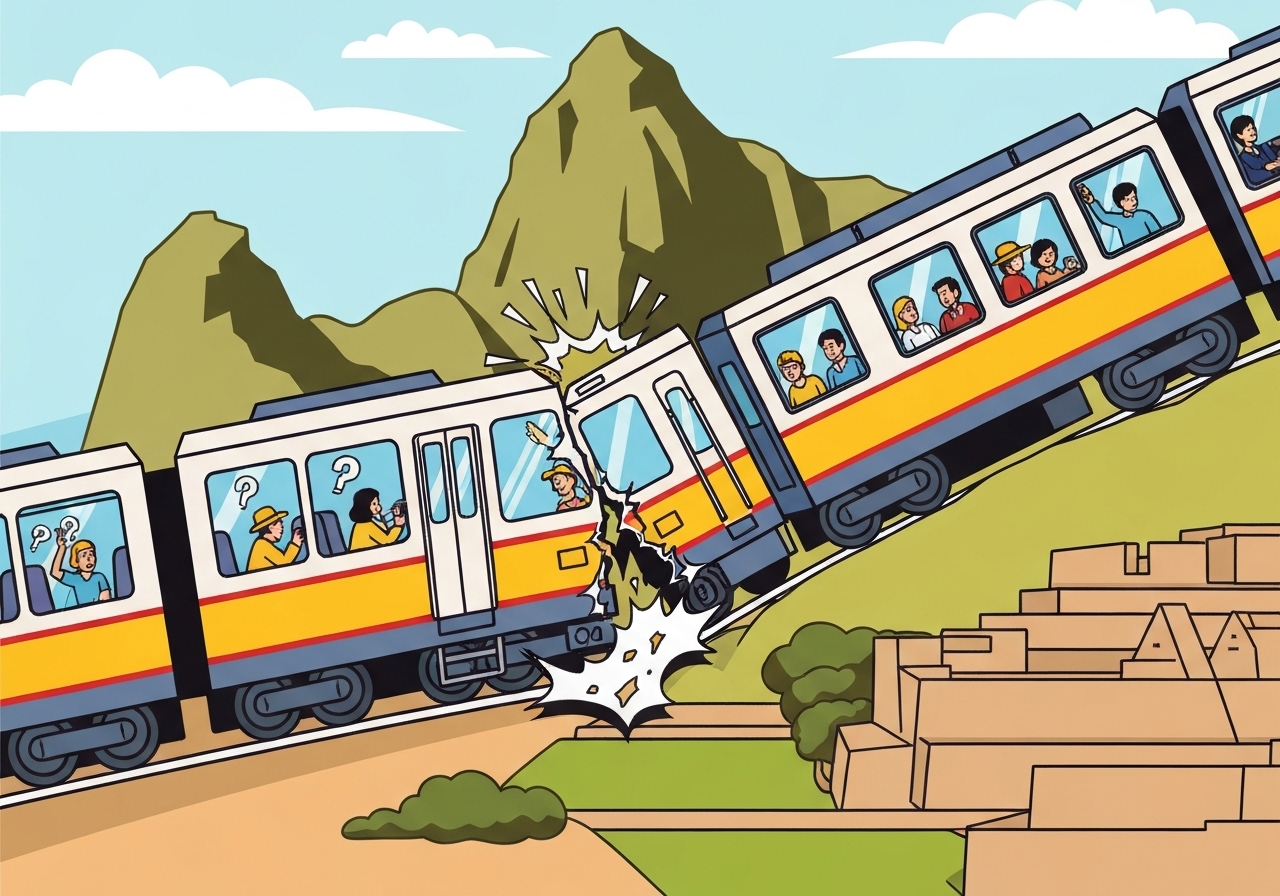
Lead: Two tourist trains bound for Peru’s Machu Picchu collided on Tuesday, Dec. 30, 2025, near the Qoriwayrachina archaeological site, killing at least one person and injuring about 30 passengers. The fatality was identified by Cuzco police as a railroad worker, and rail services between Cuzco and Machu Picchu were suspended after the accident. Local video showed multiple cars with broken windows and dented sides lodged on a narrow section of track between dense forest and a rock face. Authorities opened an investigation but had not released a confirmed cause.
Key Takeaways
- At least one person was killed and around 30 passengers sustained injuries after two tourist trains collided near Qoriwayrachina on Dec. 30, 2025.
- The deceased was a railroad worker, confirmed by Captain Jhonathan Castillo Gonzalez of the Cuzco police department.
- Rail operator statements say a train from Machu Picchu struck a train headed toward it in the early afternoon; services on the Cuzco–Machu Picchu line were halted.
- Video footage circulated on local media showed broken windows and dented car sides; the wreck occurred on a single track corridor hemmed by forest and a large rock formation.
- Machu Picchu draws roughly 1.5 million visitors per year, about a 25% rise over the past decade; most tourists reach the site by train to Aguas Calientes.
- Tourism in the region has faced interruptions from political protests and management disputes, which have previously led to temporary blockades of the rail link.
Background
Machu Picchu is a 15th‑century Inca site near the town of Aguas Calientes and receives about 1.5 million visitors annually, the majority arriving by rail. The route connecting Cuzco and Machu Picchu is a narrow, mountainous corridor with limited passing points; trains are the principal mass‑transport option for day tourists. Over the past decade visitor numbers rose roughly 25%, increasing pressure on transport and site management systems.
The rail line has also been a focal point in local disputes. Political protests and disagreements over tourist controls and conservation policy have previously caused blockades or temporary suspensions of service, complicating operations for private operators and straining relations between communities, businesses and central authorities. Safety oversight involves regional police, the national transport regulator and private operators; coordination challenges in steep terrain raise logistical complexity for emergency response.
Main Event
According to statements relayed by local authorities and the rail operator, a train coming from Machu Picchu collided with another unit traveling toward the historic site in the early afternoon near Qoriwayrachina, itself an archaeological area. Emergency crews responded and transported injured passengers to medical facilities in the region; local media reported about 30 people received treatment, though official tallies remain provisional. Captain Jhonathan Castillo Gonzalez of the Cuzco police confirmed the fatality as a railroad worker and said investigators were at the scene assessing damage.
Video shared on Peruvian outlets showed several cars with shattered windows and exterior dents, stopped on a single line bounded by dense vegetation and a steep rock face. The constrained geography of the corridor complicated rescue and recovery operations and temporarily disrupted rail traffic toward Aguas Calientes. The operating company halted services on the Cuzco–Machu Picchu route as investigators and emergency teams processed the site.
No authoritative cause has been released; witnesses and early footage do not provide clear evidence of mechanical failure, human error or external interference. Authorities have collected statements from crew members, passengers and first responders while preserving the wreck site for technical inspection. Investigators said detailed forensic work on braking systems, signaling logs and crew communications will be necessary to determine the sequence of events.
Analysis & Implications
The collision underscores how fragile transport systems can be in high‑traffic, geographically constrained tourist corridors. With roughly 1.5 million annual visitors and most arriving by train, any prolonged suspension of rail service could create immediate humanitarian and economic ripple effects for local businesses that depend on steady tourist flow. Hotels, guides and transport providers in Aguas Calientes and Cuzco may see cancellations or concentration of arrivals by alternative routes if rail outages persist.
Operationally, the accident will likely trigger reviews of signaling protocols, single‑track traffic management and emergency readiness on the route. If investigators identify equipment failures, operators may face mandatory inspections or temporary grounding of portions of their fleets. Conversely, if human or procedural lapses are found, regulators could impose tighter crew oversight, updated safety rules or infrastructure upgrades, which could raise operational costs.
The incident also has a political dimension: prior protests and disputes over site management have at times disrupted the railroad. Even absent direct protest involvement in this crash, heightened scrutiny of rail safety could merge with broader debates about access, visitor caps and local benefits from tourism. International insurers, tour operators and Peru’s tourism authorities will monitor the probe closely to advise clients and coordinate contingency plans.
Comparison & Data
| Year (approx.) | Estimated Annual Visitors |
|---|---|
| ~2015 | 1.2 million |
| ~2024–25 | 1.5 million |
Visitor estimates show roughly a 25% rise over the past decade (1.2 million to about 1.5 million), increasing train demand on a route with limited redundancy. The bulk of visitors travel by train to Aguas Calientes, placing concentrated stress on a small number of daily services. That concentration magnifies the operational impact of any incident and heightens the incentive for operators and regulators to invest in redundancy, signaling upgrades and emergency access planning.
Reactions & Quotes
“The person killed was a railroad worker,”
Captain Jhonathan Castillo Gonzalez, Cuzco police
Captain Castillo’s statement confirmed the single fatality and signaled police responsibility for onsite investigation and initial casualty reporting.
“A train coming from Machu Picchu collided with a train headed there in the early afternoon, near Qoriwayrachina,”
Railway operator (company statement)
The operator’s brief account described the collision’s geometry and announced the suspension of services on the Cuzco–Machu Picchu line while authorities examine the wreck.
Unconfirmed
- Precise technical cause of the collision (mechanical failure, signaling error, human error or external interference) has not been publicly confirmed.
- The exact, final count and severity breakdown of injured passengers remain provisional pending hospital reports.
- There is no verified evidence yet linking the crash to protests or intentional obstruction of the rail line.
- Whether full service will resume on a specific timetable depends on investigative and repair findings and has not been announced.
Bottom Line
The Dec. 30, 2025 collision of two tourist trains near Machu Picchu resulted in one confirmed death and around 30 injuries, and halted the critical rail link between Cuzco and Aguas Calientes. Given the route’s geography and the concentration of visitors who travel by rail, even a short suspension can produce major local economic and logistical disruption.
Authorities and the rail operator must now complete a technical investigation to determine cause, while tourism and safety regulators will likely push for operational reviews and possible infrastructure or procedural changes. For travelers and industry stakeholders, the immediate priorities are accurate casualty accounting, a clear incident timeline, and a roadmap for restoring safe, reliable service.