
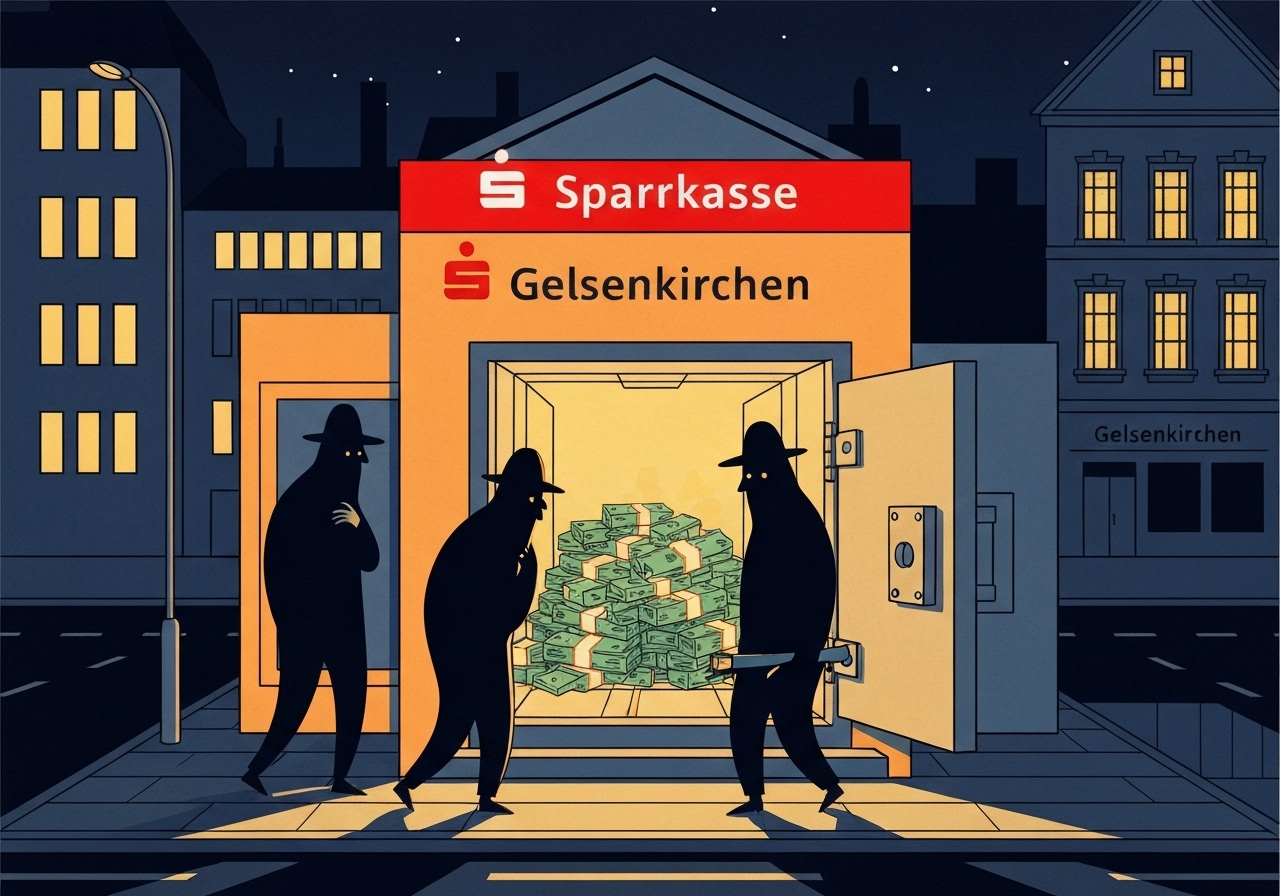
Lead: Over the quiet Christmas period, unknown thieves drilled through a concrete wall into the vault of a Sparkasse branch in Gelsenkirchen and broke into safe deposit boxes, police said. The break-in was discovered after a fire alarm triggered early on Monday, 29 December. Authorities estimate the loss at least €10 million, with some statements describing the haul as in the double-digit millions. Dozens of customers gathered outside the branch demanding access and information.
Key Takeaways
- Location: A Sparkasse retail bank branch in Gelsenkirchen, western Germany, was targeted during the Christmas shutdown.
- Timing: The hole in the vault was discovered after a fire alarm in the early hours of Monday, 29 December; most branches were closed from the evening of 24 December.
- Method: Perpetrators drilled through a thick concrete wall to gain vault access and then forced open several thousand safe deposit boxes, police reported.
- Estimated loss: Police put the value taken at at least €10 million; other statements describe the total as in the double-digit millions of euros.
- Witness reports: People saw several men on Saturday night carrying large bags in an adjacent parking-garage stairwell.
- Vehicle link: A black Audi RS 6 was seen leaving the garage early on Monday with masked occupants; its plate belonged to a car stolen in Hanover, over 200 km away, police said.
- Customer impact: Dozens of customers protested outside the branch, many reporting lost life savings or family jewellery stored in deposit boxes.
Background
Safe deposit boxes are commonly used in Germany for storing cash, jewellery and important documents; many customers keep long-term savings or family heirlooms there. Banks in Germany, including local Sparkasse branches, typically close across the Christmas period, with many branches shut from the evening of 24 December. That regular closure creates predictable windows when fewer staff and customers are on site — a factor cited in other past targeted burglaries across Europe.
Security for vaults combines structural barriers, alarms and surveillance, but determined attackers have in the past exploited lapses in perimeter security or response times to alarms. Sparkasse branches are widespread and locally managed; a single branch breach can affect a concentrated group of local customers who rely on deposit boxes for assets not held in bank accounts. Local police and national insurance frameworks then become the primary actors in response and loss assessment.
Main Event
Police said the perpetrators drilled through a thick concrete wall in the Sparkasse branch and subsequently opened several thousand safe deposit boxes. The breach was not discovered until a fire alarm sounded in the early hours of Monday, 29 December, prompting an inspection that revealed the hole and the ransacked boxes. Investigators reported an initial valuation of stolen items at least €10 million, while also noting descriptions from bank staff and customers that suggest the total may be in the double-digit millions.
Witnesses told police they saw several men on Saturday night carrying large bags in the stairwell of an adjacent parking garage, and cameras or local inquiries reportedly placed a black Audi RS 6 leaving the garage early on Monday morning with masked people inside. Authorities said the car’s licence plate was registered to a vehicle stolen in Hanover, more than 200 kilometres northeast of Gelsenkirchen, and detectives are exploring that lead for links to organised theft networks.
Customers arrived at the branch after news spread, forming a noisy crowd demanding access. One man who told the Welt broadcaster he had used his safe for 25 years said it contained his retirement savings and that he had slept poorly awaiting answers. A bank spokesperson in Gelsenkirchen did not immediately respond to requests for comment, and police continue to piece together the timeline and method used to defeat vault protections.
Analysis & Implications
The scale of the reported loss — at least €10 million — will make this one of the larger retail bank safe-deposit thefts in recent German memory and will raise questions about branch-level security during predictable holiday closures. If the attackers exploited reduced staffing and delayed alarm responses, banks across the country may face pressure to review physical security, alarm monitoring, and emergency response protocols for holiday periods.
Insurers, both private and those covering bank liabilities, will now assess coverage limits and the scope of compensation for customers. Customers who stored uninsured cash or jewellery may find recovery limited; insurance payouts and bank policies on liability for safe-deposit contents vary and often depend on declared contents and contractual terms between the bank and box holders.
Investigators will also examine whether the theft reflects organised criminal trade routes for high-value portable goods. The reported reuse of a licence plate from a car stolen in Hanover suggests cross-regional coordination; if confirmed, the case could feed broader law-enforcement efforts to map and disrupt networks moving stolen items across German and international interiors.
Comparison & Data
| Item | Reported figure |
|---|---|
| Estimated value stolen | At least €10 million (police); media cite double-digit millions |
| Safe deposit boxes targeted | Several thousand (police statement) |
| Discovery date | Early hours, Monday 29 December 2025 (after fire alarm) |
| Linked vehicle origin | Licence plate from a car stolen in Hanover (≈200+ km away) |
The figures above reflect law-enforcement summaries and media reporting available as of initial statements. Exact totals and counts are subject to forensic inventory and ongoing police confirmation; authorities will likely publish refined figures after cataloguing recovered and reported losses.
Reactions & Quotes
“Let us in!”
Customers gathered outside the branch
Angry customers chanted outside the bank, demanding immediate access and information. Several people said they had not been contacted by the bank with details about the status of their boxes or the potential for recovery.
“I couldn’t sleep last night. We’re getting no information,”
Customer, interview reported by Welt broadcaster
That interview captured local frustration: some customers said they had stored life savings or family jewellery in boxes used for decades, heightening concerns about personal financial loss and emotional impact.
Unconfirmed
- The exact final monetary total beyond the police minimum of €10 million remains unverified; some reports describe a larger, double-digit total.
- The precise number of perpetrators involved has not been confirmed by investigators and remains subject to forensic and witness corroboration.
- The alleged connection between the Audi RS 6 licence plate and a Hanover theft is under investigation and does not yet prove the vehicle or its occupants came from Hanover.
- The full inventory of boxes accessed and which customers are affected is still being compiled by police and the bank.
Bottom Line
The Gelsenkirchen Sparkasse vault breach during the Christmas shutdown exposed vulnerabilities around predictable holiday closures and the protection of high-value, privately stored goods. With at least €10 million reported stolen and many customers directly affected, the case will put pressure on banks to reassess physical security, alarm monitoring, and customer communication practices for deposit-box services.
Investigations will focus on establishing the perpetrators’ identities, the operational methods used to breach heavy concrete vaults, and links to wider criminal networks suggested by vehicle traces. Customers should track official updates from police and the bank, review their insurance coverage, and take prompt steps to document losses for any future claims.