
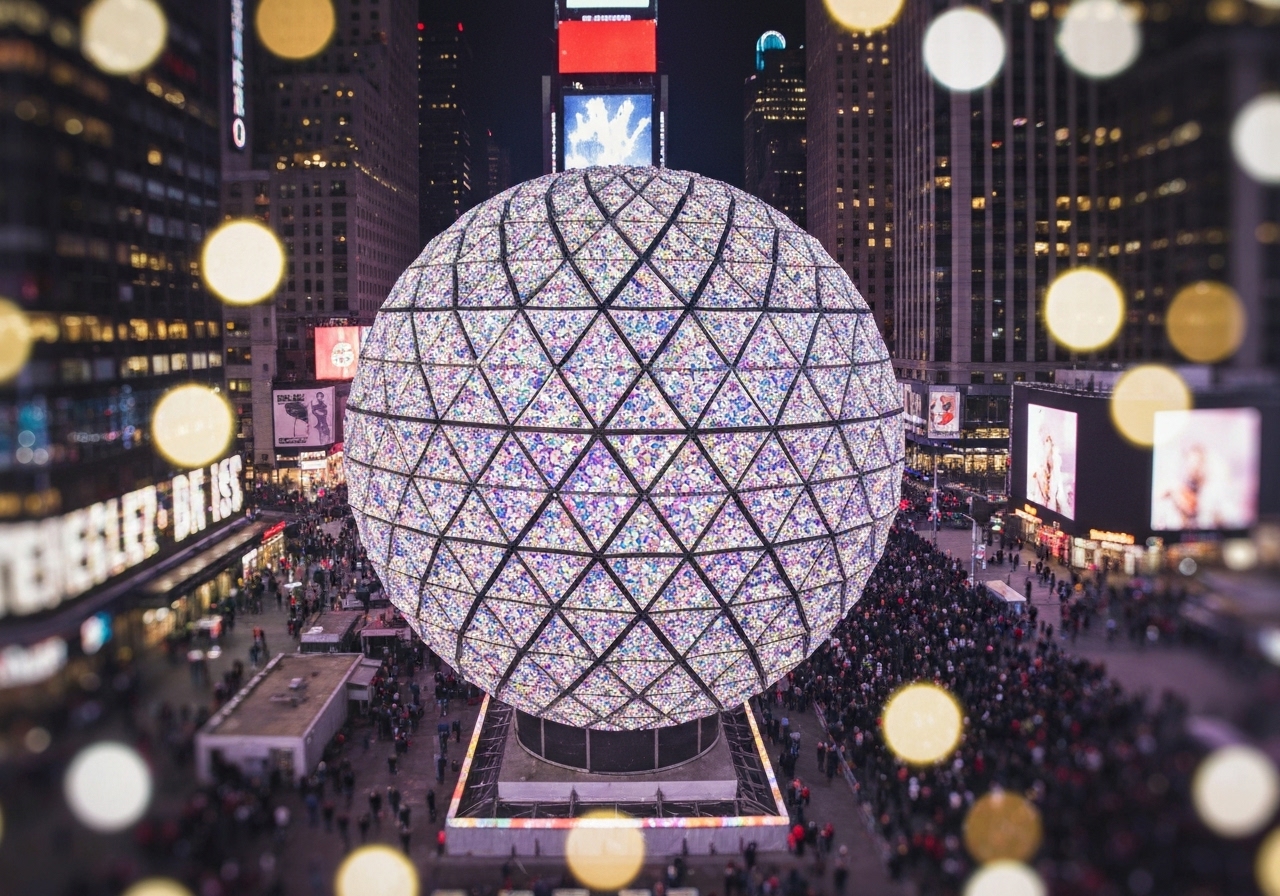
New York’s iconic New Year’s Eve ritual will welcome an expanded centerpiece for the 2026 countdown: the Constellation Ball, unveiled for the Times Square drop on Dec. 31, 2025. The new sphere — the ninth official ball used at One Times Square — measures 12.5 feet across and weighs just over 12,000 pounds, making it the largest in the event’s history since the first drop in 1907. Designers say the structure mixes thousands of circular Waterford crystals with LED lighting to create a different visual language from recent years. Organizers expect the larger ball to amplify the live spectacle in Times Square and for viewers watching the broadcast worldwide.
Key Takeaways
- The Constellation Ball is the ninth official sphere used in the Times Square New Year’s Eve drop and debuts for the 2026 celebration.
- The ball is 12.5 feet in diameter and weighs just over 12,000 pounds, the largest recorded for the event.
- It is clad in 5,280 circular Waterford crystals in three sizes — 1.5-inch, 3-inch and 4-inch — and integrates LED light pucks for dynamic effects.
- Crystal shapes move away from the triangular motifs used on balls since 1999, favoring circular facets to convey a new design theme.
- Jamestown, owner of One Times Square, describes the ball as a symbol of interconnectedness and tradition bridging past, present and future.
- The Times Square ball drop tradition began in 1907, inspired by 19th-century maritime time balls and early electric illumination experiments in Manhattan.
- Earlier iterations ranged from a 700-pound iron-and-bulb device to later aluminum and decorative versions including the 1995 rhinestone-and-strobe update.
Background
The Times Square ball drop originated in 1907 as a substitute for fireworks and pyrotechnics, which city officials had curtailed. Newspaper publisher Adolph Ochs and metalworker Jacob Starr are central figures in the origin story: Ochs wanted a spectacle for crowds at the New York Times building, and Starr — later associated with Strauss Signs/Artkraft Strauss — fashioned an illuminated lowering device that echoed nautical time-ball practice. Over the decades the physical object evolved from a crude iron-and-wood cage adorned with bulbs into ever more sophisticated, lighter and more decorative spheres.
Technological changes and aesthetic trends have shaped successive redesigns: postwar materials produced lighter frames, the 1990s brought computerized lighting and rhinestones, and recent editions added energy-efficient LEDs and precision engineering to withstand the annual descent. The ritual’s appeal rests on both live participants in Midtown Manhattan and millions tuning in on TV and streaming platforms, making the ball a global broadcast prop as much as a local tradition. Ownership and production responsibilities shifted over time, with companies like Artkraft Strauss historically involved in construction and operation.
Main Event
The Constellation Ball was revealed by One Times Square and Jamestown ahead of the 2026 drop, described by organizers as designed to emphasize continuity and renewal. Constructed with 5,280 circular Waterford crystals in three sizes and fitted with LED light pucks, the ball departs from the triangular crystal patterns that characterized recent years’ designs. Event directors say the circular facets were chosen to reflect a theme of unity and to deliver new lighting capabilities on television and in the square.
On Dec. 31 at 11:59 p.m., the ball will descend along the customary pole while the crowd counts down the final 60 seconds; at midnight the illuminated numerals will be revealed and the year will change. Technical teams rehearse the lowering mechanism and lighting sequences in advance, given the object’s increased mass — just over 12,000 pounds — and the need for redundancy and safety checks. Organizers also highlighted structural testing and LED programming to ensure both spectacle and reliability during the live broadcast.
The reveal included statements from Jamestown leadership framing the ball’s symbolism: they described it as representing cycles and interconnectedness between eras. Longtime participants in the ritual — including members of the Starr family and former Artkraft Strauss personnel — recalled the early manual lowering and the sense that the last minute before midnight felt like a distinct, transformative moment. The updated ball thus aims to marry heritage with modern production values while preserving the ritual’s emotional resonance.
Analysis & Implications
Designing the largest ball yet underscores how the Times Square drop functions as both ceremony and a media product. Bigger scale and enhanced lighting aim to increase visual impact for television and livestream audiences, reinforcing the event’s role as a global broadcast moment and an opportunity for brand and tourism visibility for New York City. The investment in crystals, LED technology and structural reinforcement reflects broader trends in live spectacle where visual fidelity for remote viewers is as important as the in-person experience.
There are logistical and safety implications to scaling the ball’s size and weight. Teams must certify rigging systems, wind tolerances, and fail-safes; rehearsal time and engineering oversight increase costs and complexity. For municipal authorities and event operators, balancing crowd safety in Times Square with the demands of a larger, heavier object requires coordination among private owners, city inspectors and emergency services.
Culturally, the choice to change crystal shapes signals how organizers manage continuity while refreshing symbolism to keep the ritual feeling relevant. The ball has always combined technological novelty and public ritual — from early electric illumination to computerized light arrays — and the Constellation Ball continues that pattern. Economically, the new installation may drive additional media attention, sponsorship opportunities and tourist interest in subsequent seasons, though quantifying that effect will require post-event audience and tourism data.
Comparison & Data
| Year/Iteration | Notable facts |
|---|---|
| 1907 (first descent) | About 700 pounds; iron/wood frame with 25W bulbs; manual lowering at midnight |
| 1995 update | Rhinestones, strobe lights and computerized controls modernized the spectacle |
| 2026 — Constellation Ball | 12.5 ft diameter; just over 12,000 pounds; 5,280 circular Waterford crystals; LED light pucks |
The table highlights the most documented milestones rather than a complete inventory of every redesign. The early ball’s modest scale reflected available materials and technologies, while later updates show a shift toward ornamentation and digital control. The Constellation Ball emphasizes crystal quantity and lighting precision, aligning the object’s engineering with contemporary broadcast standards.
Reactions & Quotes
Organizers framed the new ball in symbolic terms, emphasizing tradition and forward motion as public reasons for the redesign. Industry observers noted the technical ambition required to mount a heavier, larger fixture above an active pedestrian plaza and to ensure consistent broadcast imagery.
“Each new crystal size features a unique design celebrating the ball’s spirit of eternal positivity,” organizers said in a release describing the Constellation Ball.
One Times Square (official statement)
The organizers’ statement positioned design choices as intentional symbolism rather than purely aesthetic changes, highlighting messaging used for public engagement and media coverage.
“The ball is meant to represent interconnectedness, wholeness, and the cyclical nature of tradition,” said Michael Phillips of Jamestown.
Michael Phillips, Jamestown (owner/operator)
Jamestown’s comment frames the installation as an owned cultural artifact with branding and stewardship implications for One Times Square and the broader event.
“It felt like the longest minute in the world — you could decide to be different,” recalled Tama Starr of her years working the event.
Tama Starr (former Artkraft Strauss foreperson, family of original craftsman)
Tama Starr’s recollection underscores the ritual’s human dimension and how the countdown tradition connects to personal reflection and public spectacle.
Unconfirmed
- Attribution over the precise originator of the lowering-and-illumination concept varies; some sources credit Adolph Ochs and colleagues while family accounts emphasize Jacob Starr’s role.
- Long-term audience or tourism impacts from the larger ball are projected by organizers but not yet quantified with post-event data.
Bottom Line
The Constellation Ball marks both a physical enlargement of an enduring New Year’s Eve symbol and a continuation of a century-long pattern: blending technological novelty with public ritual. Its increased scale and crystal count aim to refresh the visual narrative for live and remote audiences while preserving the traditional countdown mechanics that define the event.
Operationally, the new ball raises engineering, safety and broadcast considerations that event producers have prepared for through testing and rehearsals. For viewers and attendees, the moment at 11:59 p.m. will remain a shared pause in time — now framed by a new centerpiece intended to connect the celebration’s history with a contemporary production standard.
Sources
- CNN — News outlet reporting the Constellation Ball details and interviews (news)
- One Times Square — Official site for event organizers and property owner (official/organizer)