
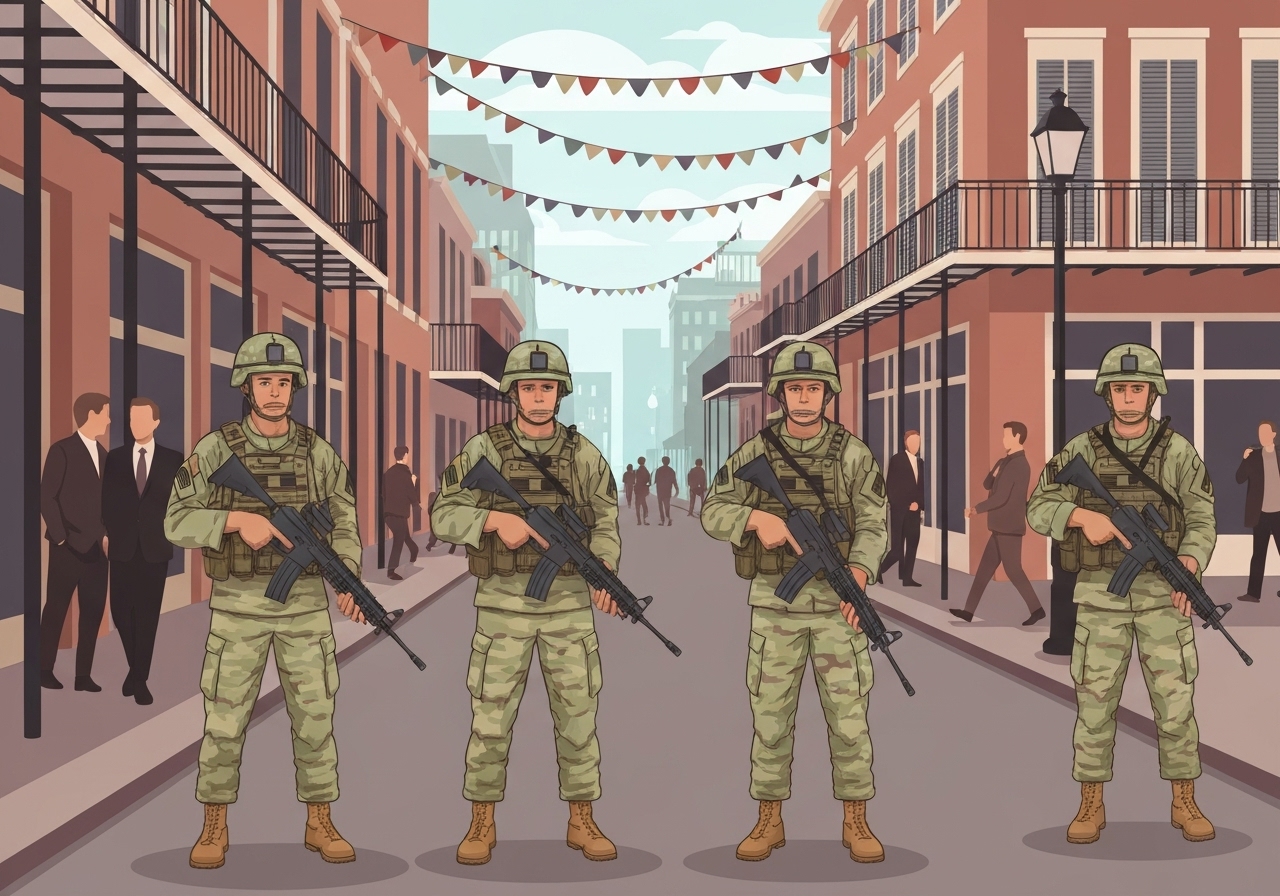
Lead: National Guard troops arrived in New Orleans on Dec. 30, 2025, to bolster security ahead of New Year’s celebrations, the first major holiday since the Jan. 1, 2025 Bourbon Street truck attack that killed 14 people. The deployment—350 Guard members authorized by the federal government—augments state police and local law enforcement as the city prepares for continuous festivities through Mardi Gras in mid-February. Families of victims and some local leaders say permanent countermeasures remain unresolved, while officials emphasize increased visible security for visitors and residents. Memorial flags for the victims fly above the French Quarter as authorities balance commemoration with crowd safety and tourism recovery.
Key Takeaways
- 350 National Guard members deployed to New Orleans beginning Dec. 30, 2025, to support law enforcement during New Year’s and through Carnival season.
- The Jan. 1, 2025 truck attack on Bourbon Street killed 14 people and injured dozens; the driver, Shamsud-Din Jabbar, was shot dead by police.
- The French Quarter’s current pedestrian security relies on a patchwork of parked vehicles, temporary steel barriers (32 in number), and bollards that officials say cannot withstand high-speed impacts.
- Police Captain Samuel Palumbo urged installation of permanent security gates rated to stop crashes up to 50 mph (80 km/h); a committee delayed a vote until the incoming mayor takes office.
- Families and plaintiffs’ lawyers have pressed for more permanent solutions, and city consultants suggested making Bourbon Street fully pedestrianized—an option resisted by some residents and business owners.
- Visible troop presence has prompted mixed reactions: some service-industry workers and residents welcome the added security, while victim families say long-term fixes are overdue.
Background
The attack on Bourbon Street in the early hours of Jan. 1, 2025 exposed vulnerabilities in the French Quarter’s crowd-protection measures. The assailant drove a pickup around a police blockade and into dense crowds celebrating New Year’s Day; law enforcement returned fire and killed him at the scene. In the aftermath, multiple investigations by city, state and private law firms examined whether the existing bollard and barrier arrangements could and should have been sufficient to stop a vehicle attack.
Bourbon Street’s nighttime pedestrian zone has historically relied on a combination of removable steel bollards, parked police vehicles, and manually emplaced large steel barriers—32 of which are used to create the walking area. Those temporary measures were already being modified at the time of the attack, prompting questions about deployment procedures and maintenance. Proposals for a durable, permanently engineered barrier system have circulated, but political, logistical and access concerns have slowed decision-making.
Main Event
On Dec. 30, 2025, columns of National Guard members—some visibly armed and in fatigue uniforms—beginning patrolled the French Quarter and Bourbon Street intersections. Troops were positioned near barricades and walked along pedestrian zones, conducting visible patrols and acting as a deterrent during peak hours of celebration. Officials said the Guard presence is meant to supplement local police and state troopers through the Carnival season, when the city anticipates sustained high tourist volumes.
Memorial flags for the 14 victims were displayed above Bourbon Street as crowds returned for New Year’s festivities. Victims’ relatives, including Melissa Dedeaux, have voiced ongoing grief and frustration; Dedeaux said she was forced to learn of her daughter’s final moments through widely circulated video and that she still sees “no safety” in the current arrangements. Legal representatives for families have continued to press municipal and state authorities for clearer, permanent protections.
City officials and a security consulting firm have offered competing short- and long-term remedies. Recommendations ranged from installing engineered crash-rated gates to converting Bourbon Street to full pedestrian-only use. Opposition from some residents and small-business owners, who cited access and operational concerns, contributed to the local committee’s decision to defer a formal vote until the incoming mayor assumes office in January.
Analysis & Implications
The Guard deployment addresses immediate public-safety optics and provides manpower for crowd oversight, but it is not a substitute for engineered perimeter defenses. Military and law-enforcement personnel increase detection and response capacity; however, deterrence against a high-speed vehicle ramming attack depends principally on physical barriers rated to absorb or stop vehicle momentum. The city’s temporary system—comprising park-formed vehicle blocks, removable bollards and manually placed steel barriers—was not designed to meet the crash standards now being discussed.
Installing permanent gates rated to stop impacts up to 50 mph (80 km/h) would materially raise the technical bar for protection but would also require significant municipal planning, vendor contracting, funding, and accommodations for deliveries and emergency access. The political trade-offs are real: some residents and business owners oppose pedestrianization or permanent gates because of access, service, and aesthetic concerns. Those objections have slowed progress despite vocal advocacy from victims’ families and plaintiffs’ counsel.
Beyond physical measures, the episode highlights systemic coordination challenges across city, state and federal agencies. The Guard’s presence, authorized by the presidential administration, illustrates how federal resources can be mobilized for prolonged local support; yet long-term reliance on temporary federal deployments can create dependencies rather than encourage permanent infrastructure investment. Fiscal constraints and competing priorities in municipal budgets may delay capital projects that engineers and police leaders say are necessary.
Comparison & Data
| Element | Current/Temporary System | Recommended Permanent Solution |
|---|---|---|
| Typical components | Removable bollards, parked vehicles, 32 steel push-in barriers | Engineered security gates or vehicle-rated bollards |
| Crash resistance | Low-speed impact tolerance (not rated for high-speed crashes) | Designed to stop up to 50 mph / 80 km/h impacts (per police recommendation) |
| Deployment/operation | Manual nightly placement, variable coverage | Fixed or hydraulic gates with controlled access |
The table highlights why officials and experts stress a shift from ad-hoc nightly setups to a standardized, engineered perimeter. Transitioning will require design choices that balance security, emergency ingress, local access, and cost, and must be integrated into routine operations for the French Quarter’s dense urban fabric.
Reactions & Quotes
Police and municipal officials reiterated the need for stronger physical measures while acknowledging operational constraints and public feedback.
“They are not meant to be utilized in the fashion they are,”
Samuel Palumbo, NOPD 8th District Captain
Palumbo used the remark to underscore that current barriers are a temporary workaround and to urge adoption of crash-rated gates. His testimony to the New Orleans Governmental Affairs Committee framed the technical deficiency driving the debate.
“It’s kind of ridiculous … that a year after this tragedy nothing has been done to resolve this situation,”
Morris Bart, attorney for victims’ families
Bart and other legal representatives have publicly pressed city leaders for faster action, framing the delay as an avoidable policy failure that prolongs families’ anguish and legal disputes.
“I saw no safety,”
Melissa Dedeaux, mother of victim Nikyra Dedeaux
Family members continue to convey personal loss and an emotional imperative for permanent fixes; their accounts have shaped public pressure on elected officials to act before peak tourist seasons return.
Unconfirmed
- Whether the specific bollard units in place on Jan. 1, 2025, were installed according to manufacturer specifications or were compromised during replacement remains publicly unverified.
- Whether any single proposed permanent gate configuration would have prevented all 14 fatalities in the actual incident is uncertain and depends on placement, timing and attacker behavior.
- Exact timelines and funding commitments for any final, city-approved permanent barrier project had not been formally announced at the time of the Guard deployment.
Bottom Line
The National Guard deployment increases visible security for the holiday season and provides manpower for crowd control and situational response, but it does not substitute for engineered, permanent perimeter improvements that experts and some city officials now say are necessary. The Jan. 1, 2025 attack exposed a mismatch between the French Quarter’s popularity and the robustness of its vehicle-blocking measures, leading to renewed calls for crash-rated infrastructure able to resist impacts up to 50 mph (80 km/h).
Resolving the issue will require political consensus, funding and technical planning that accommodate tourism, resident access and emergency operations. As New Orleans balances remembrance with reopening, the tangible choices made in the months ahead will determine whether the city moves from temporary deterrence to durable protection for residents and visitors alike.
Sources
- NPR (news report)
- Associated Press (photo coverage and field reporting)