
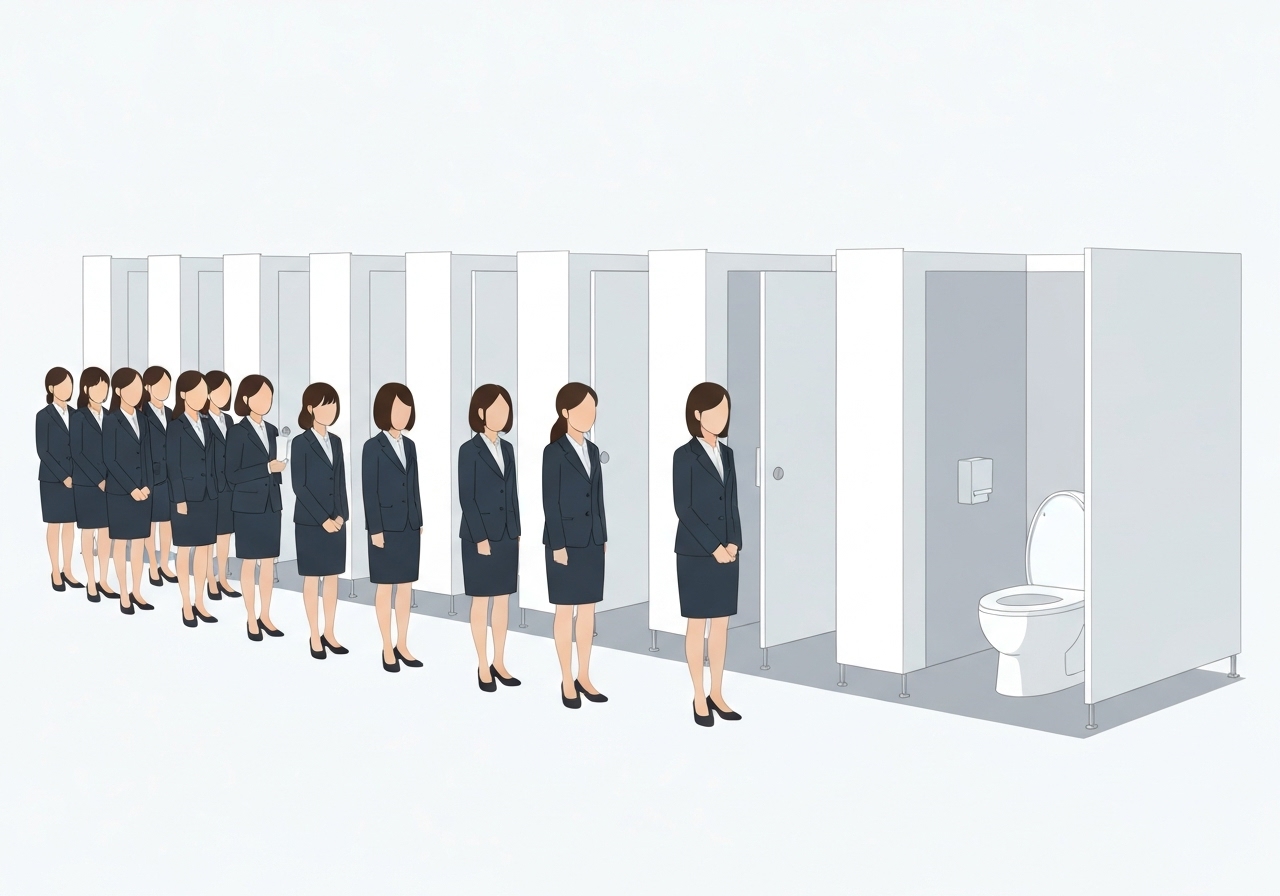
Nearly 60 women members of Japan’s parliament, including Prime Minister Sanae Takaichi, submitted a cross-party petition this month asking the lower house to add more female restrooms after long queues formed before plenary sittings. The appeal — signed by 58 lawmakers — highlights a mismatch between growing female representation and the Diet building’s century-old facilities. Lawmakers point to a single lavatory with two cubicles near the main lower-house chamber that must serve 73 female members, while men have dozens more stalls across the same building. The petition was handed to Yasukazu Hamada, chair of the lower house committee on rules and administration, and has sparked wider debate about everyday equality in Japan’s legislature.
Key takeaways
- 58 female lawmakers, including Prime Minister Sanae Takaichi, signed a petition this month requesting more women’s toilets in the lower house building.
- The lower house currently has one restroom with two cubicles directly serving 73 female MPs near the main plenary hall, creating long queues before sessions.
- The entire lower-house complex has 12 men’s toilet facilities with 67 stalls and nine women’s facilities with a total of 22 cubicles, according to reporting by the Yomiuri Shimbun.
- Women now occupy 72 of 465 seats in the lower house, up from 45 in the previous parliament; 74 of 248 upper-house members are women.
- Japan ranked 118 out of 148 countries in the World Economic Forum 2025 Global Gender Gap Report, reflecting persistent gender imbalances in politics, business and media.
- Prime Minister Takaichi has in the past expressed a desire for Nordic-style gender balance, yet her cabinet of 19 includes only three women, including herself.
- Petitioners frame the restroom issue as both a practical need and a visible symbol of progress and remaining disparities in representation.
Background
The National Diet building in central Tokyo was completed in 1936, nearly a decade before Japanese women gained the franchise in December 1945. Its original design predated the substantial increase in female political participation and has not kept pace with the shift in gender composition among lawmakers. At the December 2025 election, the number of women in the lower house rose notably, prompting complaints that facilities and daily routines still assume a male majority.
The disparity in on-site amenities exists alongside broader structural gaps. Japan has historically lagged on measures of gender equality in public life and the private sector, and the 2025 World Economic Forum report placed it near the bottom third of ranked economies. Political careers for women in Japan are shaped by cultural expectations, electoral dynamics, and episodes of sexism that candidates report facing during campaigns.
Main event
Earlier this month, 58 female lawmakers from across parties submitted a petition to Yasukazu Hamada, the lower house committee chair, requesting additional female lavatories near the main plenary chamber. The petition notes that before sessions convene, many women wait in tightly packed lines at the lone two-cubicle restroom adjacent to the hall, a situation lawmakers say can disrupt participation in debates and votes. The group described the request as immediate and practical rather than partisan.
Yasuko Komiyama of the opposition Constitutional Democratic Party, who helped deliver the petition, described the queues as a daily reminder that the legislature’s physical layout reflects older gender assumptions. Komiyama emphasized the need to adapt facilities to the current composition of the Diet and linked the demand to broader calls for workplace adjustments that accommodate women legislators. The petition was received but no timetable for renovations or construction has been announced by parliamentary administrators.
Prime Minister Sanae Takaichi, who became Japan’s first female prime minister in October, was among the signatories. Takaichi has publicly discussed women’s health issues, including the menopause, and previously said she wanted a level of gender balance akin to Nordic countries, though her cabinet appointments so far have fallen short of parity. Critics note the contrast between rhetorical support for balance and the slow pace of institutional changes such as facility upgrades and legal reforms.
Analysis & implications
At first glance the petition concerns restrooms, but the episode highlights how mundane infrastructure can expose deeper institutional inertia. Facilities built for a predominantly male legislature are now being asked to accommodate a more mixed chamber; the speed and seriousness with which administrators respond will signal how committed the Diet is to inclusive governance. If the building is updated quickly, it would be a visible sign of adaptation; delay or minimal fixes could reinforce perceptions of token change.
The restroom shortage also has operational implications. Long queues before plenary sessions risk lawmakers missing votes or being distracted during proceedings, which can affect parliamentary workflow and the fairness of participation. Small workplace barriers can accumulate into systemic disadvantages for underrepresented groups, making logistics a governance issue as much as a facilities one.
Politically, the petition offers an opportunity for cross-party cooperation on a low-stakes, high-visibility fix. Success could provide momentum for broader initiatives around childcare, committee room access, and other accommodations. Conversely, failure or slow action could feed narratives about performative gestures toward gender equality without substantive change.
Comparison & data
| Category | Facilities | Stalls/Cubicles |
|---|---|---|
| Lower-house men’s toilets (total) | 12 facilities | 67 stalls |
| Lower-house women’s toilets (total) | 9 facilities | 22 cubicles |
| Lavatory near main plenary (for women) | 1 facility | 2 cubicles (serving 73 women MPs) |
The table above, based on reporting by the Yomiuri Shimbun, shows a marked imbalance in available fixtures. Contextualizing those raw counts against representation highlights the mismatch: women hold 72 of 465 lower-house seats yet must often share far fewer cubicles. Facility counts do not map cleanly to usage patterns, but they provide a measurable starting point for administrators weighing upgrades and space allocation.
Reactions & quotes
Opposition lawmakers framed the petition as commonsense and emblematic. Their remarks have been aimed at both logistical fairness and symbolic parity.
Before plenary sessions start, truly so many women lawmakers have to form long queues in front of the restroom.
Yasuko Komiyama, Constitutional Democratic Party
Supporters argued the change sought is modest but meaningful, while some conservative voices have expressed caution about making structural changes to a historic building. The prime minister’s past comments on gender balance have been cited in public discussion.
I want to see Nordic levels of gender balance in politics, and raising awareness of women’s health is important to me.
Sanae Takaichi, Prime Minister
Unconfirmed
- No formal timetable has been published yet for construction or renovation to add new women’s restrooms in the lower house; requests are under administrative consideration.
- It is not confirmed whether any specific renovation plan would alter other facilities or reallocate men’s toilets to increase women’s capacity.
- Reports on day-to-day queues rely on lawmakers’ accounts; there is no publicly released hourly usage study from parliamentary staff verifying peak wait times.
Bottom line
The petition for more female toilets in the Diet is an immediate, tangible demand that underscores a deeper institutional imbalance in Japanese politics. While the request is modest in technical terms, it carries symbolic weight: making the legislature’s physical spaces fit its membership is a basic step toward equitable representation.
How parliamentary administrators respond will matter politically and practically. A quick, clear commitment to remodel and reconfigure space would send a message of adaptiveness and respect for all members. If action lags, the episode could become shorthand for broader frustrations about the pace of gender equality in Japan’s public institutions.
Sources
- The Guardian (international news media) — original reporting on the petition and lawmaker statements.
- Yomiuri Shimbun (national Japanese newspaper) — reporting cited for facility counts in the Diet building.
- World Economic Forum (international organization) — Global Gender Gap Report 2025 ranking and analysis.