
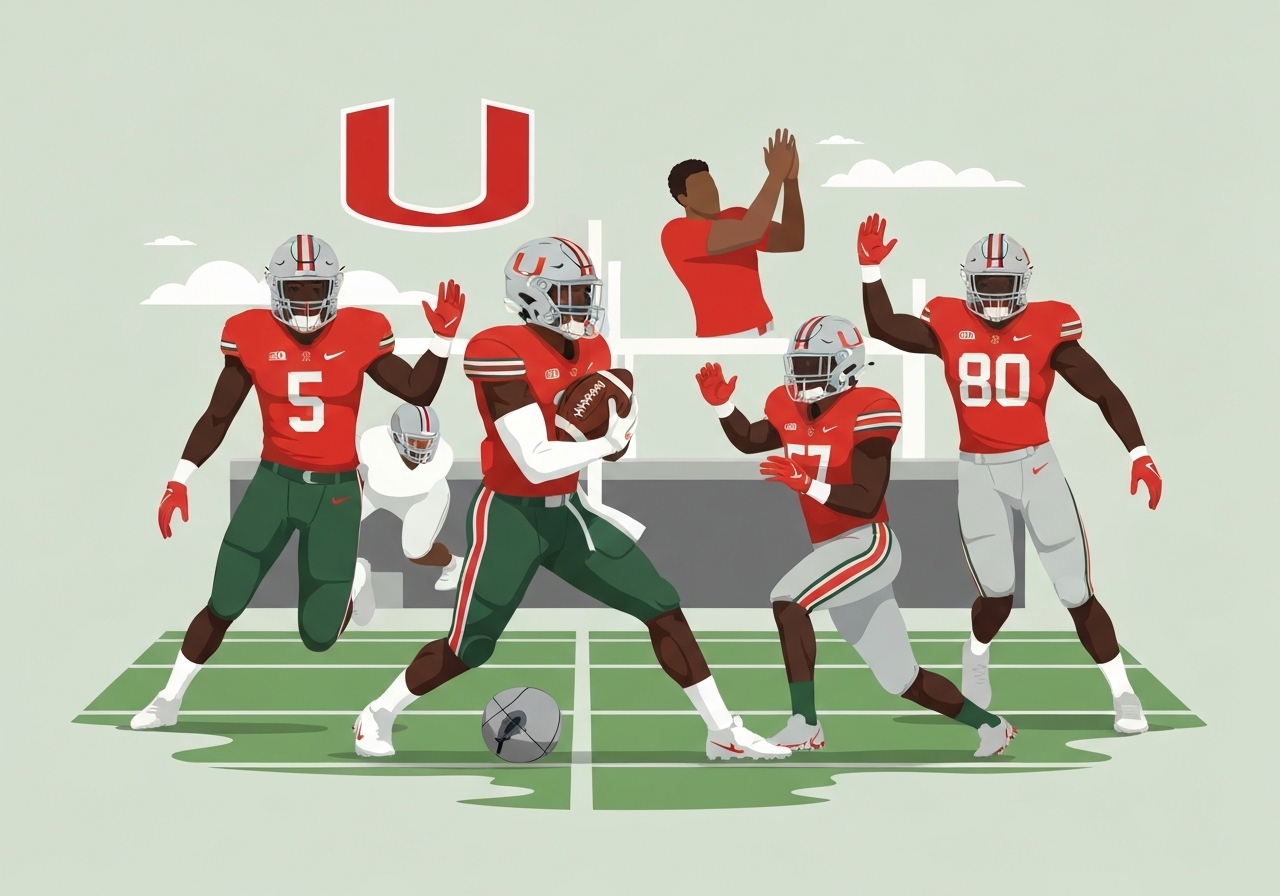
Lead: On Jan. 1, 2026 in Arlington, Texas, 10th-seeded Miami beat defending champion Ohio State 24-14 in the Cotton Bowl to reach the College Football Playoff semifinal. The Hurricanes (12-2) built an early lead — including a 72-yard interception return — and withstood a late Ohio State push to secure a Fiesta Bowl berth on Jan. 8 in Glendale. Miami’s victory, as a 9.5-point underdog, marked the largest upset in the 12-year CFP era and represents a clear reassertion of the program’s national relevance. Carson Beck’s efficient game management and a dominant front-seven performance were decisive.
Key Takeaways
- Score and stakes: Miami defeated Ohio State 24-14 in the Cotton Bowl on Jan. 1, 2026, advancing to the CFP semifinal (Fiesta Bowl, Jan. 8) with a shot at the national title.
- Seeding and records: The Hurricanes are 12-2 and entered the Playoff as the 10th seed after leapfrogging Notre Dame; Ohio State finished the season 12-2.
- Game-turning plays: CB Keionte Scott returned an interception 72 yards for a touchdown early in the second quarter; Jakobe Thomas closed the game with a late interception of Julian Sayin.
- Quarterback play: Carson Beck completed a Cotton Bowl-record 13 consecutive passes in the first half and is 36-5 as a starter heading into the semifinal.
- Defensive impact: Miami pressured Ohio State consistently — Rueben Bain Jr. and Akheem Mesidor combined for three sacks through three quarters — and limited the Buckeyes to minus-3 rushing yards in the first half.
- Special teams and kicking: Kicker Carter Davis converted a 49-yard field goal in the third quarter after a costly miss in the first round; Ohio State missed a 49-yard attempt at the end of the half.
- Historic upset: Entering as 9.5-point underdogs, Miami’s win is the largest upset in CFP history (12 seasons).
Background
Miami and Ohio State meet in the Cotton Bowl amid contrasting recent narratives. Miami’s program has been on a rebuilding trajectory under coach Mario Cristobal, emphasizing trench play and defense after last season’s high-scoring but defensively vulnerable team. The Canes earned the final at-large Playoff spot on selection Sunday, edging Notre Dame to become the lowest-seeded team in this year’s bracket.
Ohio State entered the game as the defending national champion and with a 12-0 start before finishing 12-2; the Buckeyes sought to protect that status and advance deeper into the Playoff. Coach Ryan Day had resumed play-calling duties for this matchup, a choice that carried additional scrutiny after the regular season and because offensive coordinator Brian Hartline had external commitments.
Historically, the matchup carried extra resonance: Miami last reached the national title game in January 2003 (a loss to Ohio State). Twenty-three years after Ohio State upset Miami in a classic, the Hurricanes had both a symbolic and competitive incentive to show they belong among college football’s elite again.
Main Event
The game opened with Miami dominating early field position and production. In the first quarter the Hurricanes outgained Ohio State 110 yards to 9, repeatedly pressuring the Buckeyes’ offensive front and preventing a meaningful OSU rushing attack. Miami’s offense only turned that dominance into points after a red-zone fumble was followed by sustained drives into the second quarter.
Carson Beck and the Miami offense struck first with a touchdown pass to Mark Fletcher Jr. early in the second quarter. Three plays later, cornerback Keionte Scott intercepted a bubble screen and returned it 72 yards untouched for a 14-0 advantage, swinging momentum completely to Miami and energizing the crowd and the sideline.
Ohio State regrouped after halftime. The Buckeyes engineered an 81-yard drive to open the third quarter, capped by a Bo Jackson rushing touchdown that cut the deficit to 14-7. Miami responded with a long drive finished by Carter Davis’ 49-yard field goal, and Ohio State answered again with a 75-yard drive culminating in a Julian Sayin touchdown to Jeremiah Smith on fourth down.
The Buckeyes produced several impressive mid-third-quarter drives, but Miami’s defense reasserted itself on key downs late. After Ohio State appeared poised to take the lead with just over 10 minutes left, a holding penalty and defensive stops forced a punt. Miami then put together a 10-play, 70-yard drive finished by CharMar Brown’s 5-yard run, and Jakobe Thomas’ interception two plays later sealed the win with 55 seconds remaining.
Analysis & Implications
Miami’s front line dictated the game’s arc. The Hurricanes not only disrupted Ohio State’s blocking schemes early, they converted chaos into turnovers and favorable field position. The combination of Bain, Mesidor and others generating repeated pressure altered Ohio State’s play calls and forced the Buckeyes to become one-dimensional at times, particularly in the first half when OSU registered negative rushing yards.
Carson Beck’s performance should reshape perceptions about his ceiling and poise. Beck’s stat line was not gaudy — 138 passing yards — but his efficiency, ball security and situational decision-making were exemplary. A quarterback who keeps drives moving and avoids turnovers becomes exponentially more valuable in a single-elimination format.
For Ohio State, the game highlights problems with game-plan adaptability and timing of adjustments. Once Ryan Day shifted personnel and blocking assignments at halftime the offense recovered, but the slow start left a deficit too large to overcome. The Buckeyes now face questions about in-game flexibility and whether play-calling responsibilities should be reorganized when the team faces early pressure.
Looking ahead to the Fiesta Bowl and beyond, Miami’s balanced identity (defensive toughness, special-teams competence, efficient quarterback play) makes them a matchup problem for many contenders. If the Hurricanes sustain pressure rates and limit big-play opportunities, they have a realistic path to the national title; conversely, Ohio State will need to diagnose first-half issues rapidly to rebound next season.
Comparison & Data
| Metric | Miami | Ohio State |
|---|---|---|
| Final score | 24 | 14 |
| Record (postgame) | 12-2 | 12-2 |
| First-quarter total yards | 110 | 9 |
| Halftime rushing (OSU) | — | −3 yards |
| Notable defensive sacks | Bain/Mesidor — 3 (through Q3) | — |
The table highlights where Miami seized advantage: early-yardage dominance and negative rushing for Ohio State in the first half. Those imbalances forced strategic responses that arrived too late for the Buckeyes and set up Miami’s decisive late drive. The figures above are drawn from official game reporting and postgame summaries.
Reactions & Quotes
Media and public reaction captured the immediacy of the game-turning plays and the upset magnitude.
MIAMI PICK-SIX ON JULIAN SAYIN 😱
SportsCenter (tweet)
That clip and commentary underscored how the interception-return touchdown reshaped the contest’s tone and momentum early.
MIAMI PICKS OFF JULIAN SAYIN TO SECURE THE CFP DUB‼️
ESPN (tweet)
Broadcast and social coverage emphasized Jakobe Thomas’ late interception as the definitive closing play that confirmed Miami’s upset and advanced them to the semifinal round.
Unconfirmed
- Whether Ohio State’s late-game personnel shifts will lead to permanent changes in play-calling responsibilities or staffing — no official confirmation has been released.
- Long-term health status for key Miami defensive linemen entering the semifinal is not fully disclosed; official injury reports remain pending.
- How the matchup specifics (Beck vs. Georgia/Ole Miss) will affect game planning — opponent selection will be finalized after the Sugar Bowl outcome.
Bottom Line
Miami’s 24-14 win over Ohio State is both a symbolic and practical turning point for the program: symbolically it answers the “is the U back?” question in the affirmative, and practically it advances a well-balanced team to the CFP semifinal. The victory was built on trench dominance, timely turnovers and a veteran quarterback who managed the game efficiently when it mattered most.
Ohio State’s loss exposes the cost of a slow start against a physical front and raises questions about in-game adjustment processes under pressure. For Miami, the path forward will test whether this performance was a peak moment or evidence of sustained title-level capability; for the wider Playoff field, the upset reshuffles matchup narratives and betting lines going into Jan. 8.