
Lead
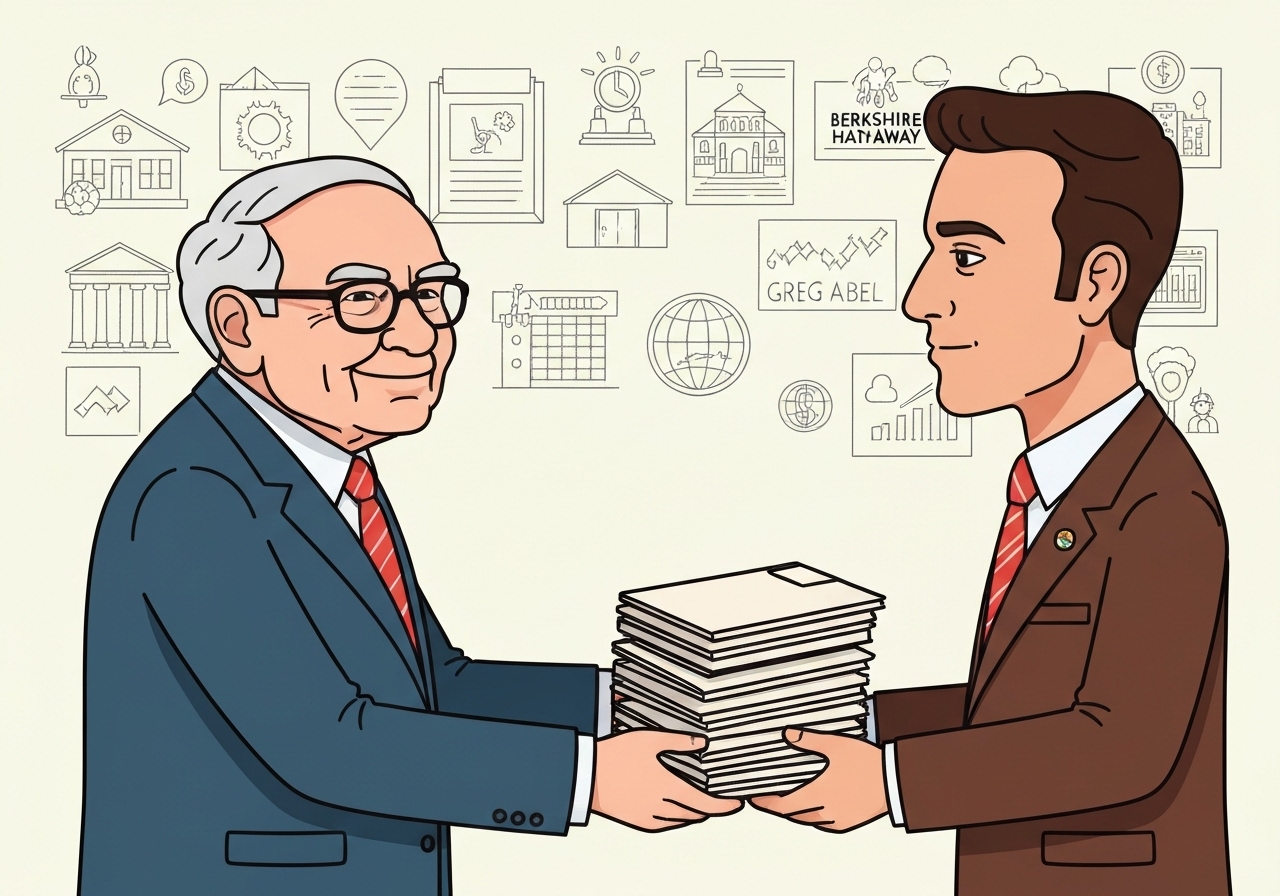
Warren Buffett has formally handed operational control of Berkshire Hathaway to Greg Abel, marking a decisive leadership transition at one of the United States’ largest conglomerates. The move places Abel at the head of day-to-day management while Buffett remains a central shareholder and board figure. The change caps a long-planned succession process that investors and corporate-governance specialists have watched closely. It also sets a new direction for Berkshire as it navigates investments, subsidiaries and succession-era governance.
Key takeaways
- Warren Buffett has transferred operational reins of Berkshire Hathaway to Greg Abel, making Abel the company’s chief day-to-day executive.
- Buffett, who led Berkshire for more than five decades, will retain a prominent role as a major shareholder and board member.
- Greg Abel brings extensive experience running Berkshire’s non-insurance businesses, including its utilities and energy affiliates.
- The handover follows an announced succession plan that the company has signaled publicly in prior years.
- Investors and governance experts are assessing implications for capital allocation, dealmaking and the company’s long-term strategy.
- Short-term market effects are uncertain; analysts expect a focus on continuity rather than radical strategic shifts.
Background
Berkshire Hathaway grew from a textile firm into a diversified holding company under Warren Buffett’s stewardship, expanding into insurance, utilities, industrials and large equity stakes in public companies. Over more than 50 years of leadership, Buffett became closely identified with Berkshire’s capital-allocation approach and its decentralized management of operating businesses. Given Buffett’s prominence and age, the company established a succession framework to ensure continuity; that planning has been referenced publicly and scrutinized by investors and regulators. Greg Abel rose through Berkshire’s non-insurance operations and took on greater corporate responsibilities in recent years, positioning him as the operational successor in the company’s governance structure.
The succession topic has been a recurring focus in annual meetings, shareholder communications and investor research because Berkshire’s portfolio and cash position give any new leader significant latitude. Stakeholders include operating-company managers across Berkshire’s dozens of subsidiaries, large shareholders who follow the firm’s investment decisions, and regulators who monitor disclosures and board governance. Because Berkshire combines active operating businesses with large public-equity holdings, the transition affects both corporate-management practices and public-market expectations. Ensuring stable stewardship of capital and a steady management ethos has been framed as the primary objective of the company’s succession planning.
Main event
The company announced that Greg Abel will assume operational leadership at Berkshire Hathaway, a shift described by the board as intended to preserve continuity across the conglomerate’s diverse holdings. The announcement emphasized a smooth transfer of day-to-day responsibilities to Abel while leaving strategic oversight and shareholder stewardship roles for the board and senior directors. Managers of Berkshire’s operating subsidiaries will continue to run their businesses with a high degree of autonomy, under the oversight and capital-allocation framework historically associated with Buffett’s approach. The company communicated the change through corporate channels to employees, shareholders and partners, framing it as a planned and orderly handover.
On the governance side, the board reiterated existing protocols for capital deployment and subsidiary governance, signaling that Berkshire’s decentralized model will remain intact. Executives and operating managers were described as being consulted during the transition to minimize disruption at business units and to maintain stable cash flows and operational performance. Shareholders and market participants reacted with a range of commentary—some highlighting continuity and others raising questions about whether strategic priorities will evolve under new operational leadership. The company said it would provide further information to investors as appropriate, while emphasizing steady stewardship.
Operationally, the shift places a leader with a background in running large, regulated businesses and industrial operations into the top management role. The board indicated that staffing and reporting relationships at the corporate center will be updated to reflect Abel’s responsibilities, but it did not outline wholesale reorganizations of Berkshire’s subsidiary management teams. The communication focused on the intention to preserve the value-creation mechanisms—capital allocation, long-term orientation and decentralized operating autonomy—that have defined Berkshire over decades.
Analysis & implications
The transition reduces uncertainty over leadership at a conglomerate whose stock and capital allocation decisions have outsized effects on financial markets and corporate governance discourse. For investors, the immediate question is how Abel will balance acquisitions, share repurchases and dividend policy against Buffett’s historical preferences. Given Berkshire’s substantial cash resources and broad exposure across sectors, even incremental shifts in capital-allocation emphasis could reverberate through industries where the company is a major participant.
From a governance perspective, the handover tests Berkshire’s ability to institutionalize practices that were long shaped by a single, dominant manager. If Abel preserves the decentralized approach while introducing modest changes in oversight and performance metrics, Berkshire could demonstrate a model of founder-to-professional leadership that maintains culture without reverting to centralization. Conversely, any notable strategic realignment—greater emphasis on operational improvements, different deal sizes, or altered public-equity exposure—would prompt reassessment by large shareholders and analysts.
At the subsidiary level, managers will watch for shifts in capital discipline and expectations for return on invested capital. Businesses operating in regulated industries—such as utilities and energy, areas where Abel has experience—may see continuity in management priorities, but other operating units could face new performance targets or reporting protocols. Internationally, partners and regulators will monitor the transition for signs of continuity in contractual relationships and long-term commitments tied to Berkshire affiliates.
Comparison & data
| Characteristic | Warren Buffett | Greg Abel |
|---|---|---|
| Primary background | Investor and capital allocator | Operational executive; utilities and industrials |
| Role at Berkshire | Longtime chairman and chief decision-maker | Now leading day-to-day operations |
| Management style | Decentralized, capital-focused | Operationally oriented, continuity-focused |
The table above highlights qualitative differences rather than numeric measures; the transition pairs Buffett’s investor-centric legacy with Abel’s operational track record. That mix can influence deal structure, integration approach and performance oversight across Berkshire’s portfolio. Analysts will watch early decisions—major acquisitions, divestitures, or changes in repurchase activity—for signals of strategic emphasis under Abel’s leadership.
Reactions & quotes
Paraphrase: Berkshire described the change as an orderly, planned transfer intended to preserve continuity across its businesses.
Berkshire Hathaway (official statement)
Paraphrase: Corporate-governance observers noted that the real test will be whether institutional processes can replicate Buffett’s judgment over time.
Independent governance analyst (comment)
Paraphrase: Market commentary emphasized investor interest in Abel’s approach to capital allocation and potential effects on large equity holdings.
Market commentators and investors
Unconfirmed
- Details of any immediate changes to Berkshire’s capital-allocation framework have not been fully disclosed and remain to be clarified by the company.
- Precise timing for potential organizational or reporting adjustments under Greg Abel has not been spelled out publicly.
- Any long-term strategic shifts in portfolio sectoral exposure or acquisition size under Abel are not yet confirmed and will depend on future board decisions.
Bottom line
The leadership handover at Berkshire Hathaway is a milestone that converts long-standing succession planning into operational reality. For investors and partners, the near-term priority is to monitor early signals on capital allocation and corporate governance that indicate whether continuity or change will predominate. Over the medium term, how Abel balances operational discipline with the cash-deployment philosophy that defined Buffett’s era will shape Berkshire’s performance and its role in markets.
Readers should watch scheduled communications from Berkshire, filings and subsidiary disclosures for definitive details. While the transition reduces one form of uncertainty by naming a clear operational leader, it introduces a period in which governance procedures and strategic preferences will be tested under new day-to-day stewardship.
Sources
- Financial Times — news media (paywalled), initial report of the handover
- Berkshire Hathaway — official corporate site and governance information (official)