
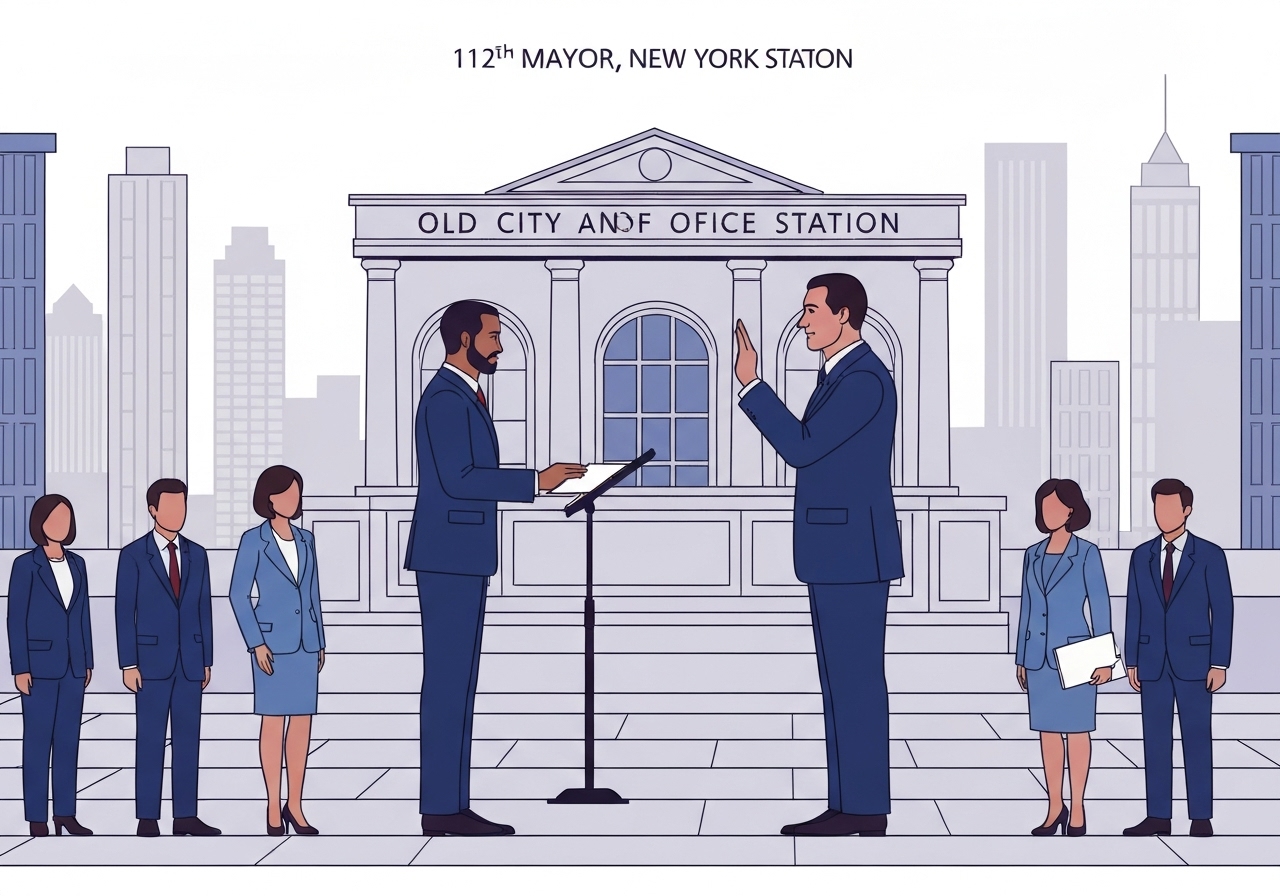
Zohran Mamdani took the oath of office at the stroke of midnight on Jan. 1, 2026, in a private ceremony held inside the long-unused Old City Hall subway station, becoming New York City’s 112th mayor. The 34-year-old former state assemblymember from Astoria was administered the oath by New York Attorney General Letitia James and in brief remarks described the setting as a tribute to public transit’s role in city life. Mamdani — the city’s first Muslim mayor and its first mayor of South Asian descent — immediately announced a senior appointment to lead transportation as his administration begins. A separate public swearing-in and street celebration is scheduled later that day at City Hall, drawing national attention.
Key takeaways
- Zohran Mamdani was sworn in privately at Old City Hall subway station at midnight on Jan. 1, 2026, becoming New York City’s 112th mayor and its first Muslim and first South Asian mayor.
- At 34, Mamdani moves from representing the 36th Assembly District in Queens to citywide office, marking one of the youngest inaugurations in recent history.
- New York Attorney General Letitia James administered the private oath; a public ceremony will be held Jan. 1, 2026 at 1 p.m. at City Hall, to be led by U.S. Sen. Bernie Sanders.
- Mamdani named Mike Flynn as commissioner of the Department of Transportation; Flynn has nearly two decades of public- and private-sector experience, including prior senior DOT roles.
- The public inauguration, billed as the “Inauguration of a New Era,” includes a block party from 11 a.m. to 3 p.m. in the Canyon of Heroes (Liberty to Murray Streets); attendance requires RSVP.
- Education and transportation were immediate priorities: Mamdani also announced a new schools chancellor, Kamar Samuels, among other senior hires during the transition.
Background
Mamdani’s rise to city hall follows a political career rooted in Queens. He represented Astoria in the New York State Assembly, aligning with progressive and democratic socialist platforms that emphasize housing affordability, public transit investment, and equity in city services. His election capped a campaign that mobilized diverse constituencies across boroughs and leaned on grassroots organizing and policy pledges aimed at reducing living costs for working families.
The choice of Old City Hall station for the private midnight ceremony carried symbolic weight. The Romanesque-Revival station, closed to regular service since 1945, is an architectural landmark and has become a site for cultural and civic references about the city’s transit history. Mamdani framed the location as emblematic of the vital role transit plays in New York’s economy and civic life, signaling that transportation policy will be central to his administration.
Main event
The private swearing-in took place just after midnight. Attorney General Letitia James administered the oath inside the station while a small group of family, close aides, and legal representatives attended. Mamdani offered a short speech thanking voters and emphasizing transit and affordability as immediate priorities. Photographs from the event show Mamdani, his wife Rama Duwaji, and officials in a setting lit for the ceremony; the image credit was attributed to AP photographer Yuki Iwamura.
Following the private ceremony, Mamdani announced the appointment of Mike Flynn as the new Department of Transportation commissioner and Kamar Samuels as schools chancellor, among five senior hires announced over the preceding 48 hours. Mamdani described Flynn as someone experienced in both government and private practice who can help execute promises such as expanded bus service and street safety measures. Flynn’s background includes nearly a decade in senior DOT roles and recent private-sector leadership supporting regional transportation projects.
The new mayor’s transition team also published plans for a public inauguration at City Hall later the same day. U.S. Sen. Bernie Sanders is scheduled to administer the public oath at 1 p.m., and a civic celebration dubbed the “Inauguration of a New Era” will run from 11 a.m. to 3 p.m. in Lower Manhattan. Organizers said the event will feature music, performances, and interfaith elements, and that attendees must RSVP to control crowds and logistics.
Analysis & implications
Mamdani’s midnight swearing-in and choice of an abandoned transit landmark sends an early and intentional policy signal: transit will be central to his agenda. By elevating transportation in the inaugural moments and naming an experienced DOT commissioner, Mamdani is attempting to convert campaign rhetoric about affordability and mobility into immediate administrative priorities. If the administration delivers faster bus service or fare changes, those moves would directly affect commuting costs and access to jobs across the city.
The appointment of a schools chancellor and multiple senior officials within days of the oath reflects a rapid transition strategy designed to set governing priorities and reassure stakeholders. Early hires help shape implementation capacity, but they also set expectations about the pace of reform. Managing relationships with state agencies, unions, and city agencies will be critical as the new administration attempts reforms that require funding, regulatory approvals, or operational shifts.
National attention on Mamdani’s inauguration could amplify both political capital and scrutiny. As the city’s first Muslim and South Asian mayor, Mamdani carries symbolic significance that may broaden his national profile and invite attention from civil rights groups, faith leaders, and diaspora communities. That visibility can be leveraged to build alliances for federal funding or pilot programs, but it also means policy missteps could have outsized political costs.
Comparison & data
| Event | Time / Location |
|---|---|
| Private oath | Midnight, Jan. 1, 2026 — Old City Hall subway station |
| Public oath & ceremony | 1 p.m., Jan. 1, 2026 — City Hall (Canyon of Heroes route) |
| Block party | 11 a.m.–3 p.m., Jan. 1, 2026 — Lower Manhattan (Liberty to Murray St.) |
The table clarifies the two-part inauguration sequence: a private, symbolic midnight oath and a formal public swearing-in and celebration later in the day. The administration has framed the public midday event as both ceremonial and civic, pairing the official oath with community-facing programming.
Reactions & quotes
Officials, experts, and observers offered immediate responses that mix praise for the choice of appointees with cautious optimism about policy delivery.
This is truly the honor and the privilege of a lifetime.
Zohran Mamdani, Mayor of New York City
Mamdani used his short address to link the setting to his policy priorities and to introduce members of his incoming team. The remark underscores a tone of gratitude and a focus on civic infrastructure.
Transportation is essential to affordability and quality of life. I look forward to building a DOT that moves faster and puts safety first.
Mike Flynn, incoming DOT commissioner
Flynn’s statement framed transportation both as a technical challenge and a lever for affordability, signaling his stated emphasis on faster bus service and street safety programs.
RPA applauds the appointment; he is a well-respected leader who can help carry out a vision for better bus service and safer streets.
Kate Slevin, Regional Plan Association (expert group)
The Regional Plan Association and former DOT leaders offered endorsements that emphasize continuity of institutional expertise, while also noting execution will depend on funding and cross-agency collaboration.
Unconfirmed
- Implementation timeline for proposed free bus service remains unspecified; no funding or legislative mechanism has been publicly confirmed.
- Details about additional senior hires beyond those announced were not confirmed at the time of the private oath and remain subject to official release.
Bottom line
Zohran Mamdani’s midnight oath at Old City Hall was a carefully staged first act that emphasizes transit and affordability as signature priorities. Early personnel choices, particularly naming a DOT commissioner with both public-agency and private-sector experience, show an intent to pivot quickly from campaign rhetoric to operational planning. Success will depend on the administration’s ability to secure funding, navigate city and state governance structures, and translate policy pledges into projects that produce measurable improvements for commuters and families.
For New Yorkers and observers nationwide, the inauguration combines historic symbolism with an immediate policy agenda. The public swearing-in and block party later the same day will offer a broader, more visible start to the term and a first test of the administration’s capacity to manage large-scale events while rolling out early priorities.
Sources
- CBS News — media report on inauguration and appointments (original article)
- The Associated Press (AP) — photo credit and coverage (media/photo)
- Regional Plan Association (RPA) — expert commentary on urban transportation (think tank)