
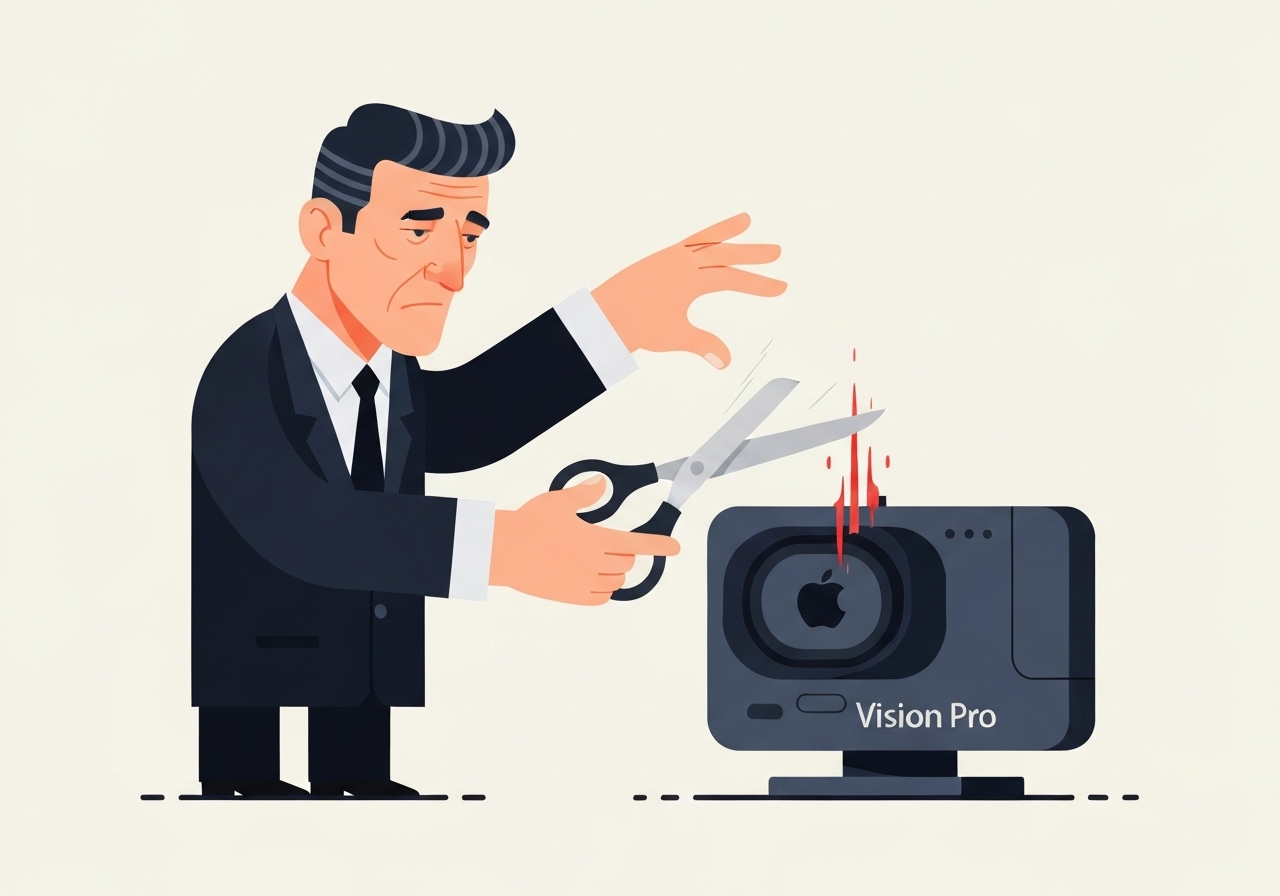
Apple has reportedly scaled back production of its Vision Pro mixed‑reality headset after weak consumer demand, according to multiple market research firms. The cutbacks include a sharp reduction in marketing and a halt in some manufacturing lines, moves that industry analysts say signal the device has not met Apple’s commercial expectations. Market trackers estimate roughly 45,000 units were sold in Q4 2025, while Apple has continued to keep official sales figures private. If confirmed, the retrenchment would mark a rare product shortfall for the company and prompt a strategic shift toward lower‑cost and AI‑focused wearables.
Key takeaways
- IDC estimates Apple sold about 45,000 Vision Pro headsets in the fourth quarter of 2025; Apple has not published official sales figures.
- Sensor Tower data, cited by the Financial Times, shows Apple cut Vision Pro marketing by more than 95% during 2025.
- Apple’s manufacturing partner Luxshare reportedly stopped Vision Pro production at the start of 2025, according to IDC.
- The Vision Pro debuted in 2023 at a base price of £3,199 ($3,499), a point analysts say limited consumer uptake.
- Counterpoint Research forecasts a 14% year‑on‑year drop in virtual reality headset shipments, reflecting softer demand across the category.
- Meta’s Quest headsets, priced around £419, reportedly control roughly 80% of the VR headset market by shipments.
- Apple says there are about 3,000 apps available for Vision Pro, a small catalogue relative to phones and tablets.
Background
When Apple unveiled Vision Pro in 2023, executives framed it as the start of “spatial computing” — an interface that blends digital content with physical space. Tim Cook described the product as turning surroundings into “an infinite canvas,” positioning it as a new platform comparable in ambition to the iPhone and Mac launches of prior decades. The headset uses eye tracking and hand gestures to interact with apps, and Apple marketed it as a premium device combining AR and VR capabilities.
But the product entered a market that remains price‑sensitive and hardware‑challenging. Early reviews flagged issues with weight, comfort and battery life, while consumers balked at the £3,199/$3,499 starting price. The app ecosystem for Vision Pro has grown to about 3,000 titles by Apple’s count, yet analysts say that remains modest compared with the surge of apps that followed the iPhone’s 2007 launch. Past smart‑glasses experiments — notably Google Glass in 2013 — also illustrate how novelty can collide with social acceptance and real‑world utility.
Main event
Market research firms reported in late 2025 that Apple has materially scaled back production of Vision Pro headsets. IDC told clients and partners that Luxshare — one of Apple’s Chinese assemblers — halted Vision Pro output at the start of 2025. The Financial Times, citing Sensor Tower, reported Apple trimmed its Vision Pro marketing spend by more than 95% during 2025, a move consistent with a lower production run.
Apple sells Vision Pro directly in a limited set of countries and has not broadened the retail footprint beyond about 13 markets, according to industry sources. That restricted availability, combined with the headset’s premium price, contributed to muted sales traction. IDC’s estimate of roughly 45,000 units sold in Q4 2025 gives a tangible scale to what analysts describe as slow adoption for a device positioned as a mass‑market platform.
At the same time, multiple reports indicate Apple is recalibrating product priorities. Tech press accounts say Apple paused work on the next major Vision Pro hardware iteration to focus resources on AI‑enabled wearables and a lower‑price model expected later in the year. Meta likewise confirmed it is shifting some investments from the metaverse to AI glasses and other wearables, part of a broader industry pivot away from heavy investment in immersive VR environments.
Analysis & implications
The reported cutbacks underscore four structural challenges for premium mixed‑reality devices: price sensitivity, form factor tradeoffs, limited app ecosystems and unclear day‑to‑day use cases. Vision Pro’s high entry price narrows the addressable consumer base, while reviewers’ criticisms of comfort and practicality point to persistent engineering hurdles. Without a broad set of native apps and clear productivity or entertainment “killer” use cases, convincing mainstream buyers remains difficult.
From a market‑structure perspective, cheaper, less advanced headsets have dominated unit shipments. Meta’s Quest line, at roughly £419 each, has captured the lion’s share of headset volumes, enabling developers and consumers to build familiarity with VR affordably. That market dynamic raises the bar for hardware like Vision Pro to demonstrate differentiated value that justifies a much higher price point.
For Apple’s supply chain and partners, pauses or downsizing of production can have ripple effects. Luxshare and other assemblers may see lower volumes and reallocated capacity to other Apple product lines. For developers, a slowdown in Vision Pro growth could reduce incentives to invest in VisionOS‑native apps, reinforcing the catalog shortage that analysts say limited adoption.
Finally, the broader industry pivot toward AI‑enabled wearables suggests Apple and rivals are recalibrating to a market environment where generative AI integrations, lower prices and more socially acceptable form factors may drive the next phase of consumer interest. A lower‑cost Vision Pro variant could test whether Apple can translate its ecosystem strengths into a more commercially viable product family.
Comparison & data
| Metric | Apple Vision Pro | Meta Quest (typical) |
|---|---|---|
| Base price | £3,199 / $3,499 | ~£419 |
| Estimated Q4 2025 sales | ~45,000 (IDC) | N/A (dominant share) |
| Market share (headset shipments) | Small / niche | ~80% (by shipments, reported) |
| Available native apps | ~3,000 (Apple) | Large catalogue (varies) |
The table highlights the asymmetric economics: Vision Pro targets a premium, lower‑volume segment while Quest competes on affordability and broad installed base. Where quantity favors cheaper platforms, platform owners can attract developers and create reinforcing network effects.
Reactions & quotes
“We can say the cost, form factor and the lack of VisionOS native apps are the reasons why the Vision Pro never sold broadly.”
Erik Woodring, Morgan Stanley (quoted by Financial Times)
Analysts point to a familiar trifecta of barriers: price, hardware ergonomics and limited third‑party software. Woodring’s summary has been widely cited in industry commentary as a concise diagnosis.
“We are shifting some of our investments from metaverse towards AI glasses and other wearables.”
Meta (official statement)
Meta’s public confirmation of a strategic pivot underscores that even major players are reprioritizing R&D and capital around AI and more compact wearable form factors.
“Your surroundings become an infinite canvas … Vision Pro blends digital content into the space around us.”
Tim Cook, Apple (product launch, 2023)
Apple’s original messaging emphasized a transformative platform rather than a single gadget; the current commercial signals will test whether that vision can be realized incrementally or requires a reset.
Unconfirmed
- Apple has not publicly confirmed the exact scale of production cuts or the decision to pause the next Vision Pro iteration; reports are based on market‑research sources and supply‑chain accounts.
- Details and timing for a lower‑cost Vision Pro model remain unverified; Apple has not announced a release date or specifications.
- The full impact on Luxshare’s business and whether other suppliers will absorb production has not been independently confirmed.
Bottom line
Reported cuts to Vision Pro production and marketing mark an important reality check for premium mixed‑reality hardware. Despite Apple’s technological advances and ecosystem advantages, high price, limited app breadth and practical design issues have constrained adoption. The device’s struggles mirror broader market trends where lower‑cost headsets have dominated unit volumes and developers gravitate to platforms with larger user bases.
That said, the situation also presents a strategic inflection point: Apple may use a scaled‑back initial rollout to refine design and pursue a lower‑price version that could broaden appeal. Meanwhile, a wider industry shift toward AI‑enabled wearables suggests the next cycle of consumer adoption will depend on tighter integration of generative AI, improved ergonomics and clearer day‑to‑day benefits.
Sources
- The Guardian — journalism: original report summarizing market research and company responses.
- Financial Times — journalism: reported Sensor Tower marketing figures and cited analyst comments.
- Sensor Tower — market intelligence: app and marketing‑spend analytics (market research)
- International Data Corporation (IDC) — market research: quarterly sales estimates and supply‑chain reporting (market research)
- Counterpoint Research — market research: VR shipment forecasts (market research)
- Meta (official) — corporate statement: investment shift toward AI glasses and wearables (official)
- Morgan Stanley — financial analysis: analyst commentary quoted in coverage (financial research)