
Lead
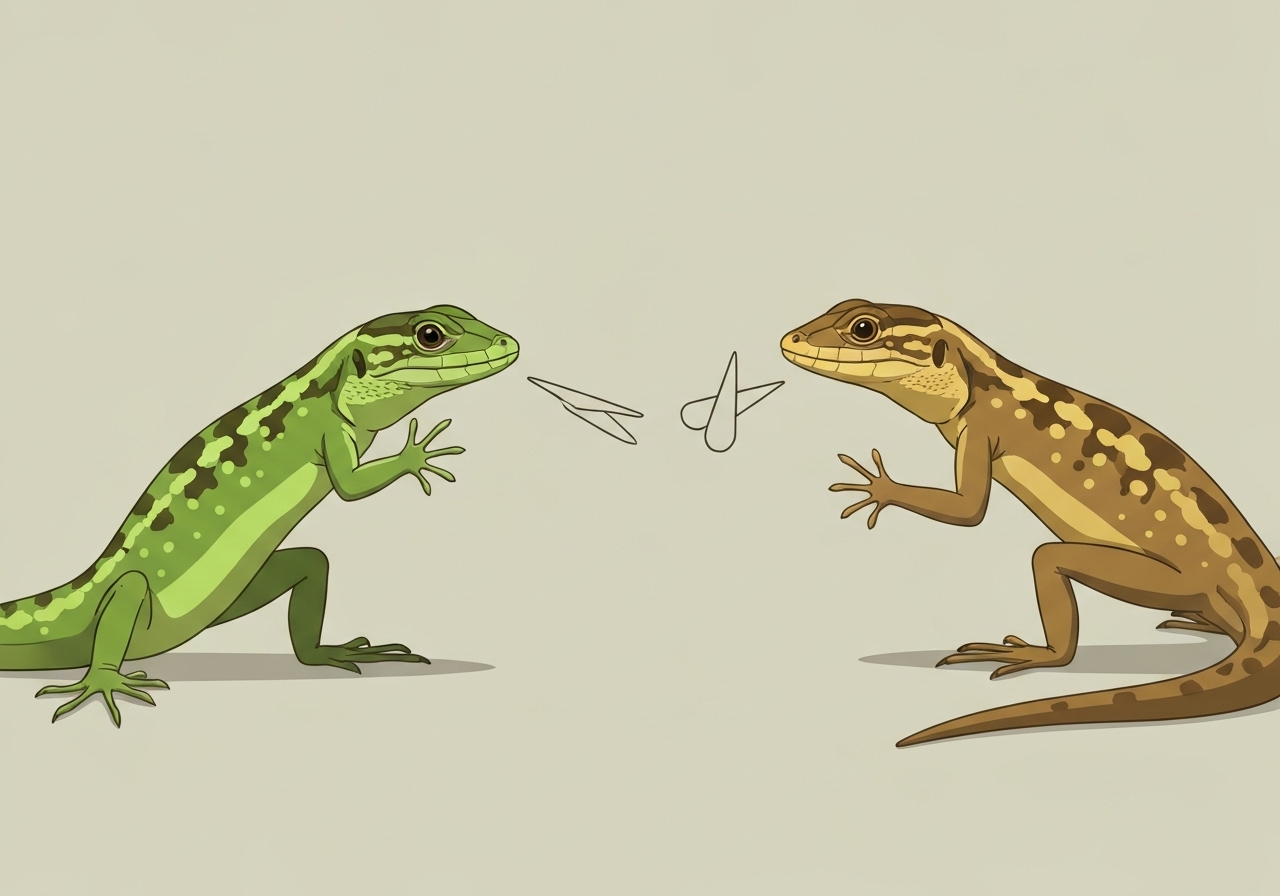
A new paper published in Science on Jan. 1, 2026, shows that common side‑blotched lizards in the dry hills outside Merced, California, sustain a three‑way behavioral cycle analogous to rock‑paper‑scissors. Researchers link throat‑color morphs — blue, orange and yellow — to distinct mating strategies and report biological mechanisms that help maintain the cycle across seasons. The pattern was first documented decades ago by Barry Sinervo, and the new study combines long‑term field observation with laboratory analyses to explain how the strategies persist.
Key Takeaways
- Study published in Science on Jan. 1, 2026, documents mechanisms behind a three‑strategy system in side‑blotched lizards (Uta stansburiana) observed near Merced, California.
- Males express one of three throat colors — blue, orange or yellow — and each morph uses a different reproductive tactic; orange males can guard as many as six females on prime territory.
- The three strategies interact in a nontransitive cycle (A beats B, B beats C, C beats A), comparable to rock‑paper‑scissors, and are maintained by frequency‑dependent selection across years.
- Researchers used a mix of long‑term mark–recapture field data and controlled lab assays to link morphology and behavior to physiological and genetic signals reported in the paper.
- The findings build on Barry Sinervo’s field program begun in the 1990s and help explain how behavioral polymorphism contributes to local diversity in mating systems.
Background
Work on side‑blotched lizards traces back more than three decades to field studies on the slopes outside Merced, California. Barry Sinervo, then at Indiana University and later at the University of California, Santa Cruz, led mark–recapture projects that tracked individual lizards through multiple breeding seasons. Sinervo documented that males develop one of three throat colors — blue, orange or yellow — and that those colors predict distinct behaviors during the mating season; he continued this program until his death in 2021.
Subsequent research framed the population dynamics as a nontransitive competitive cycle: aggressive, territory‑holding males (orange) can displace the mate‑guarding blue males; blue males can outcompete the sneaking yellow males; and yellow males can infiltrate orange males’ large harems by mimicking females or using stealth. The cycle produces fluctuating morph frequencies rather than a single dominant type, making it a classic example of negative frequency‑dependent selection in the wild.
Main Event
The Science paper released Jan. 1, 2026, reports analyses intended to uncover the proximate biology that sustains the three‑way dynamic. Authors combined long‑term field monitoring of marked individuals with laboratory assays that measured physiological markers and behavioral responses. Their integrated approach aimed to connect visible throat color, hormone or gene expression patterns, and observable mating tactics.
Field results confirmed recurring cycles of morph frequency across breeding seasons at the Merced site, consistent with earlier longitudinal records. In the field, orange males continued to secure larger territories and multiple females — the paper cites instances of orange males holding up to six mates on high‑quality plots — while blue males concentrated on mate‑guarding and defense of smaller territories. Yellow males persisted as opportunistic sneakers, often avoiding direct confrontation.
Laboratory components probed how morphs differ in physiology and responsiveness to social cues. While the paper reports correlations between throat color and specific biological markers, the authors emphasize that observed patterns reflect a web of interacting factors — environmental conditions, social structure and internal physiology — rather than a single deterministic switch.
Analysis & Implications
At a conceptual level, the study strengthens the case that behavioral polymorphisms can be stable, biologically grounded strategies rather than transient anomalies. Because each morph gains a fitness advantage when rare, negative frequency dependence helps explain long‑term coexistence. That mechanism has implications for how we think about behavioral diversity in other taxa where alternative reproductive tactics exist.
Ecologically, maintaining three strategies within one population affects mating success variance, effective population size and how the population responds to environmental change. For example, habitat alteration that systematically favors one tactic could break the balance and reduce overall genetic diversity. The paper suggests managers should consider behavioral polymorphism when assessing population resilience.
From an evolutionary genetics standpoint, the study frames morph maintenance as a multilayered phenomenon: visible color signals, neuroendocrine states and social ecology interact to produce stable cycles. This integrated view moves beyond single‑gene explanations toward network and developmental perspectives on behavioral evolution.
Comparison & Data
| Throat Morph | Typical Tactic | Typical Territory |
|---|---|---|
| Orange | Aggressive polygyny | Large; may hold multiple females (up to six) |
| Blue | Mate‑guarding, territorial defense | Smaller, defended closely |
| Yellow | Sneaker/serial mating | No fixed territory; infiltrates rivals |
The table summarizes recurring behavioral associations reported at the Merced site. Quantitative comparisons in the paper show morph frequencies oscillate across years rather than trending to fixation; researchers interpret that as evidence for frequency‑dependent selection. That pattern aligns with earlier datasets collected by Sinervo and colleagues, reinforcing the long‑term stability of the cycle at this locality.
Reactions & Quotes
Researchers involved and independent experts emphasize the study’s value in linking field ecology to proximate biology. Below are concise reactions that capture how the community has received the findings and what caveats remain.
“The work clarifies how visible tactics connect to underlying biological states, not by a single gene but through interacting systems.”
Lead authors (paraphrase of Science paper)
The paper’s authors frame their contribution as an integrative bridge between decades of field observation and laboratory biology. They stress the evidence supports multi‑factorial control — hormonal, developmental and social — and caution against oversimplifying the outcome to single‑factor causation.
“This is a textbook example of frequency‑dependent selection operating in nature, made clearer by new physiological data.”
Independent evolutionary biologist (paraphrase)
Independent experts praised the combination of long‑term field records and controlled assays as a robust approach to a long‑standing question. At the same time they note that extrapolating from one geographically limited population to the species as a whole requires additional study.
“Conservation plans should account for behavioral diversity; losing one morph alters mating dynamics and genetic variation.”
Conservation scientist (paraphrase)
Conservation scientists pointed to practical consequences: if habitat change or selective pressures favor one tactic, the resulting shift could reduce diversity and affect population stability. They recommend monitoring morph frequencies in management plans where the species is of concern.
Unconfirmed
- Whether the precise physiological pathways reported at Merced operate identically in other geographic populations of Uta stansburiana remains untested.
- The long‑term genetic architecture (for example, specific causal loci) underlying throat color and tactic choice is not fully resolved in the paper and requires further genomic validation.
- The degree to which environmental change (climate, land use) will disrupt the observed cycle at Merced is projected but not empirically demonstrated.
Bottom Line
The new Science study provides a significant integrative account of how side‑blotched lizards sustain a three‑way mating dynamic akin to rock‑paper‑scissors at a Merced, California site. By linking long‑term field data with laboratory assays, authors show that morph‑specific tactics are supported by interacting biological and social mechanisms rather than a single causal factor.
For evolutionary biology the result reinforces frequency‑dependent selection as a mechanism maintaining behavioral polymorphism; for conservation it underscores that behavioral diversity itself can be an element of population resilience. Future work should test whether the same proximate mechanisms operate across populations and determine how environmental change could shift the balance among tactics.