
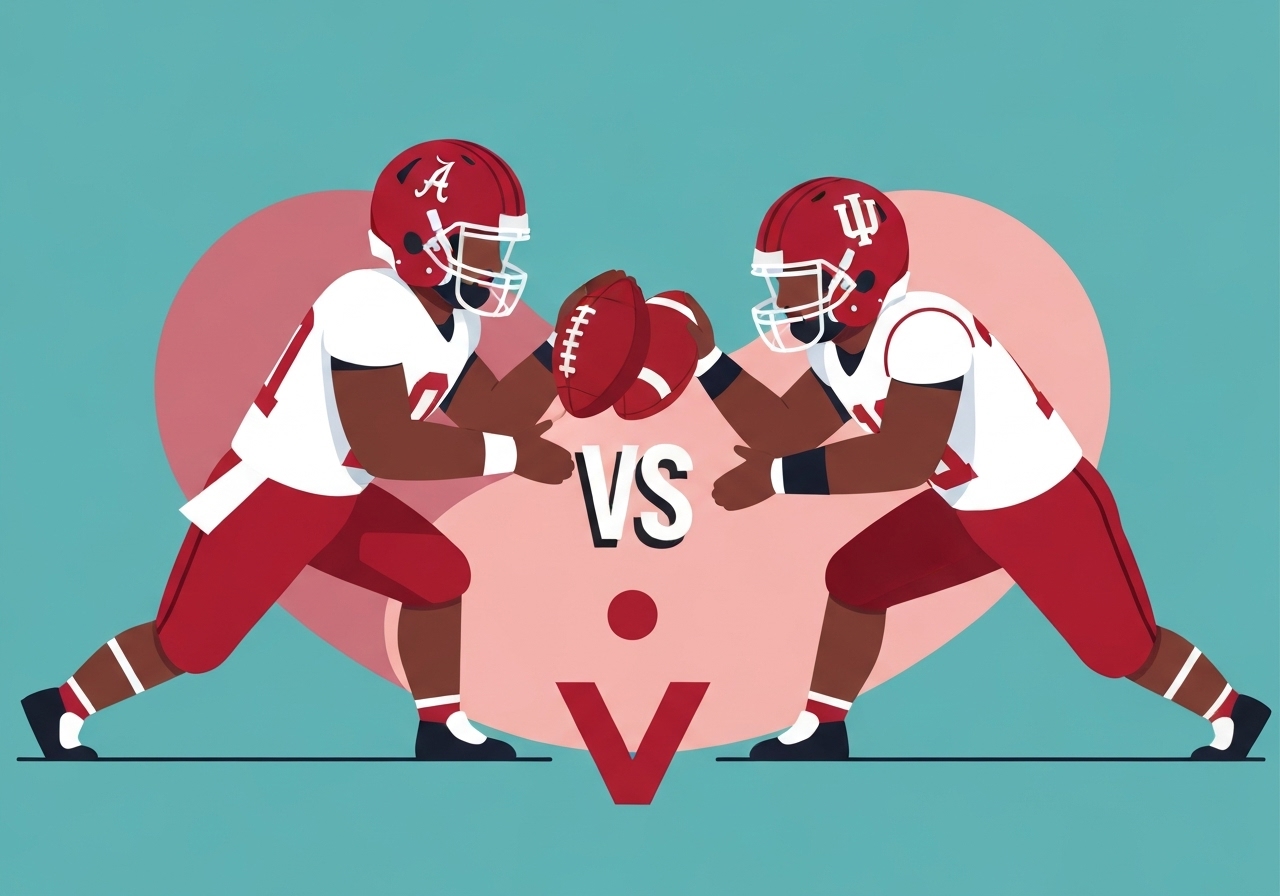
This column argues that on Jan. 1, 2026, at the Rose Bowl, three-loss Alabama can still topple No. 1 Indiana despite the Hoosiers entering as favorites. Fernando Mendoza’s Heisman-caliber season and Curt Cignetti’s AP national coach-of-the-year honors have many forecasting an Indiana victory. Still, the piece contends Alabama’s history of overturning expectations, plus a resurging Tide defense, make an upset plausible. The author frames the matchup as one where preparation, experience and situational play could overturn the pregame consensus.
Key takeaways
- Indiana arrives ranked No. 1 and is widely regarded as the top team by the College Football Playoff selection committee; Fernando Mendoza is the Heisman frontrunner.
- Curt Cignetti was voted AP national coach of the year for the second consecutive season, cementing Indiana’s rapid rise under his leadership.
- Alabama finished the season with three losses under coach Kalen DeBoer but reached the Rose Bowl through an improbable run.
- Alabama’s defense, led schematically by Kane Wommack and bolstered by LT Overton’s return, is cited as a decisive factor against Indiana’s offense.
- Historical precedents—Alabama’s 1993 Sugar Bowl (34-13), the 2008 SEC Championship (31-20 loss to Florida) and the 2023 SEC Championship (27-24 win over Georgia)—are used as context for the Tide’s comeback potential.
- The article emphasizes preparation and execution over reputation, noting Cignetti’s view that his players focus on tape rather than “mystique.”
Background
Indiana’s 2025 season vaulted the program into the national spotlight. Curt Cignetti, credited with transforming a program that had long struggled, earned back-to-back AP national coach-of-the-year honors for 2024 and 2025, and his roster features Fernando Mendoza, a Heisman-caliber talent who has dominated much of the campaign. The College Football Playoff committee rewarded that performance by placing the Hoosiers at the top of the bracket entering the New Year’s games.
Alabama’s path to the Rose Bowl represents a different narrative: a traditional power navigating turbulent transition. Kalen DeBoer inherited the program during a period of rapid change for college football and, despite three losses, guided the Crimson Tide to a major bowl game. The piece places particular emphasis on Alabama’s defensive identity under coordinator Kane Wommack and the psychological edge that comes from the program’s recent history of postseason reversals.
Main event
The Rose Bowl matchup is framed as more than a single game; the author portrays it as a clash between Indiana’s ascendancy and Alabama’s institutional resilience. On tape, Indiana appears compact, disciplined and driven by Mendoza’s playmaking. Alabama’s strategy, the column argues, will hinge on disrupting Mendoza’s rhythm and forcing a more one-dimensional Hoosiers offense.
Defensively, Alabama’s front and linebacker play are singled out. The return of LT Overton is highlighted as a boost to the Tide’s ability to create backfield disruption and pressure the quarterback, invoking comparisons to past Alabama pass-rushing tandems. The column warns that undervaluing that group would be a mistake given its proven capacity to swing high-stakes games.
The author also stresses coaching battles: Cignetti’s stewardship of Indiana is praised for discipline and fundamentals, while DeBoer is credited for steadying Alabama after turbulent seasons and for game-planning that can exploit opponent tendencies. The piece notes Cignetti’s blunt retort to questions about Alabama’s mystique—he insists his team studies tape, not legends.
Analysis & implications
Strategically, the matchup is characterized as a test of process versus peak performance. Indiana’s season-long strengths—ball control, Mendoza’s efficiency and Cignetti’s play-calling—favor a game where tempo and execution determine the result. Alabama’s viability, by contrast, rests on creating turnover opportunities and winning situational battles in the red zone and on third down.
Economically and programmatically, an Alabama win would quicken conversations about the Tide’s ability to rebound under new leadership and could blunt narratives of decline after recent setbacks. For Indiana, a win would cement a historic ascent and strengthen recruiting and national perception, potentially altering Power Five dynamics going forward.
On a national scale, an upset would also reshape postseason narratives and College Football Playoff evaluations in future seasons, reinforcing the idea that program momentum and coaching pedigree still carry weight in single-game settings. Conversely, an Indiana victory would validate the committee’s assessment and the Heisman voters’ spotlight on Mendoza.
Comparison & data
| Game | Opponent | Score | Context |
|---|---|---|---|
| 1993 Sugar Bowl | Miami | Alabama 34–13 | Alabama defense stifled Miami’s high-octane offense |
| 2008 SEC Championship | Florida | Florida 31–20 | Tim Tebow-led Florida prevailed after late-game surge |
| 2023 SEC Championship | Georgia | Alabama 27–24 | Alabama upset a dominant Georgia streak |
These historical results are used to illustrate how Alabama has both been written off and, at times, reasserted itself in critical games. While past outcomes do not determine the Rose Bowl result, they provide context for why pundits and opponents sometimes misread the Tide’s resilience. Statistical matchups—third-down conversion rates, turnover margin and red-zone efficiency—will likely be decisive; the article recommends watching those indicators in real time to assess which team controls the game flow.
Reactions & quotes
“You probably know more about the mystique than they do. Our guys just know what they see on tape.”
Curt Cignetti, Indiana head coach (postgame/press conference)
“It will not surprise me.”
Kevin Scarbinsky, columnist
Public and media response has largely split between respect for Indiana’s season and skepticism about whether Mendoza alone can carry the Hoosiers past Alabama’s overall team experience. Analysts have flagged Alabama’s situational defense and historical postseason successes as reasons bettors and neutral observers should not dismiss the Tide.
Unconfirmed
- No official injury reports in this piece confirm limited availability for any key players beyond routine game-day statuses.
- Any suggestion that Alabama will reproduce a specific historical defensive performance (1993 or 2023 replicas) is speculative and not supported by definitive evidence.
Bottom line
The Rose Bowl pits Indiana’s breakout season and superstar play against Alabama’s program depth and defensive identity. The pregame consensus favors the Hoosiers, but the column argues that single-game dynamics—turnovers, pressure on the quarterback and situational execution—can swing the result toward the Tide. Readers should watch in-game markers such as third-down defense, red-zone stops and turnover margin to gauge which narrative is prevailing.
Ultimately, the matchup is emblematic of current college football: rising programs challenge historic powers, but institutional experience and defensive schematics still matter. Whether Alabama overturns expectations or Indiana confirms its standing, the game will reshape offseason conversations about coaching, roster construction and national pecking order.