
Lead
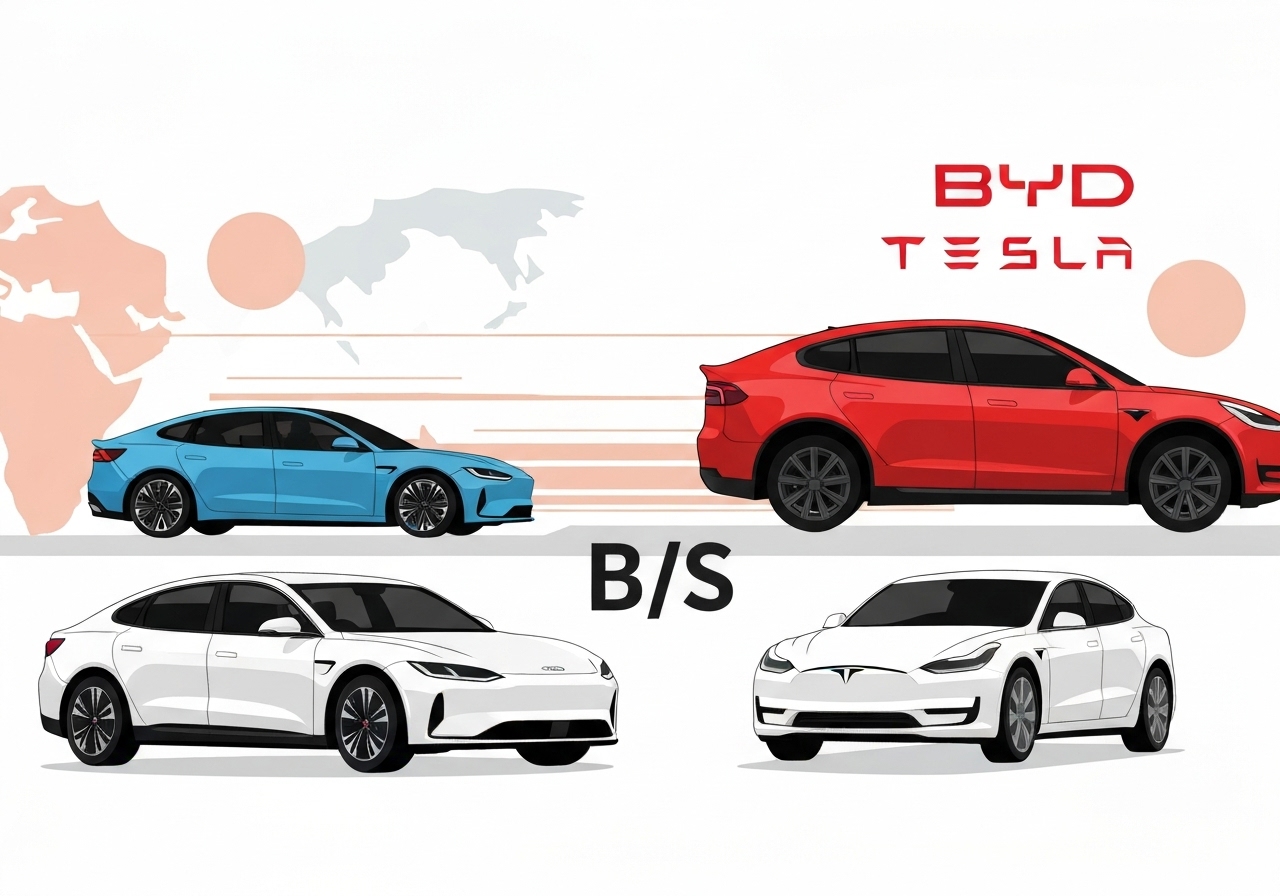
Chinese automaker BYD announced that its battery-electric vehicle sales climbed nearly 28% last year to more than 2.25 million units, positioning the Shenzhen-based company to surpass Tesla as the world’s biggest EV seller for the year. Tesla’s full 2025 tally was still pending publication, though analysts have estimated roughly 1.65 million vehicles. The shift reflects intensifying price and model competition, especially from Chinese brands, and comes as Tesla faces mixed market reception and leadership distractions. The changing ranking has broad implications for global supply chains, tariffs and the EV market’s competitive landscape.
Key Takeaways
- BYD reported battery-powered vehicle sales of more than 2.25 million units in the year, an increase of almost 28% versus the prior year.
- Analysts estimate Tesla sold about 1.65 million vehicles in 2025; Tesla was due to publish official figures later on Friday.
- BYD’s year-on-year growth slowed to its weakest pace in five years in 2025, reflecting fierce domestic competition.
- Chinese manufacturers including Geely and MG have pressured Western brands by undercutting prices on comparable EV models.
- Tesla introduced lower-priced variants of its two best-selling US models in October to try to regain momentum.
- Musk’s broader commitments—including a shareholder-approved incentive package tied to ambitious targets and investments in humanoid robots—have become a focal point for investor scrutiny.
- BYD’s international expansion accelerated, with the UK reported as its largest market outside China after sales there rose 880% year-on-year to the end of September.
Background
China’s electric-vehicle industry has grown rapidly over the past decade, driven by subsidies, infrastructure investment and aggressive pricing from domestic manufacturers. BYD evolved from a battery maker into one of the world’s largest EV producers, leveraging vertical integration and a broad model portfolio that includes both battery-electric and plug-in hybrid vehicles. Tesla, by contrast, has built a reputation on product desirability and software-enabled features but has faced stronger price competition and increasing availability of lower-cost alternatives from Chinese brands.
Global EV competition has also been shaped by tariff regimes and local content rules that many countries apply to imports, and by automakers’ strategies for market entry. In several regions—Latin America, Southeast Asia and parts of Europe—BYD has rapidly expanded distribution and local sales despite some countries imposing steep Chinese EV tariffs. Consumer price sensitivity and a growing middle market for affordable electrified vehicles have amplified the impact of lower-priced Chinese models on incumbent brands.
Main Event
On Thursday BYD released its annual sales figures showing battery-powered car volumes above 2.25 million, up almost 28% year-on-year. Those results, when compared with analyst estimates that Tesla sold about 1.65 million vehicles in 2025, indicate BYD will outpace Tesla on an annual-sales basis for the first time. BYD’s announcement identified both fully battery-electric vehicles and plug-in hybrids in its totals; the company highlighted particular strength in models such as the Seal U plug-in hybrid in some overseas markets.
Tesla’s management has responded throughout the year with pricing shifts and the introduction of lower-cost model variants, notably in October when lower-priced versions of its two top-selling models were launched in the US. Despite those moves, Tesla reported a sales contraction in the first quarter of 2025 amid negative consumer reaction to CEO Elon Musk’s political activities and growing competition. Analysts say the company must increase deliveries and margin performance to meet investor expectations tied to its compensation package.
BYD’s growth itself moderated in 2025 to its slowest pace in five years, a sign that even dominant domestic players are feeling margin and volume pressure as more competitors enter the market. Still, BYD’s pricing strategy—often undercutting Western rivals—combined with rapid expansion in international channels has allowed it to scale volumes globally. The company reported that the UK became its largest market outside China after an 880% year-on-year increase in sales to the end of September, driven largely by demand for the plug-in-hybrid Seal U SUV.
Analysis & Implications
Market structure: BYD overtaking Tesla on annual sales marks a shift from a market once dominated by Western and US-headquartered firms toward one where vertically integrated Chinese automakers can leverage scale and lower price points. That shift is likely to increase pressure on legacy manufacturers to optimize cost structures, localize production and revise product portfolios to include more competitively priced models.
Supply chains and trade policy: Greater volume from Chinese EV makers will intensify debates over tariffs, local content rules and trade barriers. Countries that have already imposed steep tariffs on Chinese EVs may face renewed lobbying from local automakers and dealers, while importers might prefer lower prices to meet consumer demand—creating friction in trade policy discussions.
Investor and corporate governance effects: Tesla’s shareholder-approved incentive, which ties executive rewards to ambitious performance goals and unconventional targets, underscores investor expectations for rapid growth. Musk’s concurrent commitments outside the car business—ranging from social media to robotics—have prompted scrutiny about management focus, which can amplify volatility in Tesla’s valuation and operational priorities.
Longer-term product competition: BYD’s integration of plug-in hybrids and more affordable BEVs gives it flexibility across varied markets, especially where charging infrastructure remains incomplete. Western automakers may accelerate partnerships, joint ventures and price-focused models to protect market share. The pace of battery cost declines, software differentiation and regulatory shifts on emissions will determine how sustainable volume advantages can be over the next five to ten years.
Comparison & Data
| Company | Reported/Estimated 2025 Sales | Year-on-Year Change |
|---|---|---|
| BYD | >2.25 million | ~+28% |
| Tesla (analyst est.) | ~1.65 million | — |
Context: BYD’s reported volume includes both battery-electric and plug-in hybrid models, which helps explain broader market reach in regions where hybrids remain attractive. Tesla’s figure cited here is an analyst estimate released ahead of the company’s official disclosure. The comparison shows BYD’s unit-scale advantage for the year, but not necessarily parity in revenue or profit per vehicle, where product mix and margin structure differ materially.
Reactions & Quotes
Company and market responses were immediate: BYD framed the milestone as evidence of its global expansion, while market analysts pointed to shifting price dynamics. Below are representative statements and their context.
“Sales of battery-powered vehicles exceeded 2.25 million last year,”
BYD (official statement)
This figure was presented by BYD in its annual sales release and used to underscore the company’s growth trajectory and expanding overseas footprint. BYD highlighted double-digit percentage increases in several international markets, notably the UK.
“Analyst estimates place Tesla’s 2025 deliveries at roughly 1.65 million vehicles,”
Industry analysts (consensus)
That consensus figure circulated ahead of Tesla’s scheduled results release and was cited by media and market commentators as the benchmark for comparing annual volumes. Analysts emphasized that Tesla’s forthcoming official totals could adjust that estimate slightly.
“We are watching pricing and product moves closely as competition intensifies,”
Automotive industry analyst
Experts stressed that lower-priced Chinese models have changed consumer expectations and forced global incumbents to reconsider pricing and feature sets. The comment reflects broader concern about margin pressure even as overall EV adoption rises.
Unconfirmed
- Precise Tesla official 2025 sales: the company was due to publish final figures later on Friday; analyst estimates (≈1.65m) remain provisional until Tesla’s disclosure.
- Exact breakdown of BYD’s 2.25 million units between pure BEVs and plug-in hybrids was not fully detailed in the company’s headline release and may differ by market.
- Long-term impact of Musk’s non-Tesla roles on Tesla operational performance is subject to interpretation and not directly quantifiable from public statements.
Bottom Line
BYD’s announcement that it sold more than 2.25 million battery-powered vehicles last year—an almost 28% increase—likely makes it the largest EV seller worldwide for the year, surpassing estimated Tesla deliveries of about 1.65 million. The milestone reflects China’s maturing EV manufacturing base, aggressive pricing strategies, and rapid international expansion, particularly in markets such as the UK where BYD reported an 880% sales jump to the end of September.
For global automakers and policymakers, the development underscores the need to adapt to intensified price competition, reconsider tariff and trade positions, and accelerate product and manufacturing strategies. Investors will be watching official company reports, margin trends, and how each firm balances volume growth with profitability in the next several quarters.