
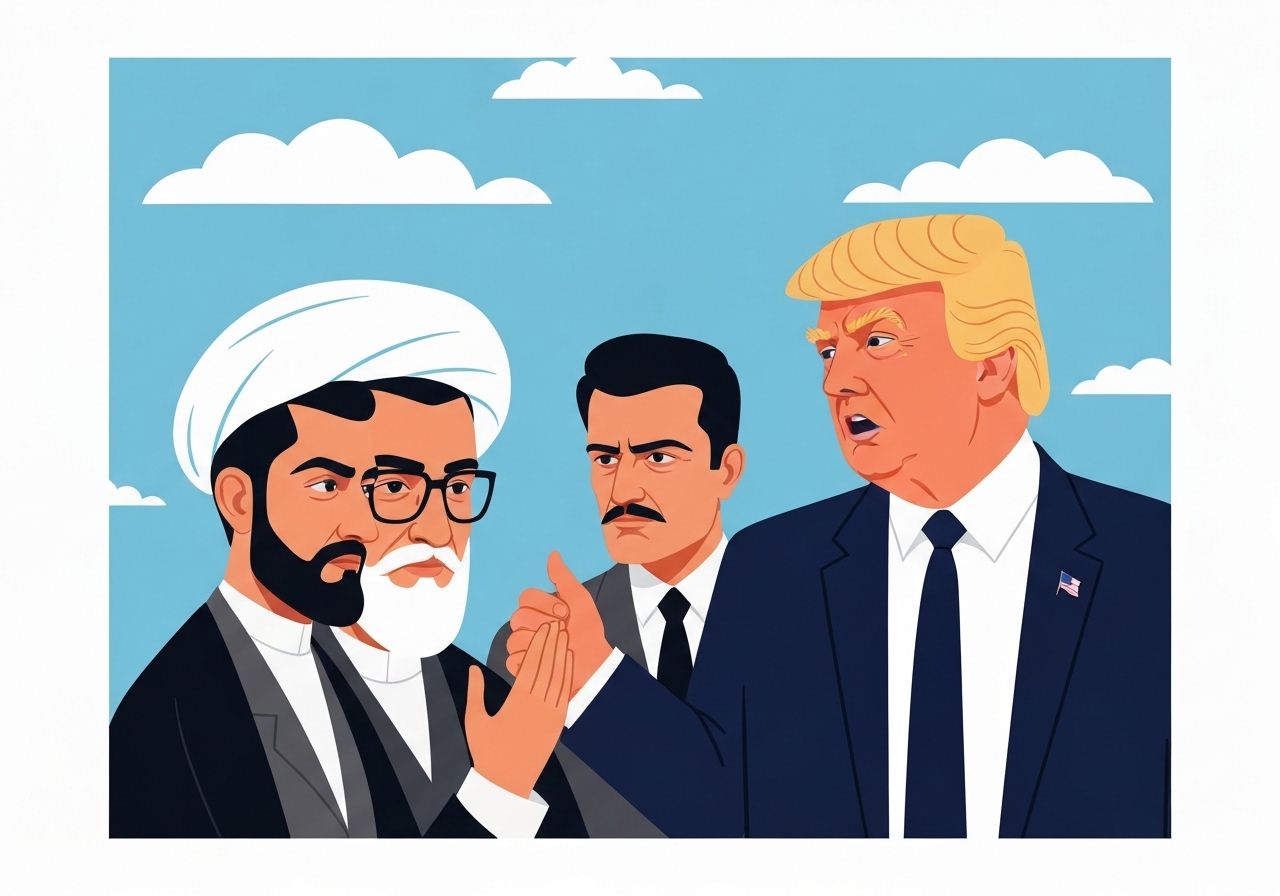
Lead: Over six days of unrest across parts of Iran, President Donald Trump and senior Iranian officials traded blunt warnings Friday as protests driven by the rial’s collapse and other grievances left at least seven people dead. The demonstrations — the largest public unrest since 2022’s Mahsa Amini protests — have not yet reached full nationwide scope but have renewed regional tensions after U.S. strikes on Iranian nuclear sites in June. Online posts by Trump and rapid responses from Tehran’s security and political leaders intensified fears of foreign entanglement and possible escalation. Local funerals and street clashes underscored a volatile mix of economic anger and political dissent.
Key Takeaways
- Protests entered their sixth day, with at least seven reported fatalities connected to demonstrations in multiple provinces.
- Demonstrations began amid a sharp depreciation of the rial; current market rates cited about 1.4 million rials to the U.S. dollar.
- President Trump posted on Truth Social promising U.S. assistance if Iran “violently kills peaceful protesters,” adding “We are locked and loaded and ready to go.”
- Top Iranian figures — including Ali Larijani, Ali Shamkhani and parliament speaker Mohammad Bagher Qalibaf — responded with warnings that foreign intervention would bring regional chaos and could make U.S. forces targets.
- June strikes by the U.S. on three Iranian nuclear sites and a subsequent Iranian attack that struck a radome at Al Udeid Air Base have already raised the stakes in the region.
- Incidents in Zahedan and the burial of 21-year-old Amirhessam Khodayari in Kouhdasht further inflamed tensions; official claims about his ties to the Basij have been questioned by some local reporting.
- Analysts warn that explicit U.S. support for demonstrators may be used by Tehran to justify harsher crackdowns, even as it risks inviting the U.S. involvement Trump hinted at.
Background
The current protests were triggered in part by the rial’s rapid fall in value, which pushed ordinary living costs higher and helped catalyze street demonstrations in several cities. Iran’s economy has faced prolonged strain since the June conflict with the United States and Israel that included reported strikes on Iranian nuclear sites. That economic pressure compounds longer-running grievances over political repression and limited economic opportunity.
The last comparably large wave of unrest came in 2022 after the death of 22-year-old Mahsa Amini while in morality police custody, which prompted nationwide protests and international attention. While the 2022 movement spread broadly and included sustained nationwide actions, current unrest remains geographically uneven so far, concentrated in provinces such as Sistan and Baluchestan, Lorestan and parts of Tehran’s hinterlands.
Across Iran’s political system, power is divided between elected figures and theocratic institutions, limiting the civilian president’s ability to respond independently. Reformist elements in government have signaled openness to dialogue, but hard-line security institutions and senior clerical authorities retain the tools to impose forceful responses.
Main Event
On Friday, demonstrations continued in Zahedan, Sistan and Baluchestan province, and other cities where funerals for those killed drew mourners into the streets. Video shared online showed confrontations at burials and citizens confronting security personnel; state-controlled and semi-official outlets offered differing accounts of events. Authorities blamed some deceased protesters for being affiliated with volunteer paramilitary forces, claims that have been challenged by family statements and local reporting.
President Trump’s public post on Truth Social — unusually direct support for the protesters — said the U.S. “will come to their rescue” if Iranian authorities “violently” suppress demonstrators. The terse message included the line “We are locked and loaded and ready to go,” a formulation that Tehran’s leaders seized on in their rebuttals. The White House has historically been cautious about overt endorsements of foreign protest movements because of the risk of undermining domestic legitimacy.
Iranian responses were swift and forceful. Ali Larijani, secretary of the Supreme National Security Council, accused the U.S. and Israel on X of stoking unrest — an allegation he did not substantiate. Senior security adviser Ali Shamkhani warned that any foreign hand that threatens Iran’s security ‘‘will be cut,’’ and hard-line parliament speaker Mohammad Bagher Qalibaf labeled U.S. bases and forces “legitimate targets” in the event of intervention.
Officials from Iran’s Foreign Ministry reiterated longstanding grievances toward the U.S., citing historical grievances such as the 1953 coup, the 1988 downing of a passenger jet, and U.S. involvement in the June strikes. At the same time, Iran’s civilian leadership under President Masoud Pezeshkian has said it seeks negotiation with protesters, while acknowledging limited power to remedy the economic collapse driving much of the unrest.
Analysis & Implications
Trump’s public backing differs from the posture taken by some previous U.S. presidents, who refrained from explicit endorsements to avoid giving Iran cover to claim foreign interference. That restraint is rooted in concern that visible external support can be used as a pretext for forceful domestic repression. Analysts caution that Tehran could cite such comments to justify an escalated security response, making the situation both a domestic human-rights question and an international-strategy problem.
Regionally, the protests intersect with recent military exchanges between Iran, the U.S., and allied forces. June strikes on three Iranian nuclear sites and Iran’s subsequent attack that hit a radome at Al Udeid Air Base in Qatar (with no reported injuries) have already increased mistrust and the risk that local unrest could expand into broader confrontations. Iranian rhetoric about “legitimate targets” in the event of intervention raises the specter of retaliatory escalation should foreign forces become involved.
Economically, a continued slide of the rial and rising daily hardship are likely to sustain protests or help them reappear intermittently. Without credible economic relief or political channels that can deliver meaningful change, public frustration could morph into longer-term instability. For Tehran, balancing repression and concession will be a fraught calculation: harsh crackdowns can restore short-term order but deepen grievances, while concessions may be politically costly for hard-line factions.
Comparison & Data
| Period | Trigger | Reported deaths | Geographic spread |
|---|---|---|---|
| June–July (current) | Rial collapse, economic grievances | At least 7 | Multiple provinces (not yet nationwide) |
| 2022 | Death of Mahsa Amini in custody | Widespread reports (varied) | Nationwide, more sustained |
The table highlights that the present unrest is serious but, based on current reporting, has not achieved the nationwide scale or intensity attributed to the 2022 protests. Key numeric anchors: current unrest entered day six with at least seven fatalities and a reported exchange rate near 1.4 million rials per U.S. dollar, illustrating the acute economic pressure driving protests.
Reactions & Quotes
“If Iran violently kills peaceful protesters, we will come to their rescue. We are locked and loaded and ready to go.”
Donald J. Trump (Truth Social)
Trump’s message was a public show of support for demonstrators and a warning to Tehran; U.S. officials have traditionally avoided such direct statements to reduce the risk that authorities will portray protesters as foreign agents.
“Intervention by the U.S. in the domestic problem corresponds to chaos in the entire region and the destruction of the U.S. interests.”
Ali Larijani (X)
Larijani’s post accused the U.S. and Israel of fomenting unrest, an assertion Tehran has often advanced during past protests though no concrete evidence was provided in this instance.
“Any interventionist hand that gets too close to the security of Iran will be cut.”
Ali Shamkhani (adviser to the Supreme Leader)
Shamkhani framed the issue as a national-security red line and invoked historical grievances to remind audiences of past foreign actions Tehran views as hostile.
Unconfirmed
- Claims that U.S. and Israeli services are orchestrating the protests — asserted by some Iranian officials but not substantiated with public evidence.
- Official assertions that Amirhessam Khodayari served in the Basij — family statements and later reports have raised questions about that claim.
- Any impending U.S. military intervention in response to the unrest — no official action or authorization matching Trump’s online wording has been confirmed.
Bottom Line
The immediate danger in the current crisis is a feedback loop: explicit U.S. backing risks giving Tehran a pretext to intensify repression, while Tehran’s threatening rhetoric risks drawing external actors into a widening confrontation. For protesters and ordinary Iranians, the core drivers are economic hardship and longstanding political grievances; the degree to which those root causes are addressed will determine whether unrest subsides or becomes chronic.
Observers should watch three indicators over coming days: (1) whether protests broaden geographically, (2) whether security forces escalate their tactics, and (3) whether international actors move from rhetoric to concrete measures. Each could materially change both domestic outcomes in Iran and stability across the wider region.