
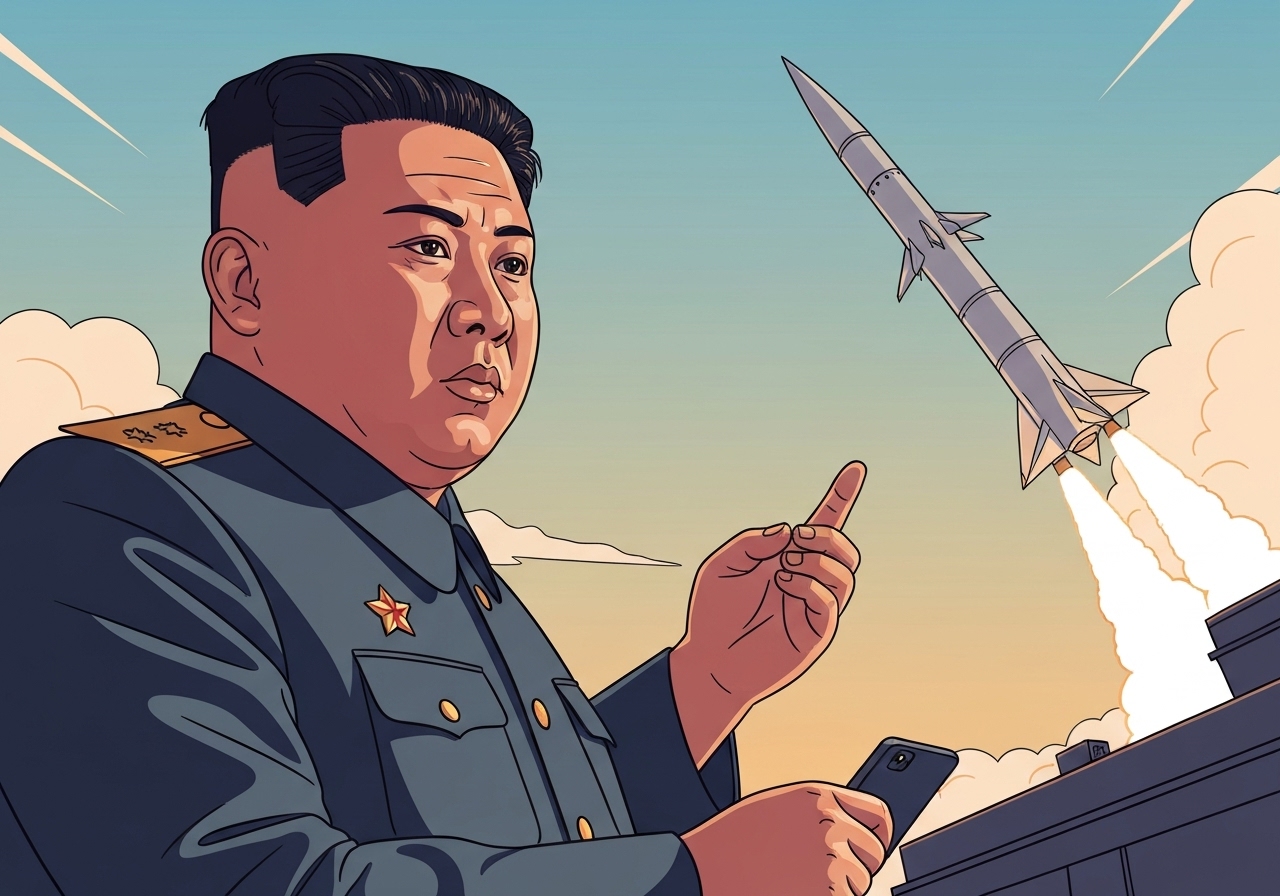
North Korean leader Kim Jong Un presided over test flights of hypersonic missiles on Jan. 5, 2026, state media reported, saying the drills responded to a “recent geopolitical crisis” and complex international conditions. The Korean Central News Agency (KCNA) confirmed the launches after neighbouring states detected multiple ballistic missile firings the previous day. KCNA said the missiles struck targets roughly 1,000 km (621 miles) away over waters east of North Korea. The tests occurred hours before South Korean President Lee Jae Myung departed for a summit in Beijing with Chinese President Xi Jinping.
Key Takeaways
- KCNA reported the drill on Jan. 5, 2026; state media said the launches were meant to test readiness and operational capability of missile forces.
- North Korean state reporting said missiles hit targets about 1,000 km (621 miles) away over the sea east of the country.
- Experts cited by state media identified the missile as likely a Hwasong-11 variant displayed in an October parade; that identification remains an expert assessment.
- The launches followed Pyongyang’s denunciation of reported U.S. action in Venezuela and were framed as bolstering a “strong and reliable nuclear deterrent.”
- South Korean officials detected multiple ballistic launches on Sunday, prompting regional monitoring ahead of the Lee–Xi summit in Beijing.
- In recent weeks Pyongyang also tested long-range cruise missiles and new anti-air systems and released photos suggesting progress on a nuclear-powered submarine.
Background
For decades, North Korean leaders have justified missile and nuclear programs as defenses against perceived threats, particularly from the United States. The regime presents weapons development as a means to deter regime-change efforts and to guarantee survival in a hostile international environment. In recent months Pyongyang has accelerated visible weapons activity—from cruise missile firings to air-defense tests—often staged ahead of key political events to signal strength to both domestic and international audiences. The ruling Workers’ Party Congress, the first in five years, is due to convene later this year and observers say Pyongyang seeks to display technological progress before that gathering.
Regional diplomacy is a concurrent factor shaping Pyongyang’s messaging. The drills came as South Korean President Lee Jae Myung travelled to Beijing to meet President Xi Jinping, with Seoul saying it would press China to play a constructive role on the peninsula. China remains North Korea’s principal economic partner and diplomatic interlocutor, and any shift in Beijing’s posture could influence Pyongyang’s calculations. The tests therefore carry both domestic signaling and external diplomacy dimensions.
Main Event
KCNA reported that the hypersonic-capable system was launched to examine system readiness, sharpen missile troops’ operational skills and evaluate the state’s war-deterrent capabilities. According to the state account, Kim said the exercise confirmed a “very important technology task for national defence” and stressed continued upgrading of military means, especially offensive systems. South Korean and neighbouring monitoring agencies reported detecting multiple ballistic launches on Sunday and Monday, prompting heightened tracking of trajectories and impact zones.
The North Korean report said the missiles struck targets about 1,000 km away over the sea east of the peninsula. KCNA framed the drill as a response to what it called a “recent geopolitical crisis” and complex international circumstances, linking the exercise to broader foreign-policy grievances. Pyongyang also released commentary condemning recent U.S. actions toward Venezuela, describing them as violations of sovereignty; that criticism was cited in state coverage as part of the rationale for the launch.
Seoul and allied monitoring authorities have catalogued the launches and are assessing technical performance from radar, satellite and open-source imagery. Some outside analysts noted that the displayed weapon resembled a system paraded in October, while stressing that image-based identification does not alone confirm flight performance characteristics such as sustained hypersonic speed or maneuverability. The timing, however, was explicitly political: the drills coincided with high-level diplomacy in Beijing and a stream of recent North Korean military demonstrations.
Analysis & Implications
If the flights demonstrated reliable hypersonic capability, the strategic implications would be material. Hypersonic weapons—by design combining high speed and potential maneuverability—seek to complicate existing missile-defence architecture and shorten reaction times for defenders. Pyongyang’s stated aim is to create a credible, survivable deterrent; adding systems that could evade interception would increase the technical and political challenge for U.S. and allied planners in Seoul and Tokyo.
Even absent conclusive proof of full hypersonic performance, repeated tests advance North Korea’s program by improving launch procedures, command-and-control routines and crew training. The regime also gains signaling value: demonstrating range and the ability to strike at sea 1,000 km away projects reach and raises the diplomatic stakes around any future coercive moves. For South Korea, Japan and the United States, every advance renews pressure to refine layered air-and-missile defenses and to consider changes in posture or asset deployment.
Diplomatically, the test complicates the Lee–Xi summit and Seoul’s appeal to China to play a constructive role on the peninsula. Beijing will be asked to balance alliance dynamics with Washington and its economic and security ties to Seoul, while managing its longstanding, if sometimes fraught, relationship with Pyongyang. International responses—ranging from public condemnation to urges for restraint—are likely, but concrete policy shifts (sanctions, military posture changes, or renewed diplomacy) will depend on allied assessments of technical advance and strategic intent.
Comparison & Data
| Item | Reported Detail |
|---|---|
| Hypersonic test (Jan. 4–5, 2026) | Missiles hit targets ~1,000 km east of North Korea (KCNA) |
| Recent related tests | Long-range cruise missiles and new anti-air missiles (reported in recent weeks) |
| Naval development | Photos show apparent progress on a nuclear-powered submarine (state media) |
The table summarizes publicly reported activities cited by North Korean state media and external monitoring. Independent technical confirmation—especially of hypersonic flight profiles and sustained maneuverability—typically lags imagery and official statements, requiring radar and telemetry analysis that outside agencies may not immediately publish. Nonetheless, the pattern of frequent, varied tests reflects an intensified weapons-development tempo.
Reactions & Quotes
South Korea’s monitoring offices and allied agencies confirmed detection of multiple launches and are continuing technical assessments; Seoul has said the matter will figure in diplomatic talks in Beijing. Analysts note the drills’ synchrony with high-level diplomacy in East Asia, underlining both military and political signaling.
“Through today’s launching drill, we can confirm that a very important technology task for national defence has been carried out.”
KCNA / State media
KCNA quoted Kim stressing the importance of upgrading offensive weapon systems and maintaining or expanding a “strong and reliable nuclear deterrent.” The state outlet tied the timing of the launch to what it described as a geopolitical crisis and to international events it viewed as unfavourable.
“The missile appears to be the Hwasong-11, shown at October’s parade, but that identification is based on imagery and open-source analysis rather than flight telemetry.”
Hong Min, Korea Institute for National Unification (expert note)
Hong Min of the Korea Institute for National Unification provided image-based analysis to outside readers, emphasizing that while the hardware matches parade displays, decisive confirmation of hypersonic performance requires additional flight data. His assessment underlines the distinction between visible design features and actual in-flight capabilities.
Unconfirmed
- Precise hypersonic performance: outside analysts have not publicly released radar or telemetry data confirming sustained Mach 5+ speeds or high-degree maneuverability for these launches.
- Weapon classification: the identification of the tested missile as a Hwasong-11 variant is an expert visual assessment based on parade imagery, not an official technical confirmation.
- Link between the launches and U.S. actions in Venezuela: North Korea cited U.S. actions as justification; independent verification of those U.S. actions and any direct causal link to the launches requires separate confirmation.
- Extent of nuclear-powered submarine capabilities: photos released by Pyongyang indicate construction progress, but operational status and nuclear propulsion capability have not been independently verified.
Bottom Line
North Korea’s Jan. 5, 2026 hypersonic-capable missile drills, as reported by KCNA, are both a technical claim and a diplomatic signal. The regime framed the launches as necessary to bolster a “strong and reliable” nuclear deterrent amid what it calls a geopolitical crisis; outside analysts are treating hardware identifications and performance claims cautiously until more data are released. The reported 1,000 km range and timing ahead of the Lee–Xi summit amplify the regional political impact, prompting Seoul and its partners to reassess defensive measures and diplomatic options.
Going forward, allied technical assessments (radar, satellite and telemetry analyses) will be decisive in determining whether the flights represent a true step-change in hypersonic capability or incremental advances in missile practice and display. Diplomatically, the tests increase pressure on China, the United States and regional partners to clarify their responses—ranging from accelerated defence cooperation to renewed engagement channels aimed at reducing escalation risk ahead of the Workers’ Party Congress.
Sources
- Al Jazeera — International news outlet reporting on KCNA and regional reactions.
- Korean Central News Agency (KCNA) — North Korean state media, official reporting on the drills.
- Korea Institute for National Unification (KINU) — Academic/research institute; expert commentary referenced.
- Office of the President, Republic of Korea — Official statements on diplomatic engagements and policy positions.