
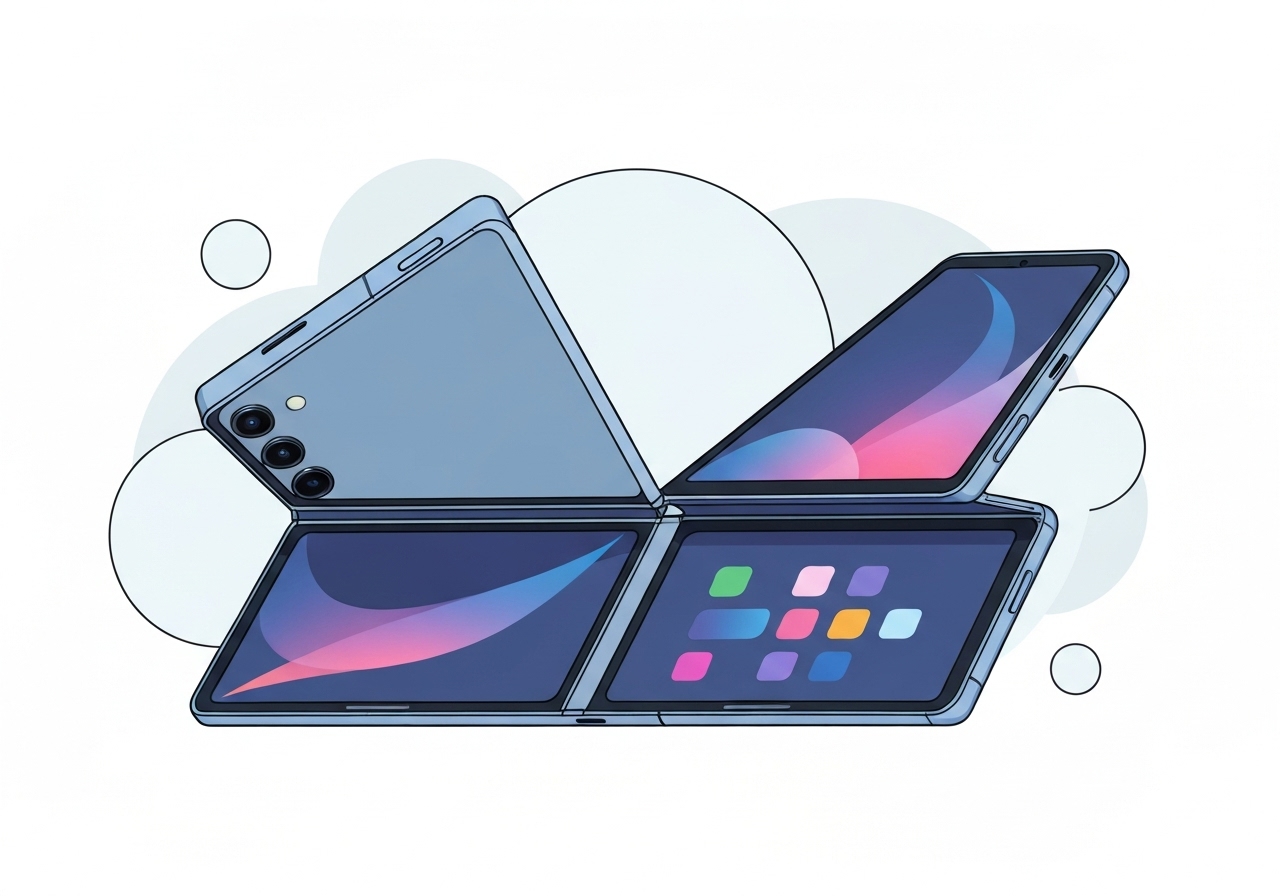
Holding the Samsung Z Trifold at a pre-CES demo confirmed a simple but striking impression: this is a tablet with a phone attached. In a brief hands-on session I found myself unfolding it repeatedly, and its behavior — springy, thin when open, thick when closed — made the device feel like a different category. The phone is on sale in South Korea but not yet officially sold in the U.S.; Samsung has said a U.S. launch will come in the first quarter of this year, and the company has not announced a U.S. price. After testing it for an hour, the Trifold left the clear result that its dual-hinge design and DeX mode could shift how some users replace laptops and tablets.
Key Takeaways
- Design: The Z Trifold uses two inward-closing hinges, making it a three-panel device rather than a single-fold phone; it is sold in South Korea and expected in the U.S. in Q1 of this year.
- Size and feel: Folded, the device is noticeably thick and carries a camera bump; fully open it is surprisingly slim and flat, feeling more like a tablet than a phone.
- Behavior: In the demo the device sometimes popped fully open from a partially propped position, thanks to a springy hinge action; folding order matters to avoid a strong haptic warning tied to the camera bump.
- Software: DeX on the Trifold functions as a native, standalone multitasking environment with windowing, and Samsung says a tailored version of Adobe Lightroom is available for the device.
- Context: The single-hinged Galaxy Z Fold 7 starts at $2,000; Samsung has not disclosed Trifold pricing but expectations are for a premium price point.
- Practicality: The cover screen is long and narrow and fits in roomy pockets, though it may be awkward in tighter pockets; there is noticeable wobble when used folded on a flat surface.
- Accessories: The form factor invites accessories — small keyboards, stands, even mice — that could push the Trifold toward laptop replacement scenarios for some users.
Background
Foldable devices have evolved from early, fragile experiments into premium products aimed at combining phone portability with tablet productivity. Samsung’s Galaxy Z Fold line helped popularize single-hinge, inward-folding designs; Huawei and others explored different multi-fold approaches. The Trifold is Samsung’s answer to a perceived gap in the market for a more tablet-like surface in a pocketable device, trading chassis complexity and price for a larger usable display area.
Consumer habits so far have been mixed: many owners of single-hinge foldables use the outer screen far more than the inner tablet display, reducing the practical advantage of folding. Meanwhile, Samsung has extended DeX — its desktop-like interface — to make larger-screen Galaxy devices act more like computers. The Trifold aims to exploit that software ecosystem by offering both an expanded canvas and a DeX mode built to run on the device itself, potentially reducing the need for external displays.
Main Event
At the hands-on session the Trifold’s physical dynamics were immediately apparent. When lifted from a partially propped stand it often completed the motion and opened fully in the tester’s hands, a result of the hinge springs and panel balance. Closing the device requires attention to sequence because the camera module sits on one side; folding the wrong panel first triggers a strong haptic pulse and an on-screen notification advising the correct order.
In pocket tests the outer screen feels longer and narrower than a standard phone face, which helped it fit into roomy trouser pockets but suggested potential awkwardness in slimmer or contoured garment pockets. The device is noticeably thick when closed; unfold it and the assembly is surprisingly thin and comfortable to hold like a tablet. The back panel picked up fingerprints quickly, and there was a clear wobble when propped on a table in its folded state.
Software demonstrations emphasized DeX as a central feature. On the Trifold, DeX acts as a standalone, windowed workspace rather than only an interface for external monitors. Samsung’s product lead noted that applications such as Adobe Lightroom have versions optimized for the Trifold, illustrating how developers can tailor interfaces to the larger, multi-panel screen.
Analysis & Implications
The Trifold represents a bet that some buyers will accept extra thickness and higher cost in exchange for a single device that can replace both a tablet and a laptop. If DeX and app support deliver genuinely productive windowed multitasking without external peripherals, the Trifold could appeal to road-warrior professionals and parents who juggle work and travel. That said, mainstream adoption depends on more than capability: durability, repairability, battery life and price will determine whether consumers upgrade from single-hinge foldables or stick with separate phones and tablets.
Price is a major variable. The Galaxy Z Fold 7’s $2,000 starting price sets a precedent for flagship foldables; Samsung has not published Trifold pricing. Even if the device adds clear utility, a substantially higher price tier will narrow the addressable market to affluent early adopters and enterprise buyers who can justify consolidation of devices.
Design trade-offs also matter. The Trifold’s springy hinge and the need to fold panels in a prescribed order introduce both a tactile novelty and potential user friction. The wobble when used folded and the device’s thicker closed profile are practical issues that could influence daily comfort—important considerations for anyone who plans to use the phone as a primary portable computer replacement.
| Device | Hinges | U.S. availability | Price (U.S.) |
|---|---|---|---|
| Samsung Galaxy Z Trifold | Two inward-closing hinges (three panels) | On sale in South Korea; U.S. expected Q1 (this year) | Not announced |
| Samsung Galaxy Z Fold 7 | Single hinge (two panels) | Available in U.S. | Starts at $2,000 |
| Google Pixel 10 Pro Fold (reviewer device) | Single hinge | Available | Reviewer used as daily driver (price varies) |
The table places the Trifold in context with current foldable options; while the Fold 7’s price point is known, Samsung has withheld Trifold pricing. The Trifold’s dual-hinge approach differentiates it mechanically, and software support—such as a Trifold-specific Lightroom—may shape perceived value beyond raw specs.
Reactions & Quotes
“There’s a specific version of Adobe Lightroom for the Trifold,”
Blake Gaiser, Samsung smartphone product head (paraphrased)
Gaiser’s point frames the Trifold as more than a novelty: tailored apps could make the device useful for creators who need a larger, portable editing surface without carrying a separate laptop.
“It flipped itself into the fully open position in my hands,”
Hands-on reviewer (observed at pre-CES demo)
The hinge behavior was a repeated observation during the demo; while the springiness makes opening satisfying, it also highlights the mechanical complexity Samsung has packed into the chassis.
Unconfirmed
- Final U.S. pricing for the Z Trifold: Samsung has not announced an official U.S. price; current expectations are that it will be a premium device but the exact figure is unconfirmed.
- Long-term durability and hinge longevity: consumer reviews and long-term test data are not yet available to confirm real-world reliability for the dual-hinge mechanism.
- Battery life under heavy DeX multitasking: extended battery performance figures for native DeX sessions on the Trifold have not been published.
- Accessory ecosystem and official keyboard/mouse offerings for the Trifold are not fully confirmed ahead of U.S. availability.
Bottom Line
The Samsung Z Trifold is a tangible experiment in device consolidation: its three-panel, dual-hinge design and on-device DeX position it between a phone, tablet and laptop. For users who value a single-device workflow and who can absorb a likely premium price, the Trifold could replace multiple gadgets for many everyday tasks.
But broader adoption depends on price, durability and meaningful software support. If Samsung and app developers deliver optimized experiences that take full advantage of the larger, multi-panel display, the Trifold could create a new niche for productivity-focused foldables; if not, it risks remaining an impressive but niche curiosity for early adopters.