
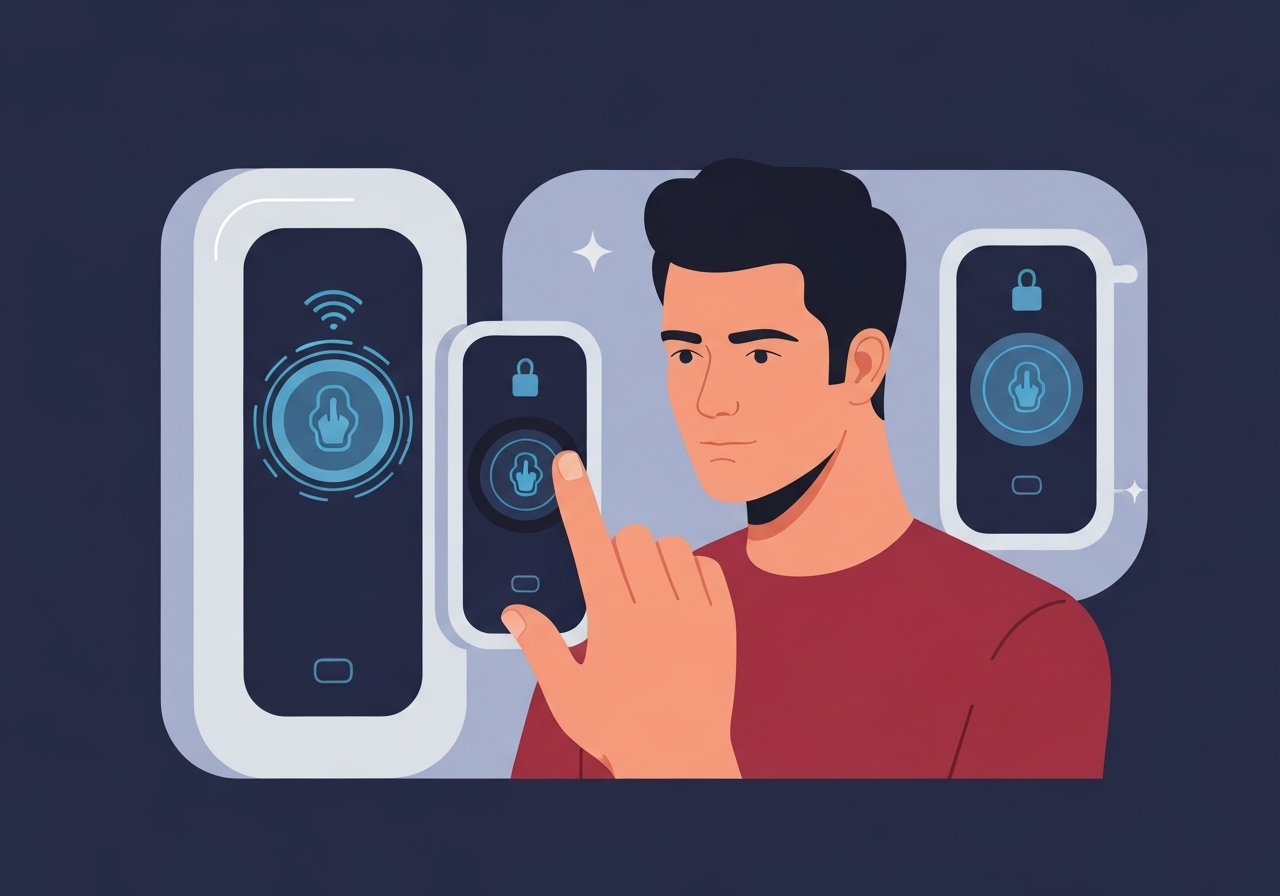
Xthings unveiled a slate of smart-home devices at CES, led by the Ultraloq Bolt Sense, a compact deadbolt that pairs facial recognition with palm-vein scanning to provide contactless entry without requiring a phone app. The company says palm-vein authentication reads vein patterns beneath the skin using near-infrared light, so it should work with wet or dirty hands and in darkness. Bolt Sense includes built-in Wi‑Fi and Xthings plans Matter support, though the lock is not expected to ship until Q2. Alongside the Bolt Sense, Xthings previewed the Latch 7 Pro (shipping Q1) and several cameras — including units that support Matter and one that uses Wi‑Fi HaLow.
Key Takeaways
- Ultraloq Bolt Sense combines facial recognition and palm-vein authentication for touch-free unlocking and does not require an app for entry.
- Xthings says palm-vein scanning reads subdermal vein patterns with near-infrared light, making it less sensitive to wet/dirty hands and effective in darkness.
- Bolt Sense has built-in Wi‑Fi and Xthings plans Matter support; the lock is expected to ship in Q2.
- Latch 7 Pro is slated for Q1 shipment and will support Matter-over-Thread and Aliro connectivity, though it lacks palm-scanning hardware.
- Ulticam IQ V2 will be Xthings’ first security camera with Matter support; Ulticam HaLow adopts 802.11ah for longer range at lower bandwidth.
- Wi‑Fi HaLow is rated up to about 0.6 miles under typical conditions, useful for large properties; Xthings will include a dedicated hub with the HaLow camera.
- Ulticam IQ Floodlight pairs AI-enabled video with 2,000-lumen floodlights for higher-visibility nighttime capture, using standard Wi‑Fi rather than HaLow.
Background
Biometric methods have become common on consumer locks and phones, with fingerprint and facial sensors widely deployed. Palm-vein authentication is a newer approach in the home market that images the vascular pattern below the skin using near-infrared (NIR) illumination; vendors argue this method is harder to spoof and less affected by surface conditions than fingerprint sensing. Matter, the cross-vendor smart-home standard, has been gaining device support because it promises easier interoperability, but many manufacturers are still rolling out updates and certification is ongoing.
Wi‑Fi HaLow (IEEE 802.11ah) surfaced at CES years ago as a long-range, sub‑GHz variant of Wi‑Fi, trading bandwidth for range and wall penetration. Although HaLow can theoretically reach several thousand meters in ideal conditions, adoption has been limited and a compatible infrastructure has been a barrier. Xthings’ inclusion of a dedicated hub with its HaLow camera aims to reduce friction for buyers who would otherwise need specialized routers.
Main Event
The Ultraloq Bolt Sense is presented as a relatively compact motorized deadbolt that supports two biometric paths: face recognition and palm-vein scanning. Xthings emphasizes that palm scanning uses NIR to read vein patterns beneath the skin, which the company argues is more reliable than surface fingerprint scans when hands are wet or dirty. The Bolt Sense also offers a touch-free workflow that does not require unlocking via a smartphone app, a feature marketed for convenience and reduced friction at the door.
On connectivity, Bolt Sense ships with built-in Wi‑Fi, and Xthings states it intends to add Matter support; the company did not provide a firm certification date and the lock is expected to reach customers in Q2. For buyers who prioritize earlier availability, Xthings announced the Latch 7 Pro, due in Q1, which lacks the palm reader but supports Matter‑over‑Thread and the Aliro ecosystem to maximize interoperability with other smart-home hubs and voices assistants.
Camera updates include the Ulticam IQ V2, which Xthings lists as its first camera with Matter support, and the Ulticam HaLow, one of the earliest security cameras announced to use Wi‑Fi HaLow (802.11ah). HaLow favors range and penetration — Xthings cites the technology’s rating of up to about 0.6 miles under normal conditions — at the expense of peak bandwidth. To avoid forcing consumers to source special routers, Xthings will supply a dedicated hub alongside the HaLow camera.
The company also highlighted the Ulticam IQ Floodlight, which combines AI-driven camera features with twin 2,000-lumen floodlights for improved nighttime illumination. That model uses standard Wi‑Fi radios, so it does not offer the long-range reach of the HaLow unit but aims to capture clearer imagery in very dark environments.
Analysis & Implications
Introducing palm-vein scanning to a consumer deadbolt signals Xthings’ effort to differentiate on convenience and reliability. Vein-pattern authentication does carry technical advantages — it images vascular structure beneath the epidermis and uses near-infrared wavelengths — but broader acceptance will hinge on proven accuracy in diverse real-world conditions and transparent handling of biometric data. Consumers will want clarity on where biometric templates are stored (locally on the device, on a hub, or in the cloud) and on encryption and deletion policies.
Matter support, if realized, could materially improve compatibility for these devices across ecosystems, lowering friction for users who mix brands. However, Matter certification and rollout timelines remain variable across vendors, so promised support does not guarantee immediate interoperability at launch. For the security camera lineup, Matter-equipped cameras could simplify integration into broader smart-home scenes, while HaLow models may open new use cases for large properties if infrastructure hurdles are addressed.
Wi‑Fi HaLow’s strength is long-range coverage and better wall penetration, which is useful for outbuildings, farms or large estates. The tradeoff is reduced bandwidth relative to 2.4GHz and 5GHz Wi‑Fi, which can limit high-resolution, high-frame-rate video streams. Xthings’ decision to bundle a hub reduces one practical adoption barrier, but wider HaLow usefulness will depend on ecosystem support and whether third-party routers and mesh systems embrace 802.11ah.
Comparison & Data
| Product | Authentication / Network | Estimated Ship | Key Feature |
|---|---|---|---|
| Ultraloq Bolt Sense | Face + palm‑vein / Wi‑Fi (Matter planned) | Q2 | Touch-free entry without app |
| Latch 7 Pro | Standard auth options / Thread (Matter-over-Thread), Aliro | Q1 | Early Matter-over-Thread support |
| Ulticam IQ V2 | Camera / Wi‑Fi (Matter) | CES announcement | First Xthings camera with Matter |
| Ulticam HaLow | Camera / Wi‑Fi HaLow (802.11ah) + hub | CES announcement | Long-range sub‑GHz Wi‑Fi (HaLow) |
| Ulticam IQ Floodlight | Camera / standard Wi‑Fi | CES announcement | AI camera + 2,000-lumen floodlights |
The table shows Xthings positioning Bolt Sense as an innovation in authentication while the Latch 7 Pro focuses on earlier Matter-related connectivity. Camera offerings span standard Wi‑Fi models for high-bandwidth needs and a HaLow-equipped unit for extended coverage. Buyers must weigh tradeoffs: HaLow’s range versus bandwidth, and the privacy/security posture of biometric systems versus conventional PIN or key-based access.
Reactions & Quotes
‘Palm vein scanning reads the vascular pattern beneath the skin using near-infrared light, so it should be less affected by surface conditions like wet or dirty hands,’ the company said when describing Bolt Sense’s sensors.
Xthings (official product statement)
‘We plan to add Matter support to Bolt Sense, though certification timing is still to be confirmed,’ an Xthings spokesperson noted, indicating cross-platform goals without committing to a fixed rollout date.
Xthings (official comment)
‘HaLow can significantly extend range and wall penetration compared with conventional Wi‑Fi, but buyers must accept lower throughput for that reach,’ said an industry analyst familiar with sub‑GHz wireless standards.
Industry analyst (unaffiliated)
Unconfirmed
- The precise Matter certification timeline for Bolt Sense remains unspecified and may shift before the Q2 ship window.
- The exact maximum range of the Ulticam HaLow unit under real-world conditions was not provided; general HaLow ratings are up to about 0.6 miles in typical environments.
- Details on where biometric templates (face and vein data) are stored and how long they are retained were not disclosed in Xthings’ announcement.
Bottom Line
Xthings’ CES lineup highlights two strategic pushes: differentiating locks through new biometric options and advancing smart-home compatibility through Matter and Thread in other models. The Bolt Sense’s combination of face and palm-vein authentication could reduce friction for everyday entry if accuracy and privacy safeguards meet consumer expectations, but adoption will depend on transparent data handling and real-world reliability.
For security cameras, the inclusion of Matter and a HaLow option signals experimentation with both interoperability and long-range connectivity; HaLow may unlock use cases for large properties, yet bandwidth limits and infrastructure remain constraints. Prospective buyers should evaluate device interoperability, local storage and encryption practices for biometrics, and the tradeoffs between range and video quality when choosing among these new offerings.
Sources
- The Verge — tech media report summarizing Xthings’ CES announcements